


RSBreth
-
Posts
1,719 -
Joined
-
Last visited
Content Type
Profiles
Forums
Blogs
Events
Articles
Video Feed
Gallery
Everything posted by RSBreth
-
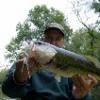 Turkey/waterfowl model, with fiber optic rear sights (that are removable) and fiber optic magnetic front, factory sling swivels front and back. Box, three choke tubes (Extended Turkey extra full, Extended light modified, Skeet.) Good condition, only a couple of normal dings, I bought this used from "Shooters Edge" down there in Spokane in '02 or '03. Puts the thump on turkeys or ducks. I don't have any good pictures, I'll take some later today and email to interested parties, or post them here. 300.00 even
 -
Smallies in the river above and below, "green fish" in the park. And yes, there's a little topwater action. The park closes at about 10:00 P. M., I think. I don't really pay attention, I park over beside the Mill and bridge, and put in under the bridge. They can't lock you in, or out, of that.
-
I fish it, on average, about 2-3 times a week. I rarely post reports anymore, but I'm down there at the park or like tomorrow, floating back from Linden to the park. Usual stuff works in the river, the park you fish just like you would any other small lake. You can fish the lily pads in the park with frogs or rats, not too many places in the Ozarks you can do that. I catch more big fish on wood cover near deep water myself. Night fishing can be awesome, and that's all I will say about that.
-
Solo Canoe Set-up
RSBreth replied to Al Agnew's topic in Tips & Tricks, Boat Help and Product Review
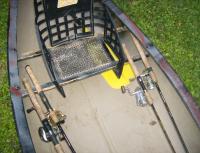
My Old Town Pack, with worn off camo. Ugly, but functional. 7-foot rods fit easily, the handles off to the side of the seat. I usually have a small foam pad on the seat, but removed it for drying. I like the Plano box set up, but I do take the tackle bag out to portage, and carry lots of plastics, so you can't see the closed-cell foam pad the tackle bag is sitting on, it's about 3/4-inch high and keeps the bag out of any bilge water, it also keeps the bag from sliding around. I have a Sit-Backer, but use the old Coleman seat back because it's quicker to remove and put back, and lighter, too. I messed around with a kayak for a little bit, but finally got the Old Town Pack solo. Couldn't be happier. Al ranks it lower than I do, but I've only paddled a couple other solo canoes. It is small, but I like its light weight, as I've mentioned before I often paddle and portage up, then float back. If I was looking for a solo for SW Ozark rivers, I would start with this one.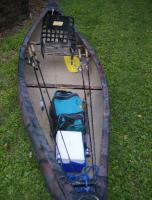
-
Yeah, but be careful. If you're just floating from one point to the other, skip the outboard. Otherwise, the water levels are good for getting around right now. Let us know how you do.
-
I usually do really well on topwaters this time of year too, but not so much this year. I've done much better on cranks and jigs. When the water comes down a tiny bit more spinnerbaits will come back in play, too. I was really nailing them on crankbaits Sunday, my full report is on my site.
-
Everything Al said, except the lake part. I love firing up the boat in the dark with the hint of dawn starting to color the eastern sky, then skimming along as the day breaks, no one else on the lake. The anticipation of the unknown day laid out before me. It's the same feeling as driving to a favorite access point on the river, listening to some good music, windows down. I don't know why, but passing under the Kimberling City bridge like that early in the morning, feeling like I have the entire lake to myself, always makes me smile. (Even though I know when I pass by later it'll be like rush hour.) Leaving my In-Laws dock in Beaver cove at 5:00 A.M., shooting across towards Point 5 on Beaver Lake makes me feel the same way. Catching nice fish is a plus, figuring out the puzzle and all that, but it's not the only thing.
-
Nah, I'm going back to that area today if I get my lazy butt on the road instead of checking the forum and watching the Weather Channel. This fish was kind of a suprise, but that stretch always has a couple of good ones, it's just a matter if you can get them to bite.
-
I had a pretty good July 4th trip. Water was up, and caught more fish on jigs than anything else. Should be better for cranks and jerkbaits after it's down a bit more, but there were less folks on the river than I would have thought, which made for a nice day, that and the nice Smallie I caught. More at: All Ozarks Fishing
-
The water is still up, but the color is excellent. I had a good day yesterday on the lower James, I won't say exactly where. You could run it with a prop if you know the river, just be careful, lots of floaters out on this kind of weekend.
-
If anyone is looking for a deal on Bomber crankbaits, the outlet store there in Springfield has a big selection these days. Lots of 5A, Flat A, Fat Free Guppys and Frys, etc. I found two of the Excaliber "Zell Pop" topwaters that normaly run 10 bucks for 3.88 each. Cool deal for me, my favorite popper. Maybe if the rain isn't too bad this morning I could go try them out.
-
I Got Someone In Trouble Today.
RSBreth replied to Chief Grey Bear's topic in General Angling Discussion
Awesome. I usually take pictures and send them to the CA of the county it happened in, but catching them in the act? Priceless. -
Hey, great report and pictures. I'm just itching to get back out on Beaver or Bull, but the water keep falling from the sky, and the creeks stay up and angry. I always heard a couple of those Northern Ozark creeks had good Smallies, now I know.
-
Well, everyone would probably like to see that fly, so post it on here if you'd like. Unless it's just top secret, then I understand, I have a couple like that. If it's really a secret but you'd still like to share it with me, just send pictures to rsbreth@aol.com, and I won't share them.
-
Wow, nice. Look like river fish to me, but with the water up, who knows. I'd be happy catching them wherever I could. Smallmouths don't grow on trees, you know.
-
It's usually pretty good. Right now it's still up and off-color. Saw some guys in jetboats today as I drove over on my way to Crane, and that would be about the only way to get around down there until the water goes down a bit.
-
KVD wins- again. I bet the other guys really get tired of that!
-
Yeah, finally posted the little Rock Bass article at my blog here:OzarkAnglers.Com Forum -> RSBreth's Blog I was going to post it at my site, but didn't. I wanted a better opening photo, but due to the rains, just couldn't come through on that. What a week. Stay dry folks, now I have to mow the bloody yard. Again.
-
You'll be fine if you just keep the bait below Fall Creek. Throw those Rogues around current breaks in deeper water in the upper end in the morning, you might be suprised how many big Browns are swimming around Taney.
-
Rock Bass A. K. A. "Goggle-Eyes" I grew up in central Kansas, so just like countless other youngsters the first fish I caught entirely by myself was a Bluegill. There are few things in life that remain pure, simple fun, but I think catching some panfish on light spinning or fly tackle may be one of the last. As I grew up I read about Rock Bass, but never caught one when I had visited the Ozarks due to the fact I was usually Trout fishing on the White or at Taneycomo during those trips. It wasn't until I moved to Springfield that I caught my first Rocky. I was fishing a small Clouser Deep Minnow at the tailwaters access for Lake Springfield, which is the James River. I was just killing some time, wet wading, and catching a few pint-sized Smallmouth and assorted Sunfish, when the line pulled tight, I set the hook, then when I pulled it in I realized it was a Rock Bass. I caught several more that day and had a great time, and I still really like catching these little guys, so let's take a closer look at these often overlooked fish. I did a long (and sometimes fruitless) Internet search, referred to my copy of "Fishes of Missouri" and as it turns out, found an older post on OzarkAnglers.com where Al Agnew summed it up better than anything else I found, but as I understand it, there are several different species in the Ozarks we commonly refer to as "Rock Bass". The northern Rock Bass, native to the Meremac River system, the Ozark Bass, native to the White River system, and the Shadow Bass, which was native to the rest of the Ozark drainages. A similar fish, the Warmouth, was native but rare in Ozark rivers, but are now more common in the large reservoirs. Many locals still call of them "Goggle Eyes", but just to simplify things here, I'll call them Rock Bass, or "Rockies". They all have similar habits, diet, and you catch them all the same way. One thing I ran across on my research was the entry on Wikipedia : "All species of rock bass are considered garbage fish and are unpopular with sustenance and sport fishermen." Huh? This is only one of the entries on the popular site that clashes with reality, because most folks in the Ozarks consider a platter of breaded and fried Rock Bass traditional after a float trip. They are good eating , too. The firm, flaky flesh is somewhere between the milder Crappie on one side, and the more nutty flavor of Bluegills on the other. In general, Rock Bass from our streams are safe to eat, it's the longer lived Black Bass that are problematic as far as the biggest widespread problem we face-mercury. See the news release from the Missouri Department of Health and Senior Services for the full report HERE: http://www.dhss.mo.gov/fishadvisory/ So… fun to catch, good to eat, wide spread across the Ozarks, and accessible to nearly every one. Now, how do you go out and catch a bunch of them? Most Rock Bass are caught as a happy accident while fishing for Smallmouth, but to target them specifically calls for a little lighter tackle. Some folks like to use the same little 4'6" or 5' rods paired with a tiny spinning reels they use at Bennet Springs or Roaring River for trout. I call these little combos "Pea Shooters". Fly anglers could be tempted to use that special little 6- or 7- foot 3 weight rod they bought for Crane Creek. I take a slightly different direction, and like longer rods for both spinning and fly. All else being equal, longer rods help cushion light line better than short ones, this usually isn't important until you hook a 3-pound Smallmouth under a log where you expected a 12-ounce Rocky, but still, longer sticks also help with line control in current, with fly gear you'll notice the difference between a 7-foot rod and a 8 footer immediately. For spinning tackle, my current favorite is the 7' Medium/Light Microlight rod from Bass Pro paired with an older Quantum reel spooled with 3/8 Fireline, and I usually use a 6-pound test fluorocarbon leader about 8-foot long, but I step it up to 8-pound when I'm fishing where it's likely to hook a bigger Smallmouth. What I like best about this rod is that it has just enough backbone to set the hook through small Texas-rigged plastics and fight good sized Smallmouths, but isn't so stiff that it won't let the little guys show off. It's also a great small creek trout rod, and doesn't cost more than 40.00 dollars. I have more expensive rods, but this one gets used more. For fly tackle, if you have a nice 8- to 9- foot rod in 4- or 5-weight you're set. Since the most effective flies for Rock Bass are sinking models (we'll get to fly selection in a minute) a longer rod helps with line control, and just like spinning tackle it helps cushion the strain on lighter line you'll use for your tippets, which should be 4 or 5x. My pick is an old IM6 Fenwick 9' medium action that casts a 5-weight line much better than the 6-weight it's rated for. This rod is a sentimental favorite usually reserved for fishing small dry flies like size 20 midges at Taney, but it's great for panfish, too. For kids, simple spin casting outfits will work great when using live bait or one of the prepared, scented baits like Berkley Gulp. Keep it simple for beginners. It's probably easier to list what lures don't work for Rock Bass than narrow down all the choices in lures and bait that do, but to put things perspective, I found this bit of information in a story by Bob Distefano in the in the February 2006 Missouri Department of Conservation News, online edition: "During the 1990s, Conservation Department biologists examined the stomach contents of more than 25,000 smallmouth bass and goggle-eyes on portions of the Jacks Fork and Big Piney rivers that were managed especially for those species. They found that crayfish make up more than 60 percent of smallmouth bass food and 78 percent of goggle-eye food. The great majority of the crayfish consumed were medium-sized, not large or small. In short, crayfish are the fuel on which Ozarks smallmouth and goggle-eye fisheries run." So if a fish loves crawfish, and crawfish tend to live on the bottom, keeping your lures on or near the bottom will be the key to success. I've caught Rockies on topwaters, but only in very shallow water, and I've caught them on hard and soft jerkbaits, but bottom bouncing crankbaits, small jigs, and smaller soft plastics worked close to the bottom are going to get you bit more often, and by bigger fish. Upper left: Three unnamed flies. Rabbit strip tail, some marabou, heavy lead eyes. Bottom Row: Bomber Fat A, Smallie Beaver, Bitsy Bug-1/8-ounce with Salty Craw trailer. Right: Zoom C-tail, Renegade 4" curly tails in Motor Oil and Electric Blue. Center: Gulp Mini Earthworms. My favorite lure day in and day out is small natural colored 4-inch action tailed worms, either Texas rigged with small wide gap hook and 1/16- or 1/8-ounce bullet weight, or a similar sized jig head for more open areas. Zoom makes two great ones, the C- Tail worm, and the brand new one called the "Shaky Tail". Under the store brand Renegade, Walmart carries good, cheap 4- and 6-inch curl tail worms that come in assorted colors. Another great lure any Smallmouth fisherman knows is the tube. Bass sized tubes can be a little big, but several smaller 3-inch tubes are out there, from Zoom to Yamamoto to Bass Pros' store brand. Strike King had two tubes slimmer than their current Bitsy Tube that were perfect, but sadly aren't made anymore. A similar but different bait is the Yamamoto "Ika" which has a tenticle like tail similar to a tube, but the body is solid, allowing less weight to reach bottom. The smaller beaver baits are also excellent. All of these work so good for Rock Bass you'd be crazy not to use them. Small grubs are another favorite, as are small crawfish colored crankbaits. One overlooked lure is a small finesse jig, like the smallest Eakins or Bitsy Bug from Strike King. Back these with a tiny craw trailer, or the smallest pork chunk for targeting bigger fish. I've tried the small plastic craws by themselves, but usually just get the pinchers ripped off by tiny fish for some reason. For flies, there are a few crawfish imitations out here, but I have had better luck with more impressionistic flies versus realistic patterns. Darker weighted Wooley Buggers, Clouser Minnows, and any of the more heavily weighted grub type flies on the market will work. One good example of this type of fly is Whitlocks' Scorpion. One thing that should work that I haven't tried yet is the same type of dark colored micro-jig and strike indicator rig popular at Taneycomo. Maybe tip it with a tiny piece of Powerbait. If someone tries this, let me now how it works. Just like Bluegills, Crappies, and (gasp!) Trout, Rock Bass are a great fish for beginners because you can easily catch them with bait under a float. In faster water it requires more precision with weighting and float placement than most of the anglers that look down on bait fishing would admit, but in calmer water, yes, it can be pretty easy fishing. A small clip-on float, a couple of split-shot, and a small baitholder hook is all you need. What kind of bait works best? Nightcrawlers are still probably the most popular and small live crawfish come to mind but usually require catching your own, minnows work, but also require some way to care for them, so for when I take someone fishing and use bait, it's one of the new, scented prepared baits. Both Foodsource and Berkley have products that don't require refrigeration, work fantastic, and come in many different shapes. Both have small earthworms that work excellent, I may be a little more partial to the Gulp product, but I have used the Foodsource 3" worms and liked them, too. Don't let fish run with any of these lures, they are appealing enough to fish that they will swallow them just like live bait, so set the hook as soon as the float starts going under or moving off. A youngster or new fisherman should have no problem catching a few without all the mess of regular live bait. O. K., where do you find Rock Bass in our streams? Almost anywhere a piece of cover breaks current, Rock Bass could be there. But if you look at their body shape, they aren't as streamlined as Smallmouth, so they don't sit in water as fast as Mr. Brown Bass does. So instead of looking at the top of a pool, prime Rock Bass cover is more towards the middle, calmer section. Boulder slides, rootballs and submerged timber, and anything else that is cover probably has everything they want. I have found a few "Rock Bass holes" as I call them on the upper Finley near my place in Ozark. These are pools that are simply full of Rock Bass, but rarely have any big Smallmouth in them. All tend to be a little smaller, shallower, and less complex than the best Smallmouth spots. Is that because the Rock Bass like slightly different cover, or is it a reaction to bigger Smallmouth preying on them or driving them away while foraging so they seek out pools absent of the bigger predator? I'm not sure, but it's something to keep in mind while scouting. Do you want to catch big Rock Bass? Go Smallmouth fishing. Seriously, my biggest Rockies have all come to my canoe while I was trying to catch Smallmouth. I do know if I was going to try to break the current record of 2-pounds 12-ounces, I would probably go with my favorite little 3/16-ounce Baby Boo Bug finesse jig. While Smallmouth fishing, I usually catch one or two 10-inch plus Rock Bass while using that jig. I use shaky head worms a lot these days, and really catch them on that, too. Third choice would be those small crawfish colored cranks. Rock Bass just love to whack 'em. But for me, catching Rock Bass isn't something I'm going to make too complicated or serious. One of these long summer days, I'm thinking my not-quite 2-year old son will reel in his first fish, and I'm pretty sure it's going to be a Rock Bass. It will probably bite on a chunk of Gulp Mini Earthworm, under a simple clip-on float, and I'll help him set the hook and reel it in. Pictures will be taken, the fish will be let go, and I think that'll be almost perfect, just like my Bluegill was way back then in Kansas. There'll be plenty of time to get all serious about Bass and Trout later.
-
Dora To The Patrick And Blair Bridge Accesses
RSBreth replied to Greg's topic in North Fork of the White River
South on 181 until you hit county highway H, take H south and it crosses the North Fork at Patrick, so you can't miss that. Blair is left at KK a little ways before you get to Patrick. http://maps.google.com/maps?hl=en&tab=wl -
Thanks. I don't fish the night tourneys, but know some who do. Some that should join us here, but aren't up on "the internets"!
-
I had noticed some time ago that there is no Bull Creek in the river and creek index, even as a subforum to Taney. Not many fish it, but I do, and often, and I know some paddlers that hit it everytime it floods, so it may be worth it to shoehorn it in there. Beaver and Swan Creeks are subforums in Bull Shoals, but at least they're in there. (Like I need another place to post stuff, right?)
-
I was really wondering how the water looked, as in level and color, but never went, so it didn't really matter. I've seen that gauge and saved it, but I still think its a good idea for Phil to put it as a sticky at the top of this topic.
-
Hey, thanks for the kind words about that post, sometimes I see an article was viewed X number of times, but you get no feedback. Anyway, once you get above the lake, the James is pretty rough on props, most guys fish from canoes or kayaks, though small jet outboards are seen more and more these days. The lake is pretty high, and the river was WAY up from the flood last Friday, so I don't know if this weekend would be good. The best access on the lower James is at Galena: http://mdc4.mdc.mo.gov/applications/moatla...txtUserID=guest But if you get out there, throw cranks around big boulders and rocky areas near faster water, and the spinnerbaits have done well for me around downed timber where there's a little current. Usually you don't catch many good sized fish in slow water, the active ones will sit right at a current break, ready to nail something.

