


John Berry
-
Posts
943 -
Joined
-
Last visited
Content Type
Profiles
Forums
Blogs
Events
Articles
Video Feed
Gallery
Everything posted by John Berry
-
Don, The generation has been for low flows. I have been fishing them with the same basic flies as I have with no generation. The hot flies have been black zebra midges, San Juan worms, and partridge and orange soft hackles. Do not be afraid to toss a grass hopper.
-
We fished hoppers for a while and got several takes but my guys were having a bit of a problem tagging them on dries. On the Norfork, we did see some blue wing olives but the trout were not keying on them. There was some sporadic activity but no steady feeding.
-
My pedastal vise is a twenty year old HMH. I would not trade anything for it.
-
Dano, We used olive bead head woolies size twelve (I tie them small so that I can cast them with a four weight) with a bit of crystal flash in the tail. We ended up using a lot of lead on the leader. We were definately getting them down. A sink tip would have been easier but we just had floaters.
-
Sorry for the late report. I did two very full days on the Norfork and this is my first chance to post a report. I took two clients to Rim last Friday. The week before Conclave it was virtually deserted. We arrived fairly early and fished late. We caught fish all day. One of the guys was pretty new to the whole thing. We did a lot of teaching and concentrated on nymphing techniques. We probably landed close to forty five fish. The big fish was a tad over eighteen inches.The hot fly was the black zebra midge. The White is loaded with fish and the anglers that can sneak out of Conclave should have a great time.
-
I just spent two spectacular days wade fishing the Norfork River with clients. On Saturday, I had a young couple that had never fly fished. In the morning, we had a mini class at the River Ridge Inn (the nicest place on the Norfork)where they were staying. We covered equipment, knots, rigging, fly selection and technique. We then had a casting class. After a nice lunch, we waded into the Catch and Release section. It was not too crowded and we easily found some great water to fish. We landed a fifteen inch rainbow on the first cast. Over the course of the afternoon, we landed about thirty trout. The big fish were two eighteen rainbows (they each caught one). The hot flies were black zebra midges and red San Juan worms. The next day I had three experienced anglers. We also waded into the Catch and Release section. Early on, we did well and caught plenty of fish on black zebra midges and pheasant tails (all size eighteen). Around noon the water started coming up. I moved my clients into safer water to fish the rise. We noted that the water did not come up much so we decided to stay and fish for the rest of the afternoon. We switched to olive woolly buggers and the fishing got red hot! We caught fish after fish and frequently had doubles and triples where everyone had a fish on at the same time. We finished the day with well over a hundred trout. The big fish was a nineteen inch rainbow and a big brown that got away. This is possibly the best day I have ever had on the Norfork for numbers.
-
I have had them all and I really prefer the pedastal vise. For one you just put it down. You do not mar your wife's dining room table. it is plenty stable. It looks way cool.
-
Grasshoppers like any other fly can have its good days and bad days.I have caught good fish on hoppers in January at Bull Shoals Dam. The fish do not have calenders. They are opportunistic feeders. When a delectable floats by they will sometimes take it. I like western foam hoppers. They float like corks and do not require dressing. Three weeks ago I caught a twentyfive inch brown on one.
-
JOHN BERRY FISHING REPORT 9/13/2007 There has been a bit of rain in the twin lakes area but this has resulted in little change in the lake levels. The lake level at Bull Shoals Dam has dropped three tenths of a foot to rest at two and four tenths of a foot below power pool at 654.00 feet. Up stream, Table Rock Lake has risen four tenths of a foot to rest at two and two tenths of a foot below power pool. Beaver Lake has dropped two tenths of a foot and is now at four and one tenth of a foot below pool. The pattern on the White River has been for no generation or low levels of generation in the morning and then to spike it with a bit more generation in the afternoon and early evening, when there is peak demand for electricity. This has created some limited but excellent wading on the White. Norfork Lake has remained steady at two and eight tenths of a foot below power pool of 552.00 feet. The pattern is to turn the generators off in the morning and to run a bit of water in the afternoon and early evening. This has created some excellent wading opportunities on the Norfork early in the day. The forecast is for cooler weather and sunny skies. With the existing conditions, I would hope for some low water on both rivers. On the Norfork, the dissolved oxygen levels continue to drop. This is most critical during periods of no generation. Last week, the dissolved oxygen level hovered around two parts per million. There were a couple of instances where it dropped below one and a half parts per million. On the White River the dissolved oxygen has continued to drop. It has averaged four parts per million most of the time. There were several instances where it went below four parts per million. Great care should be taken to prevent stressing the trout particularly near the dam where the dissolved oxygen will be the lowest. Fish should be quickly landed and carefully revived before release. On the White, fishing has been excellent. The Catch and Release section below Bull Shoals Dam has been red hot. The story here has been large terrestrials. Grass hoppers and large ants have been the most productive flies for top water. The best flies for nymphing have been black zebra midges with silver wire and silver beads and olive scuds all in size eighteen. There has not been much really high water on the White. Further down stream, the section from Cotter to Rim has been producing a lot of fish. Here again, the story has been the big hopper patterns. If you are fishing above the Catch and Release section, I recommend that you tie on a dropper at the hook bend of the hopper with an eighteen inch 5X tippet. The best fly for this technique is the black zebra midge in size eighteen. My clients have also done very well swinging a size fifteen partridge and orange soft hackles. On the Norfork River, the fishing has been a bit slow. With the only reliable wadable water, it has been getting a lot of pressure. During the week, it has not been as bad but the weekends have been a zoo. The best place to fish is still McClellan’s but it is difficult to get there. A lot of anglers have been walking in from the Handicap Access. I saw a couple of guys get caught in high water as they were walking in this week and they looked pretty wet when they got out. The hot flies here are black midges as small as you can tie them (size twenty eight or smaller). With something this small you will have to go to 8X tippet or smaller. When you cut the tippet, do so at a forty five degree angle to create a point at the end of it. This will be easier to thread through the hook eye of these small flies. Other flies to try are worm brown San Juan worms and size twenty orange scuds. Dry Run Creek is fishing well. As the weather cools you can expect a lot of large Brown trout to begin moving up into it to spawn. Egg patterns, sow bugs and San Juan worms are all good producers here. Most of the big fish are lost in the netting process. Take the biggest net you can find and do not forget the camera. Practice water safety and always check conditions before you leave home. John Berry is a fly fishing guide in Cotter, Arkansas. He has been fishing our local waters for over twenty five years.
-
 Matt, I was guiding that day and I think I spent most of the day being rained on. My clients caught a bunch of fish but they looked like drowned rats at the end of the day. I spent most of the next day drying everything out to get ready for the next two days of guiding. Sorry about the bag. I carry everything I like in zip locks and change the zip locks daily.
 -
I assume by logical connection that you mean a sulphur nymph suspended from a sulphur dry or similar combination. I don't think that is necessary. In fact, I prefer to use a pretty small nymph (like a brassie or Pheasant tail) so that it will not sink the hopper. I think the fish comes up to see the hopper and takes the trailing nymph. Most of the fish I catch this way take the dropper.
-
I also fish it quite often out west. I do not do it so much here because I spend so much time fishing catch and release water where it is illegal. it is a killer technique. I caught a monster Yellow Stone Cutt at Buffalo Ford several years ago using that very method.
-
I taught my self to cast left handed so that I could teach left handers how to cast. It is also great for cold weather. Put your right hand in a hand warmer pocket for a while. It is probably easier to learn to do this because your left hand doesn't have any bad habits (follow through, etc.). Just try it when you are practicing. It will come in handy some day!
-
Thanks, I believe that it is my largest on a dry fly.
-
JOHN BERRY FISHING REPORT 9/06/2007 Water levels continue their drop and every impoundment in the White River system is now well below power pool. There has been a little rain and the daily high temperatures have cooled to the mid eighties. The lake level at Bull Shoals Dam has dropped seven tenths of a foot to rest at two and one tenth of a foot below power pool at 654.00 feet. Up stream, Table Rock Lake has dropped three tenths of a foot to rest at two and six tenths of a foot below power pool. Beaver Lake has dropped three tenths of a foot and is now at four and three tenths of a foot below pool. The pattern on the White River has been for low levels of generation in the morning and then to spike it with up to seven generators in the afternoon and early evening, when there is peak demand for electricity. This has created some excellent boating conditions but little if any acceptable wading. Norfork Lake has dropped three tenths of a foot and is now two and eight tenths of a foot below power pool of 552.00 feet. The pattern is to turn the generators off in the morning and to run a full two generators in the afternoon and early evening. This has created some excellent wading opportunities on the Norfork early in the day. The forecast is for slightly cooler weather and more rain. With the existing conditions, I would hope for some low water on both rivers. On the Norfork, the dissolved oxygen levels continue to drop. This is most critical during periods of no generation. Last week, the dissolved oxygen level regularly dropped below two parts per million. There was one instance where it dropped below one and six tenths parts per million. On the White River the dissolved oxygen has continued to drop. It has been below five parts per million most of the time. There was one instance where it went below four and one half parts per million. When there is inadequate dissolved oxygen, the trout will be stressed. This has, in the past, resulted in fish kills. Great care should be taken to prevent stressing the trout particularly near the dam where the dissolved oxygen will be the lowest. Fish should be quickly landed and carefully revived before release. As the water flows down stream it tumbles through shoals and is oxygenated. Fishing on the White has been spectacular. The milder temperatures and consistent water flows have created some near perfect fishing conditions. There seemed to be a smaller than usual number of anglers on the recent holiday weekend. The fishing has been good from the Dam to below the confluence with the Norfork. The Catch and Release section at Bull Shoals Dam, Cotter, and Rim Shoals were all hot spots. The usual nymphs like the zebra midges and scuds were very productive. The top producer in the past week has been western terrestrials. These are the western foam grasshoppers, big ants (size six or larger) and foam beetles. These flies have been accounting for the larger fish caught and have been producing numbers of fish as well. The western flies, as a group, are easy to see and float like corks. Since they are essentially made from closed cell foam, they do not require a dressing to make them float. Conventional hopper patterns like Dave’s hopper and Schroeder’s hopper have accounted for a lot of the fish caught. On high water the best bet is brightly colored San Juan worms (bright red, hot pink, and fire orange). Big egg patterns in pink and orange have also been catching fish. If you are not fishing in a catch and release section, tie a small nymph dropper to your worm or egg. A good choice for this would be a size eighteen black zebra midge. The Norfork has not fished as well as the White. With no wadable water on the White all of the anglers desiring to wade ended up on the Norfork. It got severely crowded and many anglers expressed frustration with the situation. With that much pressure the fishing was spotty at best. Those anglers reporting success caught fish on small midge patterns like the zebra midge in black and brown and the Norfork bead head in olive. All of these flies were size twenty or smaller. Dry Run Creek has remained the ultimate place to take kids fishing. Sowbugs and San Juan worms are the ticket. There were several fish caught on dry flies there recently. This requires a bit more skill than most kids have. Remember to take the biggest net you can find and a camera. Practice water safety and always check conditions before you leave home. John Berry is a fly fishing guide in Cotter, Arkansas. He has fished our local streams for over twenty five years.
-
My name is Matt Tucker and I am a ..........
John Berry replied to Matt Tucker's topic in Introduce yourself
Matt, Welcome aboard. Thanks again for your assistance the other day. -
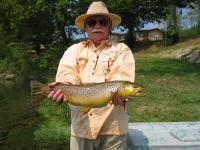
I put a measuring tape on her and she was a righteous twenty-five inches. I neglected to measure the girth and therefore am unable to compute the weight. My caricature was drawn by Bill Wright, a commercial artist for Federal Express and former editor for the Mid South Fly Fishers newsletter. Some say that it is a black and white photograph.
-
My wife, Lori, and I went to Rim Shoals on Sunday. I was fishing a western foam hopper and took this brown on the first drift. It was a pretty short battle. With a size six hook and 4X tippet you can really put the heat on them. We fished nothing but hoppers for the rest of the day and caught several fine fish but nothing like this.
-
Hoppers violate Berry's Law. "You have to tie them faster than you lose them". As a result, I buy them. I favor Dave's hopper which is not an easy tie.
-
FliTrap, Sounds great. I hope to fish the same water myself. It has been red hot lately. Hoppers rule! If I don't see you on the water, Stop by and see me at conclave. I will be tying and will give a seminar. Let me tie you one!
-
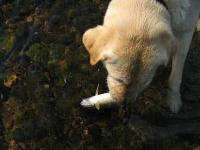
Ellie fished hard but only landed one. Sorry to hear that you will not be here for conclave. I am going to have a booth and was hoping that we would be neighbors again. I am also disappointed that we won't be able to fish together. The hoppers are red hot this year.
-
JOHN BERRY FISHING REPORT 8/30/2007 Water levels continue their drop and every impoundment in the White River system is well below power pool. There has been precious little rain in several weeks and the daily high temperatures have hovered in the mid to high nineties. The lake level at Bull Shoals Dam has dropped four tenths of a foot to rest at one and four tenths of a foot below power pool at 654.00 feet. Up stream, Table Rock Lake has dropped eight tenths of a foot to rest at two and three tenths of a foot below power pool. Beaver Lake has dropped six tenths of a foot and is now at four feet below pool. The pattern on the White River has been for low levels of generation or no generation in the morning and then to spike it with up to seven generators in the afternoon and early evening, when there is peak demand for electricity. This has created some excellent wading conditions on the days with no morning generation. Norfork Lake has dropped seven tenths of a foot and is now two and a half feet below power pool of 552.00 feet. The pattern is to turn the generators off in the morning and to run a full two generators in the afternoon and early evening. This has created some excellent wading opportunities on the Norfork early in the day. The forecast is for slightly cooler weather. With the existing conditions, I foresee continued heavy afternoon generation on both rivers. On the Norfork, the dissolved oxygen levels continue to drop. This is most critical during periods of no generation. Last week, the dissolved oxygen level regularly dropped below two and a half parts per million. There was one instance where it dropped below two parts per million. The oxygen level will be the lowest just below the dam. On the White River the dissolved oxygen has started to drop. There was one instance where it went below five parts per million. Despite the heat, the White has been fishing extremely well. The section from Wildcat Shoals to Cotter has been a real hot spot. At low levels of generation, zebra midges and small scud patterns have been effective. On high water the hot flies have been brightly colored San Juan worms (red, hot pink, and fire orange) and egg patterns. The big story has been the grass hopper fishing. It has been spectacular. On low water, particularly in the afternoon hopper patterns have been the ticket. The debate is over which pattern is the most effective Rainey’s hopper, Schroeder’s hopper, or Dave’s hopper. Should it be rubber legs, foam or deer hair? I have been using the Dave’s hopper size ten and doing well. Be sure and use at least a 4X tippet and let the fly hit the water with a splash. There is a tendency for most anglers to set the hook too soon with dry flies. Take a deep breath, and make sure the fish has taken the hopper before setting the hook. Another hot spot, on the White River, has been Rim Shoals. On low water, this section has been very productive. The best flies have been the zebra midge in brown with copper bead and copper wire in size eighteen and partridge and orange soft hackles. The grasshopper has also reigned supreme here. The Norfork is not fishing as well as the White. On the days when they are running water on the White, the Norfork can get pretty crowded, particularly on the weekends. The overcrowding has been worsened by the closing of McClellan’s. Small midges are still the best bet. Hot patterns are the black zebra midge with silver wire and silver bead, brown zebra midge with copper wire and copper bead, and the Norfork bead head in olive. All are most effective in size twenty or smaller. The partridge and orange has been the hot soft hackle. Grass hoppers have also been quite effective here. Dry Run Creek is still the place to introduce children to trout fishing. If you have not visited there you need to check it out. There are trout as big as your leg all over the place. This is what Catch and Release could all be about. The best way to fish it is by high sticking sowbugs (the dominate food source on Dry Run Creek), San Juan worms, or egg patterns. Don’t for get to take the largest net you can lay your hands on and a camera. This is where memories are made. Always practice water safety and check conditions before you leave home. John Berry is a fly fishing guide in Cotter, Arkansas. He has been fishing the local streams for over twenty five years.
-
I called the Dam yesterday and to my surprise it was off. I gathered up my gear and my yellow lab, Ellie, and headed to Rim Shoals. When I got there the water was on the bottom and there were three cars in the parking lot. I quickly rigged up and as we headed for the water I saw that every one was pretty spread out. I headed downstream to get away from the other anglers. Ellie has a tendency to help you land your fish, if the fight goes too long. I started catching fish immediately. I changed flies from time to time as the action slowed. I settled on a copper midge and started to really pound the fish. I must have caught over forty. most were twelve to fourteen but several were fifteen to sixteen inchers. I looked up stream and noted that the top riffle was not too crowded. I headed up and began fishing. I caught several nice fish the largest being an eighteen inch bow. I noticed a big nose poking up at my strike indicator. That was enough for me. I stripped off my fly, lead and strike indicator. I tied on a fresh 4X tippet and a size ten Dave's hopper. I cast a short line at the spot where the nose had poked up. I was instantly rewarded with a fat sixteen inch bow. He fought like a wildman but I was quickly able to force him in . The heavy tippet and big hook conspired against him and he was soon in my hand. I released him and revived the fly with some dry fly crystals. I cast again and was quickly into another fish. This went on for some time. The action was non stop. It was like a hopper hatch. If I went two casts without a fish I checked my fly. I glanced at my watch . It was five thirty and I knew that Lori would have Dinner ready soon. I started fishing my way out. I took three more in the process. When I got to the access, I realized how tired I was. What a day!
-
FLY FISHING DURING A HEATWAVE
John Berry replied to John Berry's topic in General Angling Discussion
Sage advice techo. I have always relied on a big cowboy hat but I have begun using sunscreen also. You cannot be too careful. -
There is really a variety of reasons. The upper river, Bullshoals Dam to the Buffalo has better access, More walk-in access and more boat ramps. Most guides live in Bull Shoals or Cotter. They are closer to home. The AG&F studies show there are more large fish in the upper river. Then there is the generation thing. The water falls out slower than it rises. Therefore given a set generation pattern, the nearer you are to the dam the more wadable water you will have. In the summer when heat is a problem, the nearer you are to the dam the colder the water is. As it goes down stream it gets warmer the water from Crooked Creek and the Buffalo are warm water streams and their water will warm the river even more. These streams are also subject to flooding (no dams). You put all of this together and you generally get better fishing on the upper river.

