Phil Lilley
-
Posts
19,030 -
Joined
-
Last visited
-
Days Won
132
Content Type
Profiles
Forums
Blogs
Events
Articles
Video Feed
Gallery
Everything posted by Phil Lilley
-
I was looking at this yesterday- didn't know it existed. But I didn't think I turned it on!!! I'll have to go look at it.
-
District 2 Fisheries 2014 Fourth Quarter Newsletter
Phil Lilley replied to mojorig's topic in Lower Bull Shoals
Yes- please keep posting! Thanks -
These are beautiful! Do you mind if I share them on our Lilleys' Landing social sites?
-
Impressive. I'm ordering all materials to tie this - right now!
-
New Years Day At Taneycomo With Oaf Friends
Phil Lilley replied to Phil Lilley's topic in Upper Lake Taneycomo
Yea, problem with "leaving it there" is that it's easy to get distracted, fall asleep and miss the bite, which is pretty subtle most of the time. -
A bunch of guys and gals get together every New Years Day at the pavilion below Table Rock dam on Lake Taneycomo for some good food and fellowship. We don't pick the day--it's always January 1. So we take whatever weather comes and let me tell you we've endured some pretty extreme temps and conditions. But 2015 wasn't too bad at all. No wind, a little chilly but over all, no complaints. Those that fished found the catching to be slow. I walked down to outlet #2 and visited with some guys and while standing there we only saw 1 trout caught and there were quite a few anglers in sight. After visiting and eating some tasty cajun jambalaya, spicy meatballs, jalapeno cornbread and more, I walked down lake to see if I could find some trout to catch. Wanted to get away from the crowds and I like the Rocking Chair area so me and Jackson set off. So wind, the lake was as slick as marble but there were trout midging the surface like crazy. They were taking a tiny, dark midge, about a size 28. I had a #24 Griffith Gnat but they didn't want any part of it. So I went to a #20 red Zebra Midge. I didn't have any floats on me--no palsas, no floats of any kind--so I greased my leader and tippet within 2 inches of the fly with fly floatant. I was hoping this would keep the Zebra up close to the surface where the trout were looking. The Rocking Chair area doesn't have a lot of gravel on the bottom--it has bed rock and big, jagged rocks. The north side where I was, there's flat bedrock with pits or holes where the water is 6 inches to 24 inches deep. Rainbows get up on this flat shelf and pick off midging hatching from the moss covered bedrock. There's also small worms that live in the moss--I'm sure they feed on those too. Normally there is a very slow current in this area of the lake when there's no generation. I like it--I usually fish a Zebra under an indicator and make real long drifted out towards the middle. But this time I targeted the rainbows on the shelf because they seemed like they were more feeding more aggressively. When fishing a Zebra in these conditions (no wind and no water movement), you just have to throw to an active spot and let it sit. I don't move the fly much, if any, because moving it sometimes spooks fish. The water is so shallow, these trout are darting out in to deep water at the slightest sign of a heron or other predator. I ended up catching 6 rainbows. But I have to say I didn't do well at all until a slight breeze started rippling up the surface of the water. It makes a huge difference!
-
New Years Day At Taneycomo With Oaf Friends
Phil Lilley replied to Phil Lilley's topic in Upper Lake Taneycomo
-
Good times and great food. Nice to see everyone. Sorry the weather turned ugly. Fishing wasn't the best either - should have been! Quite a few people fishing today too! I'll let everyone do their own reporting. I'll post a video shortly.
-
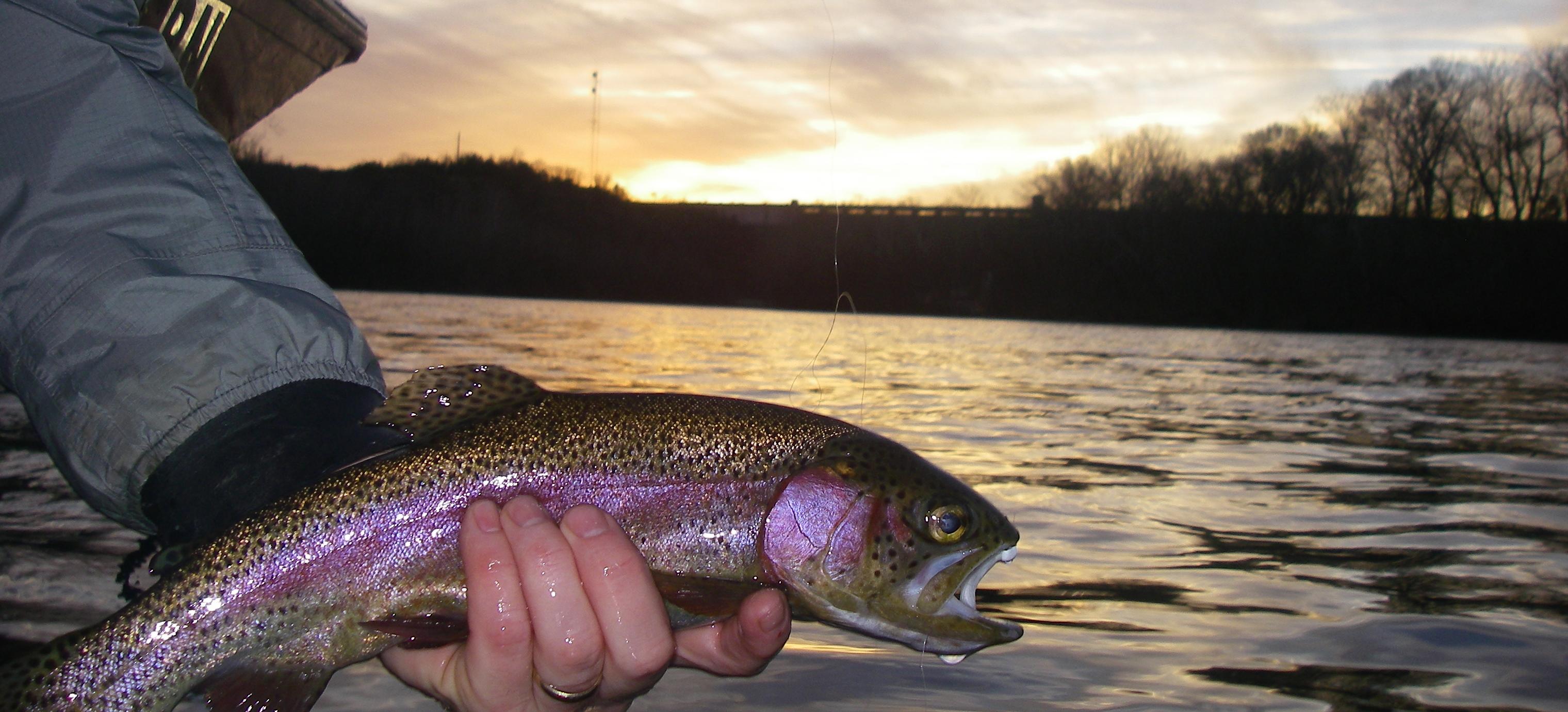 The following article depicts fishing conditions as well as stocking rates for Lake Taneycomo. Stocking numbers reflect trout stocked from Shepherd of the Hills Hatchery, a state hatchery. These numbers do NOT include 180,000 rainbows from the Neosho Federal Hatchery. There is NOT a schedule for stocking these rainbows -- they could come at any time of the year, although typically a good portion of them are stocked in the winter, December. January/February The MDC reports stocking 25,406 rainbows in the month of January, 21,226 in February. All stockings are spread throughout the month. January usually is a cold month here in the Ozarks, but the last few years have been marked by only short cold spells. Temperature doesn't affect our trout as much as warm-water species, but it does affect generation – which does affect fishing. I'm a huge proponent of running water. Insects are healthier in moving water and that's my main reason for liking it. We haven't had a winter season when we've had good generation for years because of low rainfall lake levels. The quality of water is at the top of the scale, high in dissolved oxygen, but it will be colored from the recent turn over on Table Rock, stained with silt, which lasts until late spring. Saying all that sets up the rest of my report: Cold weather, adequate lake levels and generation -- that's what'd I call normal January fishing conditions. By boat, drift. It's easy and fun regardless of whether you use live bait, lures or even flies. Bounce something off the bottom using a drift rig or just a split shot, whatever you like better… just so it's on the bottom. Drop or cast a jig, eighth-ounce if the water is really moving and less if it's not. Work it up and down, quickly or slowly, snap it or lift it; try it all and see what the trout like at the time. And try different colors such as sculpin, black, white, brown, olive, pink, and purple. Mix the sculpin colors with peach and ginger and don't forget the orange heads. Throw stick baits around structure for browns when the water runs. Work them in a stop-and-go pattern, aggressively and slowly. Keep an ear out for shad runs. Thread-fin shad get too close to the outflow at Table Rock Dam and get sucked through the turbines into Taneycomo, causing a feeding frenzy. Trout gorge themselves on the easy bites of shad, and we fishermen can cash in on the run. White jigs, spoons and small crank baits are the best bets. Drifting Gulp Power Eggs or night crawlers on the bottom from Fall Creek down is an all time favorite for most anglers. The key is not to use too much weight, or too little. Just because the drift rig comes with a ¼-ounce weight doesn't mean it's the perfect weight for the flow. Add a split shot if you're not sinking the bait or go to a smaller weight if you're bouncing too hard and snagging up a lot. Stay away from the banks, especially the bluff bank where downed trees will get you every time. Use long, sensitive rods for the best feel. Keep the rod high in the air and watch the tip for the small bump-and-hold you're looking for. Casting spoons and spinners to rainbows that are high in the water column can be a lot of fun. Don't overlook the shallow side of the lake. In this shallow water trout will pick up a spoon much quicker than in the deeper channel side of the lake. March/April The Missouri Department of Conservation reports stocking about 29,586 rainbows in the month of March and 32,626 in April. All stockings are spread throughout the month. Boy, you never know what you're going to get in these months. Weather can be really wild with cold spells, warm spells, storms and rain. Fronts do have some impact on trout but not as extreme as on bass, it seems. But this is the time of the year we should see more generation because of spring rains… normally. But the past three to four years have not been normal. We've seen shad runs up into March before so can't rule that out. White jigs continue to be hot long after the shad are gone. I usually do well using white jigs all the way into June, throwing them not just below the dam but all the way down to the Landing downtown. Maybe some of the early spawns of forage fish have something to do with it. But white jigs and small crank baits are a hot ticket in the spring. We do have a pretty good population of crappie and white bass in our lake. We typically look for them in the mouths and just up in the creeks –- Turkey, Coon, Roark, Bee, Bull and more down towards and past Rockaway Beach. Just as in any other fishery, crappie like brush, and whites like open water. You will best find either early and late and on dark days. May/June/July/August The MDC reports stocking about 36,426 rainbows in the month of May, and 38,756 in June and 43,971 in July and August. All stockings are spread throughout the month. As you can see, stocking numbers are the highest in the summer months, mainly because fishing pressure is also the highest. You might assume that's your best time to catch rainbows here but possibly not. I'd say there are good and bad fishing days every day of the year on Taneycomo. And a bad day on the water still beats a good day in the office, as anglers oft repeat! Again, lake levels pretty much dictate generation. If we have a wet spring and the lakes are full, the powers at be will use that opportunity to generate electricity and the water will run. To gauge the chance, check the lake levels for Beaver and Table Rock. If they are over power pool, or normal (915 feet for Table Rock and 1120.4 for Beaver), there's a good chance the dam will run water. Also look at history and patterns. If they are running water each day at a certain time, the pattern may hold through the week, but you can bet it may change come the weekend. There's a better chance than not that weekends you'll see less generation mainly because of less power demand. Jig-and-float fishing will work just about any time of the year under most conditions. It works best during little or no generation, of course. First I tell people, two-pound line will catch more fish, period. Tie a piece of two-pound line to the end of your line, only about two or three feet. Use the jig that fits the water conditions -- a small micro jig or a 1/100th ounce marabou jig when the water isn't running and a heavier 1/50th to 1/16th ounce jig when it is. Of course, you'll have to change your float size, too. As far as colors, there are many to try in varying sizes. Vary the depth, too, until you find out where the fish are hanging out. If there is a slow month, August can be the one. Table Rock's water stratifies and separates during the summer months with the warm water on top and the cold water forced down. Decaying debris on the bottom of the lake depletes the water of oxygen throughout the summer and fall. Taneycomo gets its water from Table Rock at 130 feet deep, so as fall progresses, we see dissolved oxygen levels plummet to the point that the U.S. Corps of Army Engineers has to add liquid oxygen to the water released just to keep aquatic animals alive, namely trout. The low oxygen condition continues until Table Rock literally turns over, usually about the middle of December. This inversion mixes the water levels in Table Rock, sending good quality water down to the bottom of the lake once again. September/October/November MDC reported stocking about 36,426 rainbows in the month of September, 32,626 in October and 39,100 in November. All stockings are spread throughout each month. Trout fishing continues to be good on the lake. Water flows generally diminish through the fall months simply because it's our dry season and the Corps is restricted as to how much water runs due to low oxygen in the water released. So you could say anchoring the boat and tossing out a night crawler or power bait is the norm for an angling outing --or a jig and float works well, too -- or fishing midges. In the fall months we see midge hatches every morning and every evening. Fly fishing below the dam draws lots of interest in the autumn. Our world famous brown trout begin their annual run to the upper reaches of the lake to spawn. They start showing up as early as mid September and stay as late as late November. Unfortunately, the run lures trophy seeking anglers, too, who crowd the first mile of the lake during the spawn. The crowds affect how the fish move and feed during the day because there's no place to hide in that first mile, no holes or bends. Trout are herded around, pushed here and there by wading anglers, which is not conducive to their biting. But they do get caught, most of the time by the person who watches his movements and is careful not to wade out too deep too quickly. December/January MDC reported stocking about 17,756 rainbows in the month of December, 25,406 rainbows in January. Most, if not all, of the rainbows were stocked in December and January come from the national hatchery in Neosho, Missouri. All stockings are again spread throughout each month. You're probably wondering why I lumped January in with December since I start with January already. I think of these two months as the best months of the year to fish Taneycomo. I get asked a lot, "What is the best month to fish?" People are always surprised at my answer, especially those who come only in the summer. We witness the least traffic all along the lake in December and January, fewer anglers wading below the dam, fewer boats buzzing up and down the channels of the lake – just less disturbance for catching great fish. I believe our trout are pretty tolerant towards us humans invading their space. They were raised by people, hand fed (by tourists) and handled several times in their short life at the hatchery. But I see patterns develop especially over a weekend when fishing slows down and I equate it to traffic. If you're in a boat, there's not much you can do about it, but if you're wading, there is. Just think about it next time you're wading below the dam, especially if you want to catch bigger trout. Another technique that works just about any month of the year is fishing with a midge. Insects called midges, part of the true fly family, could be our trout's number one food source. They hatch almost every day of the year in all parts of the lake and are easy pickin's for rainbows as well as browns. The larvae make their way to the surface from silt on the bottom, molt, emerge and dry themselves on the surface before flying away. The larvae stay in the film, or upper inch of the lake's surface, long enough to make an easy meal for a cruising rainbow. When you see rings upon rings of fish surfacing on the lake, you're seeing trout feeding on midges. Zebra midges are one of the best flies that imitate a midge larva. We fish them under a small indicator using either a fly rod or spin rod. They are so small (#14 or #16) that one has to use two-pound line. Fish them only 12 inches deep, even in 20 feet of water, because that's where the larvae are and that's also where the trout are looking for them. Cast and target midging trout. Cast to a ring… it really is a lot of fun when you get into a big hatch and feeding area. I believe during the last part of October, November and on into December, trout populations build up, and by the end of December, there seems to be a large number of fish in the lake. I feel these trout are "ripe for the pickin'" and this is proven out by the catches seen the first week or two of January, at least on the lake (not below the dam). Beautifully marked rainbows starting their spawn show up both in live wells and on stringers. The males darken and the females brighten with purple and red hues. These are usually good, plump rainbows that fight hard for their size, giving us the most for our effort. That's why I love winter fishing and I look forward to it every season.
 -
The following article depicts fishing conditions as well as stocking rates for Lake Taneycomo. Stocking numbers reflect trout stocked from Shepherd of the Hills Hatchery, a state hatchery. These numbers do NOT include 180,000 rainbows from the Neosho Federal Hatchery. There is NOT a schedule for stocking these rainbows -- they could come at any time of the year, although typically a good portion of them are stocked in the winter, December. January/February The MDC reports stocking 25,406 rainbows in the month of January, 21,226 in February. All stockings are spread throughout the month. January usually is a cold month here in the Ozarks, but the last few years have been marked by only short cold spells. Temperature doesn't affect our trout as much as warm-water species, but it does affect generation – which does affect fishing. I'm a huge proponent of running water. Insects are healthier in moving water and that's my main reason for liking it. We haven't had a winter season when we've had good generation for years because of low rainfall lake levels. The quality of water is at the top of the scale, high in dissolved oxygen, but it will be colored from the recent turn over on Table Rock, stained with silt, which lasts until late spring. Saying all that sets up the rest of my report: Cold weather, adequate lake levels and generation -- that's what'd I call normal January fishing conditions. By boat, drift. It's easy and fun regardless of whether you use live bait, lures or even flies. Bounce something off the bottom using a drift rig or just a split shot, whatever you like better… just so it's on the bottom. Drop or cast a jig, eighth-ounce if the water is really moving and less if it's not. Work it up and down, quickly or slowly, snap it or lift it; try it all and see what the trout like at the time. And try different colors such as sculpin, black, white, brown, olive, pink, and purple. Mix the sculpin colors with peach and ginger and don't forget the orange heads. Throw stick baits around structure for browns when the water runs. Work them in a stop-and-go pattern, aggressively and slowly. Keep an ear out for shad runs. Thread-fin shad get too close to the outflow at Table Rock Dam and get sucked through the turbines into Taneycomo, causing a feeding frenzy. Trout gorge themselves on the easy bites of shad, and we fishermen can cash in on the run. White jigs, spoons and small crank baits are the best bets. Drifting Gulp Power Eggs or night crawlers on the bottom from Fall Creek down is an all time favorite for most anglers. The key is not to use too much weight, or too little. Just because the drift rig comes with a ¼-ounce weight doesn't mean it's the perfect weight for the flow. Add a split shot if you're not sinking the bait or go to a smaller weight if you're bouncing too hard and snagging up a lot. Stay away from the banks, especially the bluff bank where downed trees will get you every time. Use long, sensitive rods for the best feel. Keep the rod high in the air and watch the tip for the small bump-and-hold you're looking for. Casting spoons and spinners to rainbows that are high in the water column can be a lot of fun. Don't overlook the shallow side of the lake. In this shallow water trout will pick up a spoon much quicker than in the deeper channel side of the lake. March/April The Missouri Department of Conservation reports stocking about 29,586 rainbows in the month of March and 32,626 in April. All stockings are spread throughout the month. Boy, you never know what you're going to get in these months. Weather can be really wild with cold spells, warm spells, storms and rain. Fronts do have some impact on trout but not as extreme as on bass, it seems. But this is the time of the year we should see more generation because of spring rains… normally. But the past three to four years have not been normal. We've seen shad runs up into March before so can't rule that out. White jigs continue to be hot long after the shad are gone. I usually do well using white jigs all the way into June, throwing them not just below the dam but all the way down to the Landing downtown. Maybe some of the early spawns of forage fish have something to do with it. But white jigs and small crank baits are a hot ticket in the spring. We do have a pretty good population of crappie and white bass in our lake. We typically look for them in the mouths and just up in the creeks –- Turkey, Coon, Roark, Bee, Bull and more down towards and past Rockaway Beach. Just as in any other fishery, crappie like brush, and whites like open water. You will best find either early and late and on dark days. May/June/July/August The MDC reports stocking about 36,426 rainbows in the month of May, and 38,756 in June and 43,971 in July and August. All stockings are spread throughout the month. As you can see, stocking numbers are the highest in the summer months, mainly because fishing pressure is also the highest. You might assume that's your best time to catch rainbows here but possibly not. I'd say there are good and bad fishing days every day of the year on Taneycomo. And a bad day on the water still beats a good day in the office, as anglers oft repeat! Again, lake levels pretty much dictate generation. If we have a wet spring and the lakes are full, the powers at be will use that opportunity to generate electricity and the water will run. To gauge the chance, check the lake levels for Beaver and Table Rock. If they are over power pool, or normal (915 feet for Table Rock and 1120.4 for Beaver), there's a good chance the dam will run water. Also look at history and patterns. If they are running water each day at a certain time, the pattern may hold through the week, but you can bet it may change come the weekend. There's a better chance than not that weekends you'll see less generation mainly because of less power demand. Jig-and-float fishing will work just about any time of the year under most conditions. It works best during little or no generation, of course. First I tell people, two-pound line will catch more fish, period. Tie a piece of two-pound line to the end of your line, only about two or three feet. Use the jig that fits the water conditions -- a small micro jig or a 1/100th ounce marabou jig when the water isn't running and a heavier 1/50th to 1/16th ounce jig when it is. Of course, you'll have to change your float size, too. As far as colors, there are many to try in varying sizes. Vary the depth, too, until you find out where the fish are hanging out. If there is a slow month, August can be the one. Table Rock's water stratifies and separates during the summer months with the warm water on top and the cold water forced down. Decaying debris on the bottom of the lake depletes the water of oxygen throughout the summer and fall. Taneycomo gets its water from Table Rock at 130 feet deep, so as fall progresses, we see dissolved oxygen levels plummet to the point that the U.S. Corps of Army Engineers has to add liquid oxygen to the water released just to keep aquatic animals alive, namely trout. The low oxygen condition continues until Table Rock literally turns over, usually about the middle of December. This inversion mixes the water levels in Table Rock, sending good quality water down to the bottom of the lake once again. September/October/November MDC reported stocking about 36,426 rainbows in the month of September, 32,626 in October and 39,100 in November. All stockings are spread throughout each month. Trout fishing continues to be good on the lake. Water flows generally diminish through the fall months simply because it's our dry season and the Corps is restricted as to how much water runs due to low oxygen in the water released. So you could say anchoring the boat and tossing out a night crawler or power bait is the norm for an angling outing --or a jig and float works well, too -- or fishing midges. In the fall months we see midge hatches every morning and every evening. Fly fishing below the dam draws lots of interest in the autumn. Our world famous brown trout begin their annual run to the upper reaches of the lake to spawn. They start showing up as early as mid September and stay as late as late November. Unfortunately, the run lures trophy seeking anglers, too, who crowd the first mile of the lake during the spawn. The crowds affect how the fish move and feed during the day because there's no place to hide in that first mile, no holes or bends. Trout are herded around, pushed here and there by wading anglers, which is not conducive to their biting. But they do get caught, most of the time by the person who watches his movements and is careful not to wade out too deep too quickly. December/January MDC reported stocking about 17,756 rainbows in the month of December, 25,406 rainbows in January. Most, if not all, of the rainbows were stocked in December and January come from the national hatchery in Neosho, Missouri. All stockings are again spread throughout each month. You're probably wondering why I lumped January in with December since I start with January already. I think of these two months as the best months of the year to fish Taneycomo. I get asked a lot, "What is the best month to fish?" People are always surprised at my answer, especially those who come only in the summer. We witness the least traffic all along the lake in December and January, fewer anglers wading below the dam, fewer boats buzzing up and down the channels of the lake – just less disturbance for catching great fish. I believe our trout are pretty tolerant towards us humans invading their space. They were raised by people, hand fed (by tourists) and handled several times in their short life at the hatchery. But I see patterns develop especially over a weekend when fishing slows down and I equate it to traffic. If you're in a boat, there's not much you can do about it, but if you're wading, there is. Just think about it next time you're wading below the dam, especially if you want to catch bigger trout. Another technique that works just about any month of the year is fishing with a midge. Insects called midges, part of the true fly family, could be our trout's number one food source. They hatch almost every day of the year in all parts of the lake and are easy pickin's for rainbows as well as browns. The larvae make their way to the surface from silt on the bottom, molt, emerge and dry themselves on the surface before flying away. The larvae stay in the film, or upper inch of the lake's surface, long enough to make an easy meal for a cruising rainbow. When you see rings upon rings of fish surfacing on the lake, you're seeing trout feeding on midges. Zebra midges are one of the best flies that imitate a midge larva. We fish them under a small indicator using either a fly rod or spin rod. They are so small (#14 or #16) that one has to use two-pound line. Fish them only 12 inches deep, even in 20 feet of water, because that's where the larvae are and that's also where the trout are looking for them. Cast and target midging trout. Cast to a ring… it really is a lot of fun when you get into a big hatch and feeding area. I believe during the last part of October, November and on into December, trout populations build up, and by the end of December, there seems to be a large number of fish in the lake. I feel these trout are "ripe for the pickin'" and this is proven out by the catches seen the first week or two of January, at least on the lake (not below the dam). Beautifully marked rainbows starting their spawn show up both in live wells and on stringers. The males darken and the females brighten with purple and red hues. These are usually good, plump rainbows that fight hard for their size, giving us the most for our effort. That's why I love winter fishing and I look forward to it every season. View full article
-
Two Proposals That Could Eliminate 85% Of Mdc Funding If Passed
Phil Lilley replied to bs1827's topic in Conservation Issues
Gavin - looking forward to reading about your annual trip. -
John Neporadny Some of the largest crappie of the year are annually taken at Lake of the Ozarks by anglers jerking suspending stickbaits for bass. About 10 years ago I went crappie fishing on Lake of the Ozarks with Roger Fitzpatrick, a local bass tournament competitor, who had refined a suspending jerkbait tactic to catch slab crappie. During a couple of hours of fishing, we caught 28 fish in the 11- to 13-inch range and on a couple of occasions we scored doubles. I also caught the largest crappie I’ve ever taken on my home lake --a 15-inch fish that weighted 1 pound, 14 ounces. Since then, I have jerked a LuckyCraft Bevy Shad 60 in a ghost minnow hue to catch crappie throughout the winter. The key is to find brush piles in the 12- to 15-foot range and slowly work the stickbait over the top of the brush. I throw past the brush pile, reel the lure down to its maximum depth and then employ a twitch-twitch-twitch-pause cadence with the pauses lasting about five to 10 seconds. I throw the stickbait on 8-pound monofilament line with a 6 1/2-foot medium-action spinning rod. Scaling down to 6-pound line will make the lure dive deeper, but I prefer the 8-pound line for added strength in case a hefty largemouth or hybrid white bass-striper nabs the stickbait. The stickbait technique produces quality fish, but when I want to catch numbers of crappie I resort to horizontal and vertical presentations with jigs. My favorite jighead size for casting is a 1/16-ounce model which is heavy enough to cast and control on a windy day, yet is light enough to slowly fall through a school of suspended crappie. On calm, cloudy days, I will occasionally throw a 1/24-ounce jighead to make the lure fall even slower for suspended fish. I can also vary the fall rate of my jigs by tying the lures on 4- or 6-pound monofilament or fluorocarbon line. Two of my favorite soft plastics for casting in the wintertime are the Bobby Garland Baby Shad and the 3-inch Bobby Garland Slab Slayer in blue ice, chartreuse-and-white, butter belly, pearl glow and chartreuse glow hues. The glow colors produce best for me when I shoot the lures into the dark areas of a dock or cast to the shadowy side of a dock. The same brush piles that yield crappie on stickbaits also produce when I am casting a jig. I always cast past the brush and count down my jig (usually an 8- or 10-count). I keep my line semi-taut so the lure will pendulum towards the brush and hopefully tick the tips of the limbs when I start reeling. While slowly turning the reel handle I occasionally twitch my rod to make the jig hop slightly. Strikes frequently occur while the jig is falling towards the brush or after it has ticked off of a limb. If I notice on my depth finder that baitfish are suspended high in the water column and crappie are ignoring the Baby Shad and Slab Slayer, I will switch to a technique similar to the shaky head finesse tactic for bass. I attached either an Eagle Claw Nitro Trailer worm or a Berkley Gulp Alive Fish Fry in chartreuse or white to a 1/16-ounce jighead and cast it to the deep ends of boat docks over depths of 20 to 30 feet. As the jig slowly falls through the suspended fish, I occasionally shake the jig-and-worm combo. I let the jig pendulum all the way back to the boat on a semi-taut line and watch for indications of a strike, such as a twitch in the line or if I feel my line getting heavier. When my the shaky head is directly below the boat I let it sit there for a short while before reeling it in to make another presentation to the dock. Vertical jigging is usually my last resort. Whenever I approach a brush pile, I will cast to it first to catch the most aggressive fish. Once the action stops, I will position my boat over the brush and drop my jig until I feel it hit the cover and then I will make one turn of the reel to keep my jig slightly above the snag. I drift back and forth over the brush pile occasionally letting the jig bang into the branches, which usually triggers a strike. A 1/8-ounce jighead works best for me when I am vertical fishing in deeper brush because I can feel the heavier jig better. I vertical jig with either a fuzzy-grub style jig or the Slab Slayer. The marabou of the fuzzy grub and the limber soft plastic tail of the Slab Slayer generate plenty of tantalizing movement even when I am holding my rod still, so these lures are ideal for holding in front of an inactive crappie and teasing it into biting. Catching a trophy bass on a suspending stickbait in the winter is an once-in-a-lifetime thrill, but when I want some hot action on a cold winter day I get my fix by chasing after those calico panfish. For information on lodging at the Lake of the Ozarks or to receive a free vacation guide, call the Lake of the Ozarks Convention & Visitors Bureau at 1-800-FUN-LAKE or visit the Lake of the Ozarks Convention and Visitors Bureau web site at funlake.com. Copies of John Neporadny's book, "THE Lake of the Ozarks Fishing Guide" are available by calling 573/365-4296 or visiting the web site www.jnoutdoors.com.
-
- 2
-

-
Lilleys' Lake Taneycomo Fishing Report, December 30
Phil Lilley replied to Phil Lilley's topic in Upper Lake Taneycomo
Soft plastic... can't use them. Right. -
Another year has passed. Hundreds of thousands of trout have been stocked into Lake Taneycomo, and hundreds of thousands have bent the rods of many happy anglers. Can you imagine that number? How many first-time fishers caught their first fish, let alone trout? How many caught their first fish on a fly rod? On a jig? The smiles, the memories, the stories that will be told for many generations to come. Even the "unpleasant" experiences -- yes, especially those! The cold, the snow, the rain, falling in the lake, getting a hook stuck in the finger, breaking off the big one -- all those stories seem to stand out, never to be forgotten. I guess that's what is so special about being part of a fishing destination like Lilleys' Landing for almost 32 years . . . we get to share in those experiences, and it warms our heart to hear the stories. That's what fishing does -- brings people together, friends and families, fathers and sons, fathers and daughters, grandpas and grandkids, of all shapes, sizes and even fishing skills. You don't have to catch very many trout to make memories. Even the times when a goose egg happens, the skunk saunters around or a trip to the store for frozen fish is made, those stories are told, too. This is a special place. Anglers this week have experienced a little more water running, mainly in the mornings. The last couple of mornings, four units have been running, and the level has risen as high as 709 feet. Last evening dam officials ran about the same water, but the pattern has been just coming on, build up to 709 feet and then dropping it back down. Hard to say if they'll keep this pattern up, but I can say the weather forecast calls for continued seasonably cooler temps, so they may continue to run heavy water. This has given anglers an opportunity to drift fish , which has been very good. The key to drift fishing is to get the bait or fly to the bottom using the right amount weight. Too much and you take a bigger risk of getting snagged up; too little weight, and you won't stay in contact with the bottom. That's why you're ahead of the game if you kept changing your weight until you get it right. One trick is using an 1/8th-ounce bell weight, which is on the small side, and add removable split shot as needed, pinching it to the ring of the bell weight. If the split adds too much or not enough weight, it's easy to take off or add to. I introduced the drop-shot weights for drifting a few months ago, and they are worth mentioning again. These weights, when used on drift rigs, don't hang up like splits and bells. We don't have them already tied on drift rigs, but they can be used if you tie your own or replace the bell weights. You might give them a try and see whether they make a difference. The best areas to drift have been Fall Creek down past Cooper Creek. Stay in the middle where there's fewer snags. Gulp Power Eggs as well as Power Bait Eggs in white or pink have been the best baits. Night crawlers are good, too, especially catching bigger trout than the Power Bait. A Trout Magnet under a float fished 8- to 10-feet deep in moving water has been ridiculously good, according to our guides. Pink, pink/white or just white have been the best colors. Remember, you can't use these above Fall Creek. If the water is off, fish them about four- to six-feet deep. One of our guides, Bill Babler, has been adding a #14 red Zebra Midge to his rig, tying an 18-inch piece of 6x or two-pound line to the Magnet and then the midge. He said this has been his best rig, catching good numbers of rainbows the last week. The nicer rainbows have been pulled in from Lilleys' Landing up to Fall Creek with smaller rainbows found down close to the Branson Landing. The federal hatchery in Neosho stocks rainbows in December here on Taneycomo, which are generally smaller than the rainbows from Shepherd of the Hills. These trout seem to be holding lower in the lake right now, but they will move up. Above Fall Creek in the trophy area, fishing has been exceptional. There seems to be an abundance of quality rainbows up there right now, all colored up in their winter attire. We have noticed how strong they're fighting. They must be eating well, too, because they have thick shoulders -- just overall good looking trout! If the water is running, drift flies on the bottom using either a drift rig or just a fly and split shot. Good flies to try would be a scud (#12 or #14, gray, brown, olive of tan), San Juan Worm (#14 red, cerise, pink), egg fly (Miracle or just an egg, peach, pink, light cream), or a wooly bugger (#14 black, olive, white). Boat to the dam if they're running enough water and drift from the cable clear down to Fall Creek. Trout are hitting 1/8th or 3/32nd-ounce jigs. The best colors (in order) are sculpin/ginger or peach, sculpin/olive, black, white, ginger or brown/orange. If you're making a long drift from the dam to Fall Creek, don't miss any areas. I tend to skip over areas that have not produced over the years, but lately I've been doing really well fishing them. These areas are the faster, shallower water just above Trophy Run and through the Lookout Island area. I've caught good rainbows in both these areas lately. Bill Babler has been doing well using the same Trout Magnet rig I mentioned previously but using a Miracle fly instead of the Magnet, using a #14 Zebra Midge as a dropper. He's drifting this from Andy's house to Fall Creek staying in the middle of the lake and fishing it 10-feet deep. If the water is not running, use a small marabou jig under a float and add a #16 or #18 Zebra Midge dropper. Fish it with a fly or spin rod, four- to five-feet deep. Use a 1/125- or 1/100th-ounce, brown/orange head, sculpin, pink, black, brown/orange or a olive jig. When fly fishing, use a variety of Zebra Midges in #16 or #18 -- P&P, rusty, red/copper head, black/cooper head, ugly (green) or red primrose. Vary the depth until you find what the trout will take, anywhere from six inches to four-feet deep. Fish a weighted scud under a small float, #14 to #20, 6x or 7x tippet. Try different shades of gray, olive, brown or tan. I have had good luck using a scud tied on a 200R hook. Fish it close to or on the bottom (gravel) and work it. Make it look as if it's swimming across the bottom.
-
Two Proposals That Could Eliminate 85% Of Mdc Funding If Passed
Phil Lilley replied to bs1827's topic in Conservation Issues
Clearly this article was written to put MDC is the worse light, although they couldn't help but tout MDC's positive efforts BECAUSE THERE ARE SO MANY! MDC could do a better job- sure - but these legislators should concentrate on their own wasteful spending before pointing fingers. -
Dang- we should have stopped and said hi! Pulled in behind you across from B-dock. Caught one crappie there. Just real slow for us.
-
Me and Babler put in at K this morning at 9 am. Hit all his walleye spots including the secret ones... the ones that if I mentioned them I'd get shot. But alas... they produced the same number of fish the "known" ones did - 000 Caught 4 white and one short wally at Snapp on a stick bait and white swimming minnow. One crappie close to the mouth of Beaver. All indicators pointed to a good day of catching - cloudy cover, a little current, front approaching, a little wind. But the fish weren't having it. Good time with Mr. Babler though. We'll get 'em!
-
Call the dam 417-336-5083. They'll give you the level, realtime. Edited 6/3/22 - phone number doesn't work any longer.
-
I'm a little behind... at least I can say ~~~Happy New Year!!~~~ Thank you! Phil
-
-
by Seth Turner ~~ One of my best friends was going to be down visiting family for Christmas and wanted me to take him gigging. My gigging takes place on the Gasconade River most of the time. Recent rains had the water dirtied up, so we decide to go try the Osage River below Bagnell Dam since generation had been off for a couple of days. This was going to be the maiden gigging voyage for my new boat since I just recently had the rail from my old boat modified to fit my new boat. I run a pair of 400w metal halide lights on my boat. Since the generator hadn’t been ran in a while, I fired it up and connected the lights and let everything run for 15 minutes the night before. It’s never fun to arrive at the river for a night of gigging and have to deal with malfunctioning equipment. Weather conditions weren’t very favorable for gigging. It was windy and spitting rain, but my buddy was determined to go so we headed for the river around 4pm. After a quick bite at Taco Bell in Osage Beach, we got to the ramp about 5:30pm. After getting the boat in the water, the first two jumped up and we eased our way down river. Things were slow for the first hour until we got to some shallower riffles where we usually have our best luck. The water had about 6’ of visibility, but the wind chop made it tough to make out fish on the bottom once you got more than 3’ deep. Since there was five of us, I drove and gigged last. The first two groups killed several suckers and a few small buffalo. Each group gigged about an hour and then switched. Eventually I got my turn. Once I got up there, we didn’t go very far before we came across a big school of buffalo. The first few I stabbed out were smaller and I missed. The third one I stuck at was a big one and I hit him right the head, which stunned him. It was too heavy to lift though and slid off the gig. It got it’s bearings and swam away so we had to chase him down and I was finally able to stick it again and get it in to the boat. It was easily the biggest fish I’d ever gigged. It weighed 20.32 pounds on my digital scale. I was able to gig a little while longer, but the wind and rain picked up so we called it a night and headed back. Our final fish count was 18 suckers, six buffalo, a couple gar and one grass carp. We usually do a lot better there, but with the weather conditions that we had, I feel we did decent. I kept the buffalo since my dad loves them and four suckers for myself. The other guys kept the rest. Of course the worst part about gigging is that it makes for a late night. Once you get home and just want a shower and your bed, you still have to clean fish. This time wasn’t bad since I didn’t have many to clean. Being on the water always works up my appetite so I had to score up and fry a few fish for a late night snack. For anybody that hasn’t had a fresh sucker scored up and fried, you are missing out on one of the best tasting fried treats there is! They rank right up there at the top for good eating fish.
-
-
Are you giving out ~SPOTS~ again!!??
-
Are you talking Taney? I'll move your post to Taney forum if you are and you'll get more responses.
-
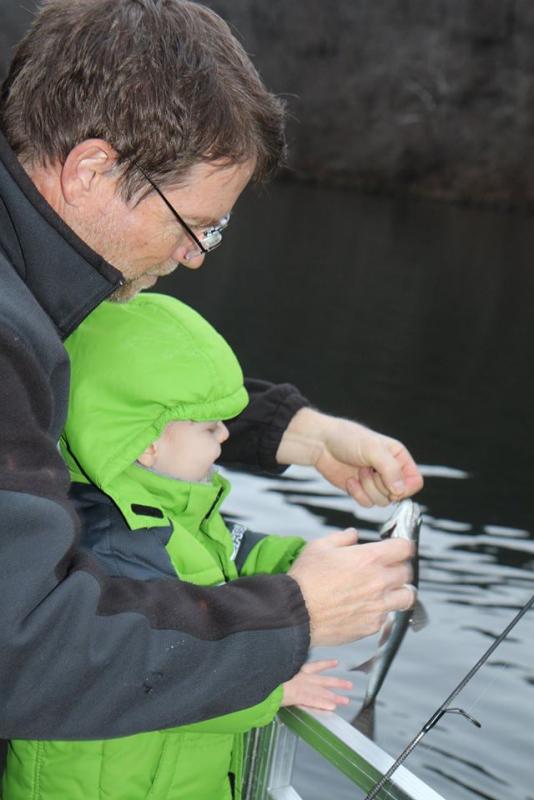
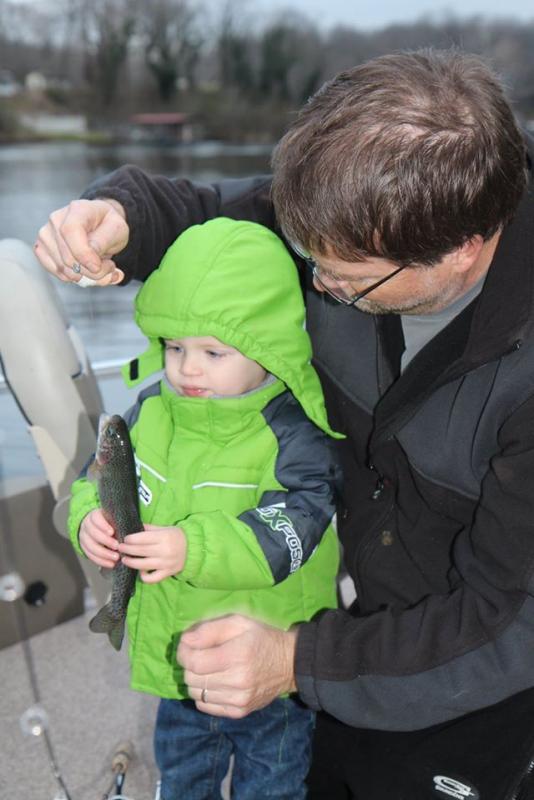
We took my grandson out fishing on Lake Taneycomo before he was 1 year old. He could barely walk, but he had fun playing with the trout in the live well. This afternoon, I took him on his first catch-fish fishing trip. Grandma, JP and I left the dock about 4 p.m. in one of our pontoons. The kids has to have room to move around, you know. We tried fishing close to the dock by the fish weren't having it. Not a bite on our inflated worms. So we boated up a quarter mile, anchored the boat on the shallow side of the lake and threw to the middle. JP and grandma Marsha were more interested in finding music on the radio than fishing. JP really likes music--he's like his daddy. Jimmy leads worship at a church in NW Arkansas. But it didn't take long for a rainbow to find one of the night crawlers I had out. Then the other rod took off. I had a problem. . . the rainbows wanted to dance--together! I got the rods straightened out and JP over to help me reel in the first trout. He immediately grabbed the first fish and held it, staring at it like, "what do I do with this!?" I cut the line and tossed it back. Picked up the second rod and started reeling in the next rainbow. I wondered what JP was thinking... "I thought we just did this!!" or "Is this the same fish??!!" He liked it although I think the experience had lost some of it's newness. He is only 20 months old. He grabbed the next one but didn't hold it very long. Back in the lake it went and JP returned to the radio while I tied new hooks on the line. Once the new worms were back in the water, it didn't take long to get bit again. JP was back to reeling... a little anyways. This time when the trout was brought into the boat, he back away like he'd had enough. Then on the 4th and final rainbow, he turned and acted like he'd never seen one before and wanted nothing to do with it (video). Don't want to ruin the kid on fishing this early in life! So we called it quits.