
Phil Lilley
-
Posts
19,030 -
Joined
-
Last visited
-
Days Won
132
Content Type
Profiles
Forums
Blogs
Events
Articles
Video Feed
Gallery
Everything posted by Phil Lilley
-
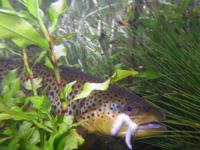
Fished this evening from the bank below the dam above the MDC boat ramp. Water running but slightly and dropping. Fished a white Doty Worm... a white shaggy yarn worm Duane Doty gave me. Caught a dozen rainbows and a brown (pic).
-
Where are you fishing? Been a great day to fish today.
-
Haven't posted in a while mainly cause I haven't been fishing much lately. Drove up Friday and fished mid afternoon. Waded in just above the MDC boat ramp. Caught 11 rainbows between 10 and 13 inches on a #20 black Zebra midge under a palsa 12 inches deep. 7x fl tippet. Water was pretty slick and fish were spooky. Had to cast out in the current to get bit, let it moved down till the float disappeared. I've taken the boat out a couple of evenings, once with the water running and then last evening when it was not. Running- threw a 3/32nd oz sculpin, olive, brown/orange and white jigs and missed way more than I hooked. Didn't really do that well. Went to a jig and float using a 1/32nd oz brown jig with orange head and caught 2 small rainbows. All drifting from the dam to Fall Creek. I think that was Saturday. Last evening, with less than a unit running, I ran up to the Red House between Lookout and the Narrows and threw a stimulator against the bluff bank - nothing. Dropped back down to within sight of our dock. Trout were midging, and have been midging real well from this area to our dock the last, I-don't-know, 4 or 5 evenings. Caught 8 rainbows from 8 inches to 13 on the same Zebra under the palsa before it got too dark to see. There's lots of rainbows in this area - has been for a week or more. I'm sure you can catch them on a jig and float too, marabou or micro. But it sure is fun targeting them with the fly rod. They take the midge almost every time you throw at a rise. Cleaned 4 rainbows, I think the first time this year, and threw them on the grill for a late supper.
-
I've been reading/studying a book you all would be interested in. Heaven by Randy Alcorn The answer would be... yes! Anyone wants to read it, send me a PM and I'll buy and send you a copy.
-
Welcome. Trust you'll like your new home waters... love those brown trout.
-
I was forced into a league... kicking and screaming Friends wanted me to play. I'm really not interested but we'll see how it goes.
-
Regardless Of Your Politics, This Is Embarrassing!
Phil Lilley replied to Mitch f's topic in New News and General Discussion
"What a joke politics has become." I think we all can agree on that! -
Shoo Goo is a little thick for me... but that's me. Buy Aquaseal at BackCountry on Campbell in Springfield or a Bass Pro.
-
-
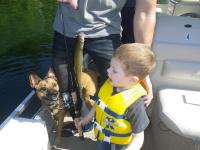
Aquaseal for sure. Patch the inside, not the outside like I did once. You'll look like a dweeb if you do. I took the grandson out for a quick trip before they headed back to KC. Night crawlers above the resort. Caught 8 in short order. Kept a couple of a microwave snack/lunch. They were biting bait good. Pretty still... probably was hard for fly rodders.
-
Islamorada Florida Keys Fishing In July/august 2012
Phil Lilley replied to syxx's topic in U.S.A. - South & West Regions
We look forward to your continued reports here on the forum. -
Ozark Trout Bum goes on location in this episode, participating in Project Healing Waters on Lake Taneycomo. Local guides visit with host Steve Brigman about their day on the water with wounded veterans. Trout Bum regular John Berry offers up his best tips on fall fishing and shares his strategy for fishing soft hackles. Wes Swee is also on hand to talk about the drought's effect on Ozark fisheries. Podcast Powered By Podbean Also available on iTunes.
-
Lilleys' Lake Taneycomo Fishing Report, August 31
Phil Lilley posted a topic in Upper Lake Taneycomo
by Darin Schildknecht This week the Corps of Engineers has changed their generation pattern. Here on Lake Taneycomo they have been alternating days of generation. On the days they have been running it, it has only been about half a generator or 25 megawatts for most of the day with some slight fluctuation in the afternoon. The other days the generators have been off for most of the day but then just about half a generator for the afternoon starting about 3pm. The days the water has been off wade fishing up in the dam area has been productive. Fishing #16 or #18 Rusty, Copper Dun, or Ruby Red midges has been doing well under a Palsa pinch on indicator about 18 to 24 inches deep on 6x or 7x fluorocarbon tippet in the slower moving water. In the faster water size 14 to 18 gray or tan scuds are working also under a Palsa. With the scuds in the faster water you can use 5x tippet. If you want to strip something black and olive bead head Wooly Buggers are catching fish. When the water has been running wading is a little harder. There are a few spots where it is possible but BE CAREFUL the water moves faster up there when the generators are running. The best way to fish by the dam in running water is from a boat. Fishing pinkish colored San Juan Worms or #12 Scuds would be the way to go. Below Fall Creek fishing has been great the last couple of days. Air injected night crawlers have been producing the most fish. Chartreuse and orange Gulp has also been a fish catcher this week. With both of these 4 pound test or less is a must. Also, a jig and float has been my favorite. Sculpin and orange with an orange head or brown with an orange head both in 1/50oz. -
by John Neproadny Jr. When those first cool nights in September start to cool down the Lake of the Ozarks, crappie awaken from their summer siesta. During the heat of July and August , crappie seem to disappear at the Lake of the Ozarks as they burrow into brush piles or drop into the depths of the main lake or creek channels. Dropping a minnow into the deep brush or drift-fishing channel drops and bluffs still catches some fish, but most of the crappie seem to be taking a summer vacation during this time. While September days can still be hot, the nights become cooler and the lake's water temperature gradually drops out of the 80-degree range. This drop in water temperature and the massive schools of newly hatched shad lure crappie out of their summertime doldrums and trigger a feeding spree that lasts throughout the fall and into early winter. Crappie on the main lake can be taken in September as the fish suspend over brush piles around docks, but the best action begins in the tributaries and larger creeks. The shallower water in these arms tend to cool down quicker than the main lake. These cooler waters draw hordes of baitfish that arouse a crappie's appetite. Some of the best tributaries and creeks to try for crappie in early September include the Niangua and Little Niangua rivers, Grand Glaize, Gravois and Linn creeks. Later in the month, the action slows down some in the creek arms but picks up on the main lake. Live bait and artificial lure techniques both work in September. When fishing the main lake during this time, I recommend using minnows or a jig-and-minnow combination. In the morning, a jig-and-minnow works best for me. Since the main lake is usually clear during this month, I favor using jigs in colors imitating shad, such as white, gray or blue, Since I want the lure to fall slowly for suspending fish, I select a 1/32- or 1/16-ounce marabou jig, which I tip with a minnow to make the crappie hold onto the bait longer. Targeting docks and brush piles under the floating structures, I cast to these area first. If this fails to produce or if I catch some fish but the bite stops, I move up to the dock and present the jig vertically into the brush piles. The crappie tend to congregate around docks on main and secondary points 15 to 20 feet deep. Later in the day, the sun and heat tend to drive crappie deeper into the brush, so I switch to a minnow on a hook. I stick the minnow on a 2/0 gold Aberdeen hook and place a split shot about 18 inches above the bait. Moving out to the deeper brush (18 to 20 feet), I drop the minnow straight down into the crappie beds. I vary my depth until I get a bite because some times the fish hold over the top of the brush and on other occasions they drop to the bottom. Using two rods at one time has helped me catch crappie during this month. I usually lower one line with a minnow and set it right above the top of the brush, while I keep the other rod in my hand and work the bottom with a jig-and-minnow combination. The stained and cooler waters of the creeks and tributaries allows you to fish shallower for crappie. The key to finding crappie though is to locate brush close to deep-water structure such as points, mouths of coves and channel drops. On the upper ends of the creeks, crappie can be taken as shallow as 6 to 8 feet, but the key depth range in the rest of the creek is usually 10 to 15 feet. Since the creeks contain more active fish, jigs produce just as well as minnows. My favorite lure for crappie in the creeks is a blue ice Bobby Garland Baby Shad attached to a 1/16-ounce jighead. The same approach that I use on the main lake also produces in the creeks. Keeping my boat away from the brush, I cast past the cover and count as the lure falls, so if a crappie hits I have an idea how deep the fish are and I can present my lure at about the same depth on subsequent casts. When I reach a certain count (depending on the depth of the brush), I start retrieving the jig. The lure slowly falls to the top of the brush where I lift it through the branches. Most of the strikes occur as the lure falls into the brush or after it nudges a limb. After making several casts to the brush pile, I position my boat over the top of the cover and present the jig vertically. With this presentation, I let the jig sit in one spot and rely on the movement of the boat to impart action to the curly tail jig. If this fails to trigger a strike, I jerk the jig up about a foot and let it flutter back down. This action imitates a dying shad struggling to the surface and then falling back down. Any crappie hanging around the brush can't resist such an easy meal. An ultralight spinning rod-and-reel combination works best for all of these techniques. I recommend using 4- to 6-pound test line for the jig tactics and 8- to 10-pound test for dropping minnows into the brush. While the water cools down in September, the crappie action heats up at the Lake of the Ozarks. For information on lodging and 162-page vacation guide, call the Lake of the Ozarks Convention & Visitors Bureau at 1-800-FUN-LAKE or visit the Lake of the Ozarks Convention and Visitors Bureau web site at funlake.com.
-
The first time I fished this technique was the year I bought the resort. I used a Bassnapper 1/100th oz ginger jig and caught the snot out of rainbows and a good number of browns.
-
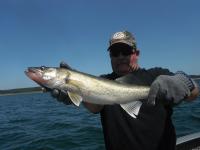
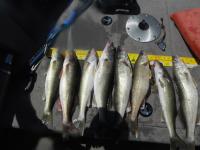
We got on the water a little late, about 10am, this morning. Took out from Lead Hill and fished the flats, East Sugarloaf, and an area by Pt. 26 and down to Pt. 25. Had a two limits by 2:15pm. 25 walleyes were caught, with 8 nice fish, only one under 20 inches. Copper and brass spinners with the Northland fish graphics worked early, but Slow Death was the best from Noon on. When the wind picked up and could not slow the boat down, we ducked into Sugarloaf and caught two there. Speed was a key factor, you had to be under 1.0 mph. Next time out, I will have my drift sock in the boat to slow us down in the wind. Great day on the water. The late summer bite is holding on.
-
Field and Stream - Open Letter Link
-
After someone here asked about information on using a jig and float on Taneycomo for trout, I looked at my articles and didn't like what I found. So I wrote an article just on fish a jig and float. Here's the article - I've got it posted on the main site but haven't gotten all the images done for it. I'll post a link when I'm done. Jig and Float One of the most effective trout fishing techniques on Lake Taneycomo is the jig-and-float technique. If you hire a guide on our lake, chances are you'll fish with a spinning rod with a small jig and a float. Why? Because this way of fishing is fairly easy and it flat catches trout. Guides use spinning rod equipment when using a jig and float, but you can easily use a fly rod and be just as effective. First we'll cover using spinning equipment since this is what most anglers use. Spinning Rod A good general rod for jig-and-float is a medium action, six-foot graphite rod. Some anglers like to use a longer rod such as seven feet or even longer. Length is important because throwing the rig and setting the hook is difficult using a short rod. In setting, you are dealing with slack from the rod tip to the float as well as the line from the float to the jig. If you're fishing eight-feet deep, that's a lot of slack to pull before getting to the fish on the end of your line. A longer rod will definitely help get a good hook set. Some of our guides have changed to using eight- to nine-foot spinning rods to give them the power needed to set the hook when fishing nine to 12 feet under a float. A medium to stiff action rod is much better than a soft tip rod. You need all the power you can muster if fishing at a distance from the boat and/or at deep depths. Casting a jig-and-float can be difficult depending on how deep you're fishing and how much line is hanging off the end of your rod. Place the jig in the water behind you (assuming you're fishing from a boat). With a flicking wrist motion, propel the rig forward using the water and rod as a sling-shot. It's not a lob cast but more of a direct-line drive. Fly Rod Using a jig instead of a fly on a fly rod? Heaven forbid!! Many anglers who don't fly fish traditional ways (with nymphs, dries or streamers) are learning to use a fly rod and enjoying the jig-and-float technique. It's easy in that there's only one thing to watch -- the float. The ideal fly rod here on Taneycomo is a nine-foot, five-weight rod and simple fly reel with a minimal drag system. Nothing fancy. Float WF five-weight line and tapered 12-foot, 3x leader. Add some tippet material, a jig and float and you can catch trout to your heart's content. I like using a fly rod when jig-and-float fishing because I can recast and move my jig around with just a flick of the wrist. I don't have to reel in and cast back out as with a spin cast. It's not necessary but it's good to keep your fly line clean and coated with floatant so that your line stays on top of the water. This will help when recasting and setting the hook on a fish. If your leader is sinking, coat it, too. Line Conditions dictate what size and kind of line you use for jig-and-float. I suggest using no more than four-pound line on your reel; two-pound is okay but not necessary. Here's a quick list of conditions and what should be used with them: Clear water, bright sun, no generation -- two-pound fluorocarbon (6x or even 7x) Generation, slow drift - four-pound mono or fluorocarbon (6x or 5x) Generation, medium to fast - four-pound mono Small jigs, 1/100th or less or micro jigs (half) - two-pound fluorocarbon (6x or even 7x) Medium jigs, 1/80th or larger - four-pound mono or fluorocarbon (6x or 5x) As you can see, water color, sun, generation and size of jigs all play a part in choosing what type of line as well as the diameter. Learning how to use tippet material can be very important when using the jig-and-float technique because you can't change the line on your spools every time you want to change the line that your jig is tied to. Tippet is the line you tie on to the end of the line coming off your reel and the line that you tie your jig to. You can use a triple surgeon's knot to connect these lines. It's easy to use and will connect even a large diameter line to a small diameter line without too much of an issue. Some of our guides use a barrel swivel to connect the tippet to the line. They tie on the exact length of line they want to fish under the indicator and place the indicator above the swivel (pic). This does make is difficult to change the depth, but if you're confident that you will catch fish at that depth, it's a good way to do it. Floats Floats or indicators are used to float the jig at the desired depth and to give the angler an indication that a fish is nibbling on his jig. Size, style, shape and color are all important. If you're drifting in current and using a fairly heavy jig and it's dragging close to or on the bottom, then your float needs to be large enough not to be dragged under water at the slightest pull of the jig. Large carrot floats are good for this type of fishing. If the current is slow, a large float still may be used -- it just depends on how heavy the jig and how deep you're fishing. Large floats are also used when you're having trouble casting small- to medium-sized floats. You can pinch a split shot on the line just under, actually touching the float to give you more weight when casting. Just make sure the weight isn't too much for the float. The downside to using a large float when fishing small jigs in no current is that sometimes the trout will only slightly take the jig, "taste" it and, thus, not move the float but just a tiny bit. A large float won't show this movement but a small float will. There are all kinds of floats. We like to use carrot style-shaped floats either slit or solid with a hole through the middle for the line. Some come with a rubber band to hold the line in place and some with a wood, toothpick stop. Some anglers prefer to use a rubber band instead of a stick. If you're using tiny jigs such as thread jigs or micro jigs, you can use a Palsa style float, but these are very hard to cast using a spin cast rod and reel. Color is dictated by what the angler can see best in his conditions. Jigs Jigs have been around for decades. They are all-round great lures for all kinds of fish. Here on Taneycomo we use marabou jigs and micro jigs. Marabou jigs are tied either with or without a collar. For use under a float, we use jigs as heavy as 1/8th ounce and as light as 1/125th ounce. Marabou are feather pieces demonstrating life-like movement when under water. Marabou is dyed and comes in many colors. Jig heads are either lead or a lead-type metal and painted to the desired color. Head color does make a difference, just like marabou color. Here's a list of color combinations we use for trout on Lake Taneycomo: sculpin, brown head sculpin, olive head sculpin, orange head scuplin/ginger, brown head sculpin/ginger, orange head ginger, brown head olive, olive head olive/sculpin, olive head brown, orange head brown/orange, orange head black/black head white, white head black/yellow, black head black/olive, black head There are more colors and combinations too numerous to list here. And yes, sculpin -- named after the small freshwater "muddlers" in the lake that our browns love -- is one of the best colors to use here on our lake. Turner Micro jigs are another extremely effective jig to use for trout. These tiny jigs are made by a small company in Springfield, Missouri. Although costly, they flat catch trout and are just as good as most flies we use. Turner Micro jigs come in two sizes. We call them full and half micros. Full micros are about 1/128th ounce while the half micros are about 1/256th ounce. The hackle isn't tied but shrink- wrapped to the collar with heat, unlike all other marabou jigs. The feathers are a hen hackle, not marabou, which demonstrate even more lively movement under water. The heads are hand painted to the finest detail -- right down to the painted eyes. We use the following colors, in order starting from the best colors: [*]olive, orange head [*]olive, gold head [*]sculpin, gold head [*]ginger, gold head [*]black, black head [*]brown, brown head [*]pink, chrome head [*]gray, chrome head [*]white, chrome head Technique Trout are a fickle fish -- moody might be a better adjective. Sometimes they like their jigs moving a lot, sometimes they like them dead still, not moving at all. Sometimes they're aggressive and sometimes very lethargic. You have to determine which mood they're in and adjust your fishing to match. If you're fishing with marabou, it could be as simple as trimming the feathers on your jig if the trout are only taking the end tails. Choosing the depth at which you set your float is important. At best, it's experimenting at different depths to see where the trout are holding, especially if you're fishing deep water, more than eight-feet deep. If you're fishing eight feet or less, start halfway down and probably move deeper. Occasionally, trout are holding higher in the water column but not very often. They are usually close if not on the bottom, especially the larger trout. Fishing more than eight-feet deep takes a longer spin rod, or you can change to a fly rod. There are occasions when fishing more than eight- feet deep is necessary--when there's generation or when you're fishing lower in the lake where water is deeper. The following is likely the most important bit of information offered in this article: FIND AN AREA OF THE LAKE WHERE THE SURFACE IS BROKEN BY WIND. You can catch trout when the lake's surface is glassy, but that's far from ideal. Ideal surface conditions are from slightly to medium choppy. This works the float that works the jig below. Also, fish feed better when there's chop on the surface, for whatever reason. I've proven this out 99% of the time in many hours of fishing on the lake, with and without clients. If there's generation, a little or a lot, drifting with a jig-and-float can be very effective. Even if all four units are running, our guides fish nine- to 12-feet deep from jig to float. A good combination is a full pink micro jig with a scud trailer. A trailer is an extra fly tied on a line from 18 to 24 inches below the jig using tippet material, usually 5 or 6x. The line is tied either to the jig's eye or the bend of the hook. When casting the rig from the boat, don't cast it out so far that you can't see the float if it moves every so slightly. You can cast too far and miss seeing a subtle bite. Our trout aren't very boat shy. They won't sit right under your boat, but they won't dart out and move 100 yards away either. Fifteen to 20 feet from the boat is fine. In any surface condition, experiment with working the float. When I say working the float, I mean moving, twitching or jerking the float, thus moving the jig underneath. Try a little, just every 10 seconds instead of moving it all the time. Then try leaving it alone altogether. I typically only leave the rig in one place for about a minute at the most unless I'm drifting with the current. In that case, the rig will move along on its own. Slack control is vital no matter what the conditions but especially if you're drifting in current. Pay close attention to the line between your rod tip and float. Don't let the line swirl and twist in the current. Keep it as straight as possible by lifting the line, re-establishing the line and reeling in slack. This will make setting the hook quick and powerful. If you're not getting bit, CHANGE colors, CHANGE jig size, CHANGE depths, CHANGE locations. Keep changing until you find the right combination. It may be that the trout are just not feeding. Know that generation can stop and start at various times of the day for no apparent reason. But keep fishing. That's why they call it fishing and not catching! Good Luck
-
When Fishing/hiking, Do You Carry A Handgun?
Phil Lilley replied to rfd515's topic in General Angling Discussion
The monkey with the gun would be up there too. -
When Fishing/hiking, Do You Carry A Handgun?
Phil Lilley replied to rfd515's topic in General Angling Discussion
If I had a section for classic posts, this one would be at the top. -
For Sale Ice House " Shut Up And Fish" Beer Sign Must See!
Phil Lilley replied to jbtiwns30's topic in Buy - Sell - Trade
Is this a wood carving? Can't really tell. Might add another pic or two and describe it a little better. Thanks -
You don't see this everyday... LINK
-
You're fine up to Lookout Island. You probably can go past and on up to Trophy Run if you keep it all the way up on plane. Stay middle right going up. There's a shoal/riffle on the left next to the top of the island that is shallow. Once past island, you're fine till you get past the clubhouse. Then you have to stay in the middle of the 'V', staying right again. At the boat ramp, you can stay on plane and get to Big Hole but that's as far as I'd suggest going up. Boulders on the left past the ramp - stay middle right. Now that's one FULL unit. If it's the half unit they're been running, I would not go past Lookout Island. I didn't even mention the Narrows - you have to stay left and in the channel here or you'll get in trouble on the gravel flat.
-
http://www.ebay.com/sch/i.html?_trksid=p5197.m570.l1313&_nkw=1988+missouri+trout+stamp&_sacat=0
-
http://www.ozarkanglers.com/wp-content/uploads/2012/08/big_hole.pdf http://www.ozarkanglers.com/wp-content/uploads/2012/08/dam-ramp.pdf http://www.ozarkanglers.com/wp-content/uploads/2012/08/rocking_chair.pdf These are some maps I've had on file. I probably need to go over them since they're more than 2 years old but the general layout should be close.


