

Outside Bend
-
Posts
1,161 -
Joined
-
Last visited
Content Type
Profiles
Forums
Blogs
Events
Articles
Video Feed
Gallery
Everything posted by Outside Bend
-
Coolest Fish You've Ever Caught
Outside Bend replied to ozark trout fisher's topic in General Angling Discussion
Weirdest- I caught a burbot on a fly once out west. Wicked ugly things that look like they'd be more at home in some blackwater jungle stream than a Rocky Mountain freestone. -
I guess my response would be that whether MDC stocks the fish or not is a moot point-they're still managed by the state, using public funds. And state-funded management projects tend to have far-reaching, additive effects to fisheries and watersheds. Modifying or removing a low-water bridge, for example, benefits miles of stream habitat across many property lines. Stream revetments, nutrient and wastewater management, buffer strips, etc- even if those aquatic management practices aren't occurring on your property, you're still benefitting.
-
I've thought about this quite a bit the last few weeks, and I guess this is how I've come to think of it: -The water is property of the state. - The fish are property of the state. - State funds are used to manage both the water and the fish. All anglers pay for that management, not just the ones who own property adjacent to streams. I don't care if an MDC or DNR employee has ever stepped foot on your property, the fisheries running through your land have probably benefitted from publicly-funded activities elsewhere in the watershed. Looking at it that way, it seems to me anglers have a right to access the fisheries they pay to manage, and that those publicly-managed fisheries shouldn't be exclusive to one person or group. It's like saying we're going to build a public school using everyone's tax dollars, but the students whose families own property adjacent to the new school are the only ones allowed to attend. Frankly, I can't think of a compelling reason why anglers, who pay for the management of those resources, shouldn't be able to access them via the high water mark.
-
Not sure how common it was, but from my own family history drifting trammel nets on the Black River during the Depression and keeping whatever fish you caught was regular practice. A lot of those folks were miners before they were farmers, and only kept a few pigs, chickens, or cattle, along with a small truck garden for family use. Most of the deer were long gone, and wild turkeys were trapped and shipped to St. Louis markets, so fish and small game were about the only viable wild protein source available. I think we need to understand the Ozark landscape is dynamic, and it's still changing. The development and expansion of roads has brought more people to the area- places like Nixa are some of the fastest growing in the nation, and other Ozark towns have also grown dramatically in the last several decades. Large farms are subdivided into 5 or 10 acre ranchettes, or sold whole to wealthy surburban or out-of-state absentee landowners. In some places the effects of agriculture have been reduced, in others they've just been replaced by nutrient inputs from lawns, golf courses, and septic systems. The expanding human population and their water needs deplete the regional aquifier, the increase of impermeable surfaces increases runoff to streams, people's innate desire to screw with the natural course of a stream leads to more erosion, deeper incision of the stream channel, and less fish habitat. Mining activities- gravel, lead, you name it- have profound impacts. On a more natural note, natural events like ice and wind storms are changing the age and species structure of our forests, as are human management decisions. Chestnuts and chinkapins are mostly gone, American elm is mostly gone, butternut is rapidly heading that way, and oaks, black walnut, and various ash species could all be severely reduced by gypsy moths, cankars, and ash borers in the future. It's not a static system, and the choices we make today still impact the landscape just as the decisions our parents and grandparents made.
-
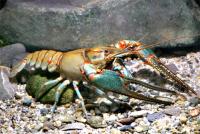
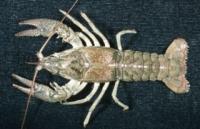
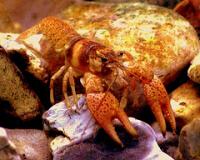
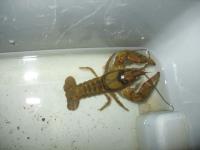
Bill- The longpincered crayfish is probably the most abundant species in Table Rock and most of the other White River reservoirs. It's also the largest crayfish you'll encounter, sometimes as much as ten inches long. I've attached a picture. They typically hang out around rocky ledges and large boulders, though they can also be found in bays and inlets. The northern crayfish is another common species-their body is typically gray mottled with dark gray or brown markings, with pincers sometimes appearing blue or green with orange tips. They're more common in calm inlets and backwaters, standing timber, and soft bottoms of organic material and mud. They're typically 3-5 inches in length, though they can get 7-8 inches long. Those are the two most common, although you'll also find the Ozark crayfish on occasion. It's typically a tan or orangish colored crayfish with numerous black bands and speckles on the body, and typically tops out about three inches in length. It's most often found in cobble and small chunk-rock areas, as well as gravel banks and points. You may also occasionally find the ringed crayfish, which gets about the same size and is typically tan or olive mottled with black. Ozark Crayfish Ringed Crayfish Those four species are probably 99% of what you'll find in Table Rock- imitate them and you should be pretty well covered. Good luck!
-
If that's the case, it should be an easy case for the feds to prove in court. I'm not saying illegal activities didn't go on at Zoe, I'm not saying the owner wasn't privy to those activities. I'm saying everyone ought to have the right to respond to those charges in court. There are more democratic ways of going about this guy's prosecution than arbitrarily seizing his assets.
-
The landowner claims he didn't know what was going on. IMO, unless the government can prove otherwise, there's no reason for them to be seizing his assets. I'm an absentee landowner, with property 70 miles from where I live. I get down there as often as I can, but I can't be patrolling it 24/7. I've found plenty of evidence of illicit activity- abandoned and stripped cars, illegal dumping, pot paraphernalia, etc- activities which I'm by no means complicit in. I'm sure similar things happen throughout the Ozarks- you simply can't be everywhere at once, and to think that your property can be seized for activities you neither condoned nor took part in, to me sets an awfully frightening precedent. That the government is basically the landowner's hands behind his back- he seems to have very little recourse, especially with frozen assets- is downright appalling.
-
That is pretty amazing, I just assumed he wanted more cowbell.

-
There was a report up by Moberly that a lion had been hit by a car. Turned out to be a golden retriever. It happens. If you were on foot or bike and saw a mountain lion, it probably wasn't a mountain lion.
-
It doesn't affect anyone aside from you and your brother. Do whatever you need to.
-
Nah, I grew up in south St. Louis county though.
-
Nice deer! I'm pretty familiar with that area and you're absolutely right- far too many deer. I hope your neighbors appreciate what you're doing on behalf of their hostas Congrats.
-
Hahahaha, yes.
-
I should've added that Black Oak Arkansas gets heavy airplay on my way to the river
-
It was my understanding The Wildife Codeis a permissive set of regulations, and if it doesn't expressly allow a specific action you shouldn't expect it to be legal. I could be completely wrong on that, though.
-
Just depends on the mood, really. Heading to the river, I usually do Buddy Guy, The Band, Canned Heat, Cake, The Decemberists, Flaming Lips, Zeppelin, Sabbath, Modest Mouse, Uncle Tupelo and a few other alt country type bands. Heading back from the river I'm usually more mellow and contemplative, and that's when I'll put on the Dylan, Neil, Doors, Pink Floyd, Clapton, etc. Lots of times there'll be some old Carlin material in that mix, too.
-
Wyoming has a setup similar to what you describe Al- landowners are paid for allowing public access to their property, but folks who want to use that property for hunting or fishing are still required to receive written permission from the landowner. To me that would solve both of the primary issues folks have been airing- landowners get something for putting up with inevitable bad behavior, and they also get to know who will be on their property. Landowners in the program also have some say in how their land is used- if you don't want to allow mule deer or pheasant hunting on your property, for example, you can restrict that. I don't see why you couldn't do a similar thing in MO- if a landowner wants C&R or mandatory kill on spotted bass in the streams where they allow the public.
-
Smallie, it's a shame your stream is being degraded by gravel mining, but you may not be getting any response from MDC because you're barking up the wrong tree. DNR is supposed to be the one taking care of water quality issues in the state. And your example illustrates the point perfectly- if Brazil Creek was in the public domain, private landowners wouldn't have the right to do in-stream gravel mining. No one's saying the public should be able to fish landlocked ponds, with fish stocked by the landowner. But you didn't stock the fish in the creeks, and you didn't grow the water that flows there. They're a public resource, and the public ought to be able to access them. If you want to argue the public shouldn't access those streams because there's bad apples out there who will ruin the stream, fine. I've seen plenty of LANDOWNERS use their streams as dumping grounds. I've seen numerous landowners tearing up stream bottoms with ATVs, with tractors, with backhoes. I've watched landowners cut down every single piece of vegetation from the streambanks, because it gives them a more picturesque view of the stream. I've watched landowners mine gravel out of "their" streams. I've watched landowners straighten streams, I've watched landowners throw levies up alongside streambanks, excacerbating flooding elsewhere. I've watched landowners run their livestock through streams, and I've watched banks collapse as a result. Mineral Fork is one of those quasi-navigable streams, and the vast majority of the stream is in private ownership. And it's one of the trashiest, most denuded smallmouth streams I've fished in the Ozarks. Compare that to places like the upper Current, which is primarily public ownership. You'll see garbage- soda and beer cans, fishing line, etc. But you see far fewer tires, refrigerators, car bodies, cattle in the stream, ATVs in the stream, and gravel mining operations. There's bad actors in every crowd- just because you own the land next to a stream doesn't mean you're any more responsible a steward of that stream than the guy who wants to spend a day fishing there. The argument ignores the fact that there are benefits to public access- the more people who are able to use a resource, the more people who are invested and concerned about it. You get Stream Teams, you get advocacy. When you have to start going up against folks like Tyson and gravel miners and the Farm Bureau- folks who do far more damage to our states' streams than a few beercans and worm boxes, it's nice to have those advocates.
-
To my knowledge, Korkers is the only company which makes wading boots with interchangeable soles. I'd have a bigger problem with the government advocating a specific brand of boots than the government banning boots of a particular style. The issue is there's a high likelihood felt soles spread aquatic invasives, and continuing to use felt soles doesn't address that issue. Interchangeable felt soles only help if people actually use them, and there's no mechanism to determine whether folks have a handful of soles they use interchangeably, or if they just continue to use one felt sole everywhere they go. Unless you can figure that one out, it's not actually doing anything.
-
You forgot to mention it's completely impractical, too.
-
You mean aside from the NRCS, Department of Agriculture, state/university extension offices, CRP/WRP, using public funds and resources to stock private impoundments, and the fact that MDC has an entire division devoted to helping private landowners using public funds, right?
-
So what will we do until someone comes up with an innovative way to rid the felt of algae? You can choose to wear felt soles. You can chose to pee on the toilet seat as opposed to lifting it up. You can choose not to wash your hands after wiping your butt. I won't be applauding any of those decisions.
-
Drought And Forest Fires.
Outside Bend replied to jdmidwest's topic in New News and General Discussion
http://mdc.mo.gov/conmag/2004/03/too-much-sugar http://mdc.mo.gov/conmag/2003/09/wild-turkeys-and-creeks -
Creating a stream access law doesn't prevent landowners from accessing the streams running through their property. You're not taking anything from anyone. I guess it's a difference in philosophy. Historically, many streams were in the public domain- they were routes of trade, travel, commerce. To me, a landowner deciding who gets to travel in a stream corridor is like an adjacent landowner determining who gets to travel your local county road or highway. That's just the way I feel about it, though.
-
Gorgeous fish, nice job!


