

Outside Bend
-
Posts
1,161 -
Joined
-
Last visited
Content Type
Profiles
Forums
Blogs
Events
Articles
Video Feed
Gallery
Everything posted by Outside Bend
-
I'm not ignoring didymo can be spread by other means Troutfiend- I've said again and again and again and again that boats and other contaminated fishing gear can spread didymo. That it can be spread via those other means doesn't mean felt soles don't spread it too. And since their are effective ways of cleaning boats and other fishing gear, and the same can't be said of felt. You want evidence it's spread to other streams where boating doesn't occur then fine, Dry Run Creek. They say ignorance is bliss. If you want to ignore the issues associated with felt that's fine, just realize their are consequences for the decisions you make.
-
Drought And Forest Fires.
Outside Bend replied to jdmidwest's topic in New News and General Discussion
From a wildlife perspective, they don't provide as much food as other hardwoods. From an economic perspective, they don't fetch as high a timber value as other hardwoods. You can't make staves from them, so what's the point? Historically, maples weren't a dominant tree species in most of the state's forests. The state's forests were adapted to periodic burnings, and maples aren't particularly fire hardy. They did exist, even dominated, in a few areas- sheltered slopes and bottoms where fire didn't penetrate. Fire set the clock back on succession. It kept maples from becoming abundant. It restricted cedars to bluffs and other rocky areas. Fire removed leaf litter, exposing bare mineral soil for trees like pine to take root. Fire opened the canopy, allowing shade intolerant species like oak, hickory, walnut, and others to thrive. Without fire to manage the forests the succession clock keeps going, and shade-intolerant species can't establish new seedlings. It's happening in many parts of the Ozarks and particularly along the hills of the Missouri River. Removing fire from the equation is an unnatural situation too, just as unnatural as the current abundance of maple and cedar in the state. -
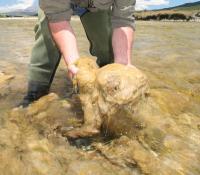
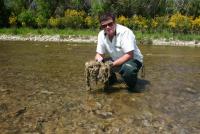
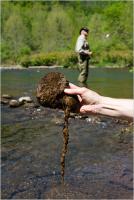
I don't want to fish in that. Nor does it look like a particularly healthy stream to me. Didymo covers the stream bottom. Bugs live on the stream bottom. Fish spawn on the stream bottom. Fish eat bugs. Fish spawn to reproduce.
-
Drought And Forest Fires.
Outside Bend replied to jdmidwest's topic in New News and General Discussion
They don't provide much food for deer, turkey, squirrels and the like, compared to oak, hickory, pine, etc. Nor are they of much timber value compared to other hardwoods. I'm not sure how likely a major forest fire is in the state, but there's a lot of wind and ice-caused deadfall in some parts of the Ozarks, and I'd be concerned about it going up. Concerned enough to postpone deer season, especially when folks are inevitably be burning leaves and garbage and the like? I'm not sure. -
As an angler I've reaped the benefit of stream access laws like Montana's, and as a landowner I've had to deal with trespassing, poaching, illegal dumping, ATV's, and abuse of stream corridors. I'd like to see Missouri adopt more liberal public access laws because I feel like the public has a right to use our streams, but there is an associated cost to landowners. Many western states have easements and other agreements with landowners, where they are paid to provide public access to hunt and fish on their property. I'd be very interest to see Missouri adopt a program like that.
-
That's qualitative information, and everyone has different experiences. I've fished many Ozark smallmouth and trout streams with rubber soles and had no problems. I've fished many Arkansas tailwaters with rubber soles and had no problems. I've fished many western freestone and tailwater streams with rubber soles and had no problems. The only time I've had a dangerous dunk was on the NFoW- in felts. But I'm not about to advocate we ban felt just based on my personal experience, or the experience of others. Here we have to disagree. I put the health of our fisheries ahead of the minor inconvenience of avoiding a slick spot. Use cleats, use a wading staff, wade carefully. I've caught enough fish in rubber soled boots to know they're not an insurmountable handicap. Read the above posts. The reason the studies focus on felt soles is because the question is whether felt soles can transport didymo, not whether boats can transport didymo, or what variables allow didymo to spread. Read above posts. Didymo attaches to stream sediments. The bottoms of your boots ought to be spending more time in contact with stream sediments than your boat, canoe, kayak, float tube, etc. There's a greater likelihood your felt soles are going to pick up didymo more readily than those other avenues. The reason for the felt ban proposal is because there's no good way of ridding felt soles of didymo cells. That's no the case with rubber soles, waders, wading boot uppers, bootlaces, boat hulls, float tubes, kayaks, and the rest. You're still ignoring the fact that a spring creek isn't a tailwater, and vice versa. Not a lick. The science has shown didymo can be carried by felt soles. That it's not present in Bennett or Meramec doesn't mean didymo can't be carried around by felt soles. That it's not present in Bennett or Meramec doesn't mean it hasn't been introduced there. It may just mean Bennett and Meramec aren't hospitable to didymo. Again, you're trying to say that a diatom should have the same habitat requirements as a trout. It's apples and oranges. Oh, okay. I just talked with Arkansas Game and Fish, who have found didymo in Dry Run Creek, the small C&R stream below Norfork Dam. It's heavily used by anglers, and it's too small for float craft of any kind. That really only leaves one option- I guess you'll need a new pair of boots. Aside from the anglers who aren't fishing only in Missouri, right Phil?
-
Troutfiend, I like you, and I don't mind debating this, but you're ignoring the fundamental reality that a tailwater is not a spring creek, and vice versa. You can't compare species between the two, because you're not taking into account the vastly different habitat characteristics. It's like saying a bluegill ought to do as well in a farm pond as the Gulf of Mexico because hey, they're both wet. By your logic, you could argue Crane is a poor trout stream- it has lower numbers of trout, fewer large trout, and fewer trout species. You're not looking at all the variables. It's unreasonable to assume a species which thrives in a tailwater would thrive in a spring creek, but it is reasonable to assume a species which thrives in one tailwater would thrive in a tailwater with similar characteristics. If you want to stand on the proximity argument, fine. Bull Shoals is closer to Norfork than to Crane, and by you're logic it's even more likely an angler would move from BS to Norfork than from BS to Crane. And Norfork has didymo. You hold up the absence of didymo from smaller streams as evidence it's not being spread by anglers, yet say nothing about the spread of didymo throughout many mid-south tailwater fisheries. If you can explain how the spread of didymo throughout those systems indicates it's not being spread by anglers, I'd like to hear it. And again, no one's saying boats, canoes, kayaks, and other angling gear can't spread didymo. What folks are saying, again, is that there's no reasonable, effective way to clean felt soles and prevent them from carrying live didymo cells from one stream to another. We know that didymo can be carried by felt soles, we know that felt soles can transfer sediment from one stream to another, we know that it takes a very small number of live didymo cells to start new colonies. We know there's some pretty significant correlation between angling activity and the presence and spread of didymo. You're right, there's still research that can be done. But instead of erring on the side of caution in regards to our aquatic research, you seem content to continue spreading didymo and other invasive species until all the research you believe is relevant is completed. To me that's an incredibly ignorant position. I don't buy the expense of rubber soles argument, either. You can find decent rubber soles for 50 bucks or less, and to me it's like saying you'll chance getting the ol' lady knocked up because you're too cheap to spend $10 on a pack of Trojans. The preventative measure is far cheaper than the possible outcome.
-
Out of curiousity Troutfiend, why'd you pick Crane? A big regulated tailwater is a vastly different beast than a small spring-fed stream, and surely with this argument you understand there's a pretty big logical leap- the assumption that a species should behave similarly in very different habitats. That didymo isn't present in Crane doesn't mean didymo isn't spread by felt soles, nor does it mean didymo has never been introduced to Crane. It may just mean the habitat in Crane isn't conducive for didymo to form large colonies as it does on nearby tailwaters. You'd be much better served comparing between systems with similar characteristics, like Bull Shoals and Norfork. They're even closer to each other than Bull Shoals is to Crane. Then again, didymo has been reported in Norfork. You could compare Bull Shoals and Beaver. Then again, didymo has been found in Beaver. You could compare Bull Shoals and Taneycomo. Then again, didymo has been reported in Taneycomo. You could compare Bull Shoals and the Little Red. Then again, didymo has been found in the Little Red. You could compare Bull Shoals and Mountain Fork tailwater in Oklahoma. Although didymo has been reported from Mountain Fork, too. That didymo has cropped up in all these very popular trout tailwaters just doesn't seem all that coincidental to me.
-
Why the White R. tailwater has didymo and Crane doesn't is irrelevant to whether felt soles spread didymo. What effect flooding has on didymo is irrelevant to whether felt soles spread didymo. Didymo's preferred pH level is irrelevant to whether felt soles spread the organism. Whether didymo prefers large rivers versus spring creeks is irrelevant to whether felt soles spread didymo. How many didymo cells are required to infect a new stream is irrelevant to whether felt soles spread didymo. And yes, it's one. They reproduce vegetatively. They are interesting questions Troutfiend, but they have no bearing on whether felt soles can move didymo cells from one stream to another. I'm all for it Troutfiend, I just don't think the vast majority of anglers with felt soles are going to spend hours detailing their boots after each fishing trip to make sure they're clean. There's no effective way to clean felt soles, that's the point. Whirling disease was also spread via contaminated fishing gear. It's the law of unintended consequences- people don't mean to spread these things through fishing gear, but they do, and the implications can be far-reaching on ecosystems, on local economies, and on policy. Their are consequences for our actions, and we are responsible for the decisions we make. You can either face that or bury your head in the sand. I don't know whether Crane has didymo or not, or whether the organism would behave differently in a small spring creek versus a large, regulated tailwater. I do know that the proximity of those two systems means it's likely infected gear is being used in Crane, and that the folks who are using that infected gear are gambling with the health of our fisheries because they don't feel like wiping their feet. To me that seems pretty inconsiderate, the height of selfishness. Sometimes a cigar is just a cigar. Preliminary research on didymo, implicating felt soles and other fishing gear as vectors for transportation, would have already been a few years old by the time Simms announced they were producing feltless wading boots in 2008, and NZ had already implemented a felt ban. Isn't it possible these guys just saw the writing on the wall?
-
Excellent stuff Geoff, and a great way to enjoy the fall.
-
JD- I'm not sure your proposal would really help. For one, it wouldn't prevent an out-of-stater from fishing infected waters, then legally coming to MO streams and fishing uninfected waterways using infected gear. And if you think banning felt is a serious government intrusion, wait until DNR has to catalog, inventory, and monitor every river, lake, stream, ditch, wetland, reservoir, and private impoundment in the state to ascertain the distribution of didymo. The associated regs book would be enormous and ever-changing, as new instances of didymo were found. An outright ban on felt is easier and more effective. I'm not sure it's verified, but there was an earlier post where someone said didymo had been present in Taney. From what I've read the stuff requires pretty stable environmental conditions to take off, which is why it's commonly found below regulated tailwaters and in spring creeks. My guess is the sometimes drastic changes in flow, water quality, and water temperature below Table Rock make it hard for didymo to colonize. ness- Folks in YNP are talking about supplemental stocking of cutthroat to augment natural populations, partly because whirling disease has wiped out many of their spawning streams. Hatcheries throughout the country have had to be fitted with disinfectant technology, costing taxpayers and sportsmen millions. Some western rivers saw a 90% decline in fish populations, and some still haven't completely recovered. I don't think the affected guides, tackle shops, lodge, resort, and motel owners, RV rental companies, campgrounds, restaurants, and other tourism-dependent businesses would like to relive those days again. Sometimes we do blow things out of proportion. Other times we too quickly forget lessons of the past. TF- The only reason I advocate banning felt is that folks like you deny it has any issues, even when the science indicates otherwise. Most folks I've met don't want to be told they can only use rubber soles. They also don't want to spend the time religiously cleaning their felt soles so as to prevent the spread of invasives. Most folks I've met clean their felts as often and as thoroughly as a truck stop toilet seat. I'm just saying you can't have it both ways. Other groups (extraction industries, ag companies, etc) must bend over backwards as environmental stewards, but when the ball's in our court and we have to change our behaviors to benefit the ecosystem we're exempt? That sounds like utter hypocrisy to me. It's ridiculous to expect a scientist to accidentally be present to document the very first instance of didymo being introduced to a new stream- the chances of it happening are astronomically small. And you'd be hard-pressed to find a scientist who wants his legacy to be "the guy who intentionally introduced didymo to stream XY." When you set the bar unreasonably high, there will be no evidence to convince you felt soles spread didymo. It's not academic skepticism, it's blatant denial. If anglers aren't spreading didymo, what's the alternative explanation? It's just coincidence that an organism undetectable to anglers rapidly colonizes world famous fisheries at a time when felt soles and international fishing travel are rising in popularity? It's just coincidences that these organisms appear at fishing access sites, or in streams where fishing is allowed, but are absent from nearby streams where fishing is banned? That's too coincidental to be coincidence, unless you have a plausible alternative explanation. There's substantial evidence felt soles can harbor didymo, substantial evidence that felt soles can transport didymo, substantial evidence that felt soles can introduce didymo to new streams, and substantial evidence that felt soles are difficult to effectively clean and disinfect, especially compared to other gear. So why not eliminate felt? Instead of waiting with are thumbs up our bums waiting for some burning bush to tell us what should be intuitively obvious, we could go with what we know, and do something proactive to slow the spread of an ecologically damaging organism. If the research concludes that felt soles have no impact on the spread of didymo, the ban can always be repealed, and folks can go back to wearing them. Until we know conclusively, what's the harm in being a little cautious?
-
Here, let me help you... After 36 hours (not five), and two thorough cleanings, there were still live didymo cells present in felt soles, while none were present on rubber soles. To me, that's pretty substantial evidence that felt soles are tougher to keep clean than rubber. You may disagree if you like, but I tend to concur with the study, 290 is significantly more than zero. I'm sure Simms and Orvis are deep in the pockets of New Zealand's National Institute of Water and Atmospheric Research. It would be ridiculous to blindly accept that New Zealand's South Island has been severely affected by introductions of didymo, and that perhaps managers and researchers want to simply gain a better understanding of the organism, its mode of transport, its means of introduction, and how to manage it. And who says this is a boon to the wading boot industry? Redesigning boots, developing rubber compounds, retooling factories, replacing cheap materials like felt with expensive materials like rubber- those are all costs, and these businesses were not required to do it. They are looking out for their self-interest- their businesses rely on healthy fisheries, and healthy fisheries are jeopardized by aquatic invasives like didymo. Farmers don't make money when there's no crops to be had, turkey call manufacturers make no money when there's no turkeys to be shot, fishing boot manufacturers don't make money when there's nowhere to fish without encountering giant mats of algae. It makes business sense to look out for your long-term interests. You seriously can't figure out why a scientist wouldn't want to put didymo-laced boots into an uncontaminated waterway? One. Because if there are live organisms on the felt, and the felt is being moved from stream to stream, it stands to reason the organisms are being moved from stream to stream, too. Felt can transport didymo, we don't want to transport didymo, that's why they're advocating we ban felt. I don't see the variables of moon phase and coarse woody debris by size class, because they're not relevant to whether felt soles transport didymo. If you're only spending 20 minutes fishing in your felt-soled boots, you may have a point. But an 8, 10, 12, hour day soaking in the river is going to allow didymo infested water to penetrate much deeper into a felt sole than a 20 minute soak in disinfectant. The outer layers may be clean, but the inside's still dirty, and the next long soak on a fishing trip will bring contaminated material into contact with the stream. Luckily your shoe laces, wading boot uppers, and waders themselves aren't made of felt, nor should they be spending the bulk of their day in contact with stream sediment. Those materials have less surface area, less interstitial space, and are much easier to keep clean and disinfected than the felt soles.
-
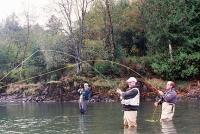
Question: Aside from the presence of noxious didymo blooms, what do New Zealand, Chile, the Bow River of Alberta, South Dakota's Rapid Creek, Tennessee's South Holston and Cumberland tailwaters, Virginia's Pound River, the Connecticut River of the northeast US, and several Catskill mountain streams all have in common? Hint: Chile. New Zealand. Bow River, AB. Vancouver Island, BC. Rapid Creek, SD. Cumberland River. Jackson River, VA. Connecticut River. Battenkill River. Catskill. Notice a pattern? I'm not sure what the big mystery is- people are pretty good at moving critters around, knowingly or unknowingly. Eurasian milfoil, zebra mussels, rusty crayfish, goldfish, rudd, emerald shiners, brook trout, pike, walleye, spiny waterfleas, yellow perch, New Zealand mudsnails, common carp, tiger salamanders, bullfrogs, green frogs, and many other species have been introduced by anglers at one point or another, intentionally or accidentally. That folks could be inadvertently transporting snails, didymo, whirling disease, and other small organisms via felt soles shouldn't be that revelatory. The spread of didymo is well correlated with the advent of felt soles, as well as anglers taking more destination trips to places around the world. Anglers transport a significant amount of sediment between streams via felt soled boots. There's a significant correlation between streams with didymo and streams with high angling pressure. There are documented cases where didymo occurs downstream of a public fishing access, but not upstream. There are documented cases of didymo being absent on streams where angling is banned, while infesting nearby streams where angling is allowed. Anglers move sediment between streams via felt soled wading boots. Other aquatic invasives like whirling disease and New Zealand mudsnails have been documented in felt soled wading boots. Studies have shown felt soles trap far more whirling disease spores than rubber soles. Studies have shown felt soles trap far more live didymo cells than rubber soles, even after repeated thorough cleanings. You can find a lot of the information on google, and links to many of the studies at www.stopans.org. When it's mineral extractors, or loggers, or Big Oil, or the Government, or Purdue, or Tyson, or otters, or giggers, or aquaculturists, or farmers, or ranchers, or CAFO's, or sewage treatment plants, or Monsanto, or any other agent causing environmental harm, sportsmen jump all over it. But when the evidence indicates that perhaps our activities too have environmental consequences, we seem to want to ignore or deny it. In this instance it doesn't seem to me that policymakers are pulling facts out of the air, rather they're using the scientific research which has been done to come to a rational conclusion. Felt soles are a major pathway for invasive species like didymo and whirling disease, and reducing the prevalence of felt soles reduces the likelihood of those organisms spreading. That can be accomplished either voluntarily or through bans, I don't particularly care. Perhaps it's not a matter of a lack of research, but that the research doesn't agree with the dogma of some angling demographics...


-
I'm with Chief on this one- people, anglers included, need to realize the choices they make can have a profound and sometimes detrimental impact on the resources they love. Not to get to Python, but if birds were spreading these invasives to any appreciable extent, you'd expect to see them colonizing areas along major flight corridors. Instead, most of these invasives show up in high angler traffic waters. Bird feathers are designed to shed water, angler's boots are designed to absorb water. I've watched more waterfowl cleanse themselves after a day in the water than anglers. And regardless of whether birds are spreading it, that doesn't mean people aren't spreading it, too. You guys seem to be attacking an argument no one is making- that if you switch to Vibram soles it will stop the spread of invasives. People want you cleaning everything- wading boots, shoelaces, waders, all of it. The felt ban is actually pretty logical- felt soles contain an enormous surface area (that's what makes them work), and they spend most of the day in contact with the stream bottom, where aquatic nasties like didymo grow. The pressure their under can force organisms deep inside the felt, where it's difficult to treat with disinfectants. You remove felt soles, you remove a lot of the nooks and crannies aquatic invasives can hide on an angler's person. I'm not in love with the new Vibram soles, they don't work nearly as well as felt in some situtations. I'm not a big proponent of the ban either- I'd much rather seen anglers take responsibility for their actions. But I've also noticed many anglers are either oblivious or in denial that their activities can have an impact on the resource, so I'm not holding my breath. And while new boots or a bottle of bleach may be an impediment, the environmental damage, the cost of removing these organisms (if even possible), and the loss in recreation and tourism dollars I think would be far worse. If banning felt is what it takes to keep these things out of our streams, I'm open to discussing it. If anglers aren't going to police themselves, I think we ought to do something.
-
You'll be able to find them at any MDC regional office. Or if you'd like, you can call the office and they'll often mail them to your address.
-
A mojo for fish...whod've thunk it?! The "Fish Tickle" was my favorite part, though. There has to be a much better Urban Dictionary entry for that. Sounds like something I'd rather be doing with a lady than with a bunch of guys in an ice shack at -20*F. Jus' sayin....
-
Building A 12' Cedar Strip
Outside Bend replied to woodman's topic in Lodging, Camping, Kayaking and Caoneing
I love looking at projects like this Woodman, thanks for sharing. Do you have to use clear cedar for the strips? Seems like that'd be the toughest part. Thanks again for sharing, I look forward to seeing how it turns out! -
I wonder if throwing rocks into the river to move suckers around would be considered harassment of wildlife. Tossing rocks in the creek to move the suckers closer to your loungechair seems sorta contrary to the fair chase principle, to me at least. Heaven forbid you have to get up and do a little walking...
-
Because of the time and expense involved. The premise that you don't have to sample every organism in a populations isn't foreign to these folks. Yes, they could send a survey to every angler in the state- then someone would have to be paid to enter survey cards from every angler in the state, many of whom view the state's smallmouth management in similar ways. To me it doesn't matter that every angler gets a survey card, but that those anglers who do get a card are representative of the states' anglers as a whole. I guess I don't see why the state agency charged with managing smallmouth sending out a survey about the state's smallmouth management should be met with cynicism. I see it as a good sign, that they're looking for suggestions, that they're reaching out to their constituencies. Not receiving a survey doesn't mean you can't get involved- you can still contact MDC and share your opinions.
-
Good stuff there FlyFlinger, and nice work on the hackle. I wouldn't call it an addiction, but it is nice to be able to conjur up any bug at any time. Keep on it, it gets easier.
-
There's really no black helicopters or cloak-and-dagger involved with this stuff guys- it's a random statistical sample, not everyone gets a survey. There's no compelling reason for them to stack the deck; think about it and you'll realize it wouldn't be in their interest to alienate the angling public. You don't bite the hand that feeds you. The survey is just that: a survey, to characterize the state's angler demographics and attitudes regarding stream smallmouth/rock bass fishing. If you think MDC could do a better job, let them know. If you'd like to see an area managed a different way, let them know. Leave it to some of y'all to MDC makes a management decision you don't like, then whine some more when MDC asks for your input regarding management decisions
-
It is. That's what has the Pilsbury Boy all excited.
-
If you're comfortable fishing them, I'd throw in some itty-bitty stuff as well- Griffith's Gnats, as well as some emerger patterns like the RS2 and WD-40 in gray, cream, and olive. Midge hatches are pretty prolific down there, and many of the fish seem to really target the small stuff.
-
The Flystart are great reels period, and an excellent way to start of a young angler. They're really all you need for Missouri trout fishing. That said, I'd try and get in touch with a flyshop or a Ross dealer. I believe Ross has been or will soon be taken over by 3M/Scientific Anglers, which could potentially impact warranties and repair service in the future, if you bought the reel now.
-
White Ribbon Conservation Issue
Outside Bend replied to troutfiend1985's topic in Conservation Issues
Sorry Al, my initial post wasn't too specific- I was looking at the same phenomena from the other end. The fish appeared in the Osage through stocking, and seem to have colonized downstream tributaries of the Missouri in subsequent years. Maybe one. Maybe the other. Maybe both. I'll let the academics figure it out. It's something to wonder about, but to me its irrelevant to the management of the fisheries in question. What's important is managing to limit the impact of spots outside their historic distribution.


