

Outside Bend
-
Posts
1,161 -
Joined
-
Last visited
Content Type
Profiles
Forums
Blogs
Events
Articles
Video Feed
Gallery
Everything posted by Outside Bend
-
White Ribbon Conservation Issue
Outside Bend replied to troutfiend1985's topic in Conservation Issues
While we're completely off topic, I'll go ahead and say I don't see how the "spots are naturally moving up the Mississippi," theory can hold much water If so, you'd expect spots to colonize the Meramec before the Osage. But they were found below Bagnell 15 years before they were found in the Meramec. If they can work their way up the Mississippi and Missouri and colonize their tributary streams, I see no reason why they couldn't continue working up the Mississippi and colonize tribs like the Cuivre. It's pretty good black bass habitat, and there's no river control structures blocking fish passage. Yet MDC hasn't collected spots in that system. If they can use the Mississippi to colonize Missouri streams, I don't see why they wouldn't use the Mississippi to colonize Illinois streams. Yet they don't appear to be doing so. That seems pretty unnatural to me. -
Yes, bighead carp are present in the lower Meramec.
-
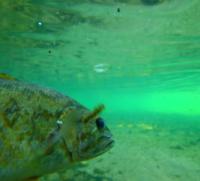
It's a warmouth, and a nice one!
-
White Ribbon Conservation Issue
Outside Bend replied to troutfiend1985's topic in Conservation Issues
Haha alright, although I'm not sure why. I despise brussel sprouts, so I avoid them like the plague. I've never gotten into midget wrestling, so I'm not heartbroken if I don't see it on TV. I'd rather have a Boulevard than a Budweiser. I've fished several White Ribbon streams, but I like the Blue Ribbon waters more. They're just my preferences, and I'm not saying they're better than anyone else's. If you'd like to pop brussel sprouts as you watch midget wrestling on your iPhone while cracking a Budweiser on a White Ribbon trout stream, by all means go for it. I'll have a beer with you. We all ought to do whatever it is we love, and bickering about it doesn't interest me. Not everything's an argument Drew. Many things affect fish growth, one of them is habitat. Big streams have more habitat than small streams- big streams aren't as prey limited, they're more productive, they offer more volume to occupy, more places to spawn, more places to hide. Yes you can catch big trout in Mill Creek, but there will be more large fish in Little Piney, and even more large fish in NFoW. Part of that equation is habitat. Troutfiend- I don't think the C&R idea is a bad one, especially a C&R section which only exists from something like Nov 1- March 1, leaving plenty of time for the trout to get fished out before water temperatures get too warm. If you can get some of the local folks signed on though, I really think that's the way to go. -
White Ribbon Conservation Issue
Outside Bend replied to troutfiend1985's topic in Conservation Issues
My enjoyment of trout fishing doesn't hinge on the raw numbers of trout in the stream, but the challenge those fish are. I've found fish which have spent a season or two in stream are more challenging for me than the ones which were dumped 20 minutes ago, and that the Blue Ribbon reaches tend to have more of those resident fish than the White Ribbon reaches. So I focus more of my energies on the Blue Ribbon areas. Not saying the White ribbon shouldn't appeal to some folks. Not saying White ribbon streams don't have resident, or even wild fish. Just saying the White Ribbon regs don't generally appeal to my demographic. I guess I'm pretty ambivalent about the regs some folks are advocating- I don't fish White Ribbon areas very often now, but I'd probably spend more time there if there were more holdover fish. In the grand scheme of things I think a half mile of C&R water won't make much difference, especially in areas its unlikely to be enforced, and that we ought to think long and hard about the ramifications of shutting local anglers out of their local waters. NFoW is only stocked with browns, its rainbows are self-sustaining. I've caught wild rainbows up to 17" out of there, and many of the 10-14" fish still had parr-marks, even gravid fish. They do tend to fade as the fish get older, although they can still be visible. One of the reasons you see predominately 6" fish in most MO wild trout streams is likely habitat limitation, the other is the simple fact that in most populations juveniles are just more prevalent than adult fish. -
White Ribbon Conservation Issue
Outside Bend replied to troutfiend1985's topic in Conservation Issues
I've asked you many times to provide relevant evidence Chief, and yet you haven't. Call it what you'd like- if telling you to look up basic information on your own is a sign of a marked man, I'd hate to see what you say about the guy who makes unsubstantiated claims based on no evidence, who ignores requests to provide such evidence, who gives no indication such evidence exists, and who apparently can't indicate where one would go to find such evidence. The evidence you're asking about is in the biology and natural history of smallmouth bass- the nuts and bolts life history data which has been extensively researched and established for decades. I'm not going into it here because, although it's basic information which isn't disputed in the scientific community, you'll likely ignore it, or it'll lead to eight more pages of Chief's-right-the-scientists-are-wrong diatribe. I see both scenarios as fruitless. If you'd like though, you can spend some time on google looking it up, you can pick up the phone or email an MDC biologist. It's not that I'm hiding anything, Chief- the information is out there and it's easily accessible. Anyone can look it up and find out for themselves, they don't need me doing it for them. I'm just tired bored of playing this game. -
White Ribbon Conservation Issue
Outside Bend replied to troutfiend1985's topic in Conservation Issues
Meanwhile, the discussion wasn't about whether smallmouth miles exceed spot miles in the state, but whether non-native spots or non-native trout have had a greater impact on smallmouth's range... My quote above implied that, just as in people, smallmouth have a preferred temperature range. Temperature plays a major role in the physiological processes of coldwater organisms, such as smallmouth. When temperatures fall out of their optimum range, smallmouth exhibit poorer growth, lower fecundity, poorer recruitment, and behavioral changes. On the flip side, smallmouth perform best in water temperatures around and above 70*, which are the upper threshold for trout. If there's competition, it's at the margins, in habitat which would be marginal for smallmouth bass whether or not trout were there. I'm not going to waste my time doing your research Chief- you're fully capable of doing that. The correlation between temperature and growth in fishes has been well established, as has the concept of thermal optima. The biology and life history of smallmouth speaks for itself- they're not adapted to cold water. A species won't do well in a habitat for which it isn't well adapted. You're arguing against biology here, and you either have the information to back up that argument, or you don't. This isn't FOX news, repeating unsubstantiated claims doesn't make them true. Until you can demonstrate that smallmouth do well in poor smallmouth habitat, I don't see a reason to continue beating this dead horse. MDC's Watershed Inventory and Assessment. -
White Ribbon Conservation Issue
Outside Bend replied to troutfiend1985's topic in Conservation Issues
Gee Chief, I guess when you make claims that "There is not one waterway in the State of Missouri that has been taken over by spots," and “Spots have not taken over smallmouth habitat. They are co-existing,” it gives me the impression you don’t believe spots are having much impact on native smallmouth. My mistake. You don’t need Al’s estimates, just the ability to read a map coupled with some basic math skills. According to MDC, spotted bass went from being absent to the most prevalent black bass species on the lower 20 miles of the Big River, part of the Meramec watershed. Spotted bass went from being absent from the Bourbeuse River to being present all the way to Noser Mill. In the Moreau River, the proportion of sites where spots were collected went from 10% in 1960 to 64% in the 1990’s- and at the same time as spotted bass populations have been expanding, smallmouth bass populations have been declining. Hybridization between the two is prevalent in that system. Non-native spotted bass are the third most prevalent sportfish in the lower Osage River, more abundant than both largemouth and smallmouth. Contrast that with trout, which were once widely stocked throughout the Ozarks, but which only persisted in less than 1% of those streams. You have an introduced species which has displaced smallmouth from prime habitat and had a large impact on its distribution, versus an introduced species which may have possibly displaced smallmouth from some poor smallmouth habitat, although that can’t be substantiated. Those two situations aren’t analogous, period. And I never said there were, but the fact remains smallmouth don’t do well in coldwater habitats, simply because they fall outside the preferred temperature range. Just because you want to say “Trout are stocked in what was good smallmouth waters,” doesn’t make it so. There’s a lot of information out there to support the idea that those coldwater streams were never good smallmouth habitat, while I haven’t seen anyone provide verifiable evidence smallmouth do well in coldwater streams, or that there were more smallmouth in coldwater streams before trout came on the scene than there are now. Yes. This may be a revelatory concept, but a primary food source is going to be more important to a species than a secondary food source- otherwise they wouldn’t be a secondary food source. A species which gets 80% of its calories from caddisflies won’t have much direct impact on a species which gets 80% of its calories from crayfish, especially when those two species aren’t occupying the same habitat to any appreciable extent in the first place. These are the BS anecdotes I was talking about Chief. You’ve caught smallies and largemouth in the same areas. I’ve caught smallmouth and trout in the same areas. It doesn’t mean the habitat is conducive to their growth. It doesn’t mean the species don’t have different optimal habitats. It doesn’t mean the species tend to partition habitat in order to reduce competition. Finding largemouth in good smallmouth habitat doesn’t make it good largemouth habitat, just as finding smallmouth in good trout habitat doesn’t make it good smallmouth habitat. -
As has been alluded to, big fish like the water where you can't easily get to them- they didn't get big by being dumb. If that means deep water, they'll exploit it. If that means skinny water that folks overlook, they'll exploit it. If that means tough to reach, technical little eddies and swirls, they'll exploit it. If it means hanging out in the cushion just before a massive logjam, or under an impenetrable growth of overhanging vegetation, or a slot underneath a cutbank, or a crevice under a rock shelf, they'll exploit it.
-
That Hardee's in Cassville is no longer there, no? Last time I went it was a breakfast place that apparently loves to burn their eggs : )
-
Also, Let me know when you're planning on going, a couple weeks in advance. If you'd like, I have a couple books I can mail you which have some pretty detailed maps of nearby rivers.
-
White Ribbon Conservation Issue
Outside Bend replied to troutfiend1985's topic in Conservation Issues
I like ya, Chief, so I'm going to generally ignore the "crap" statement. But calling my position crap does nothing to support your own position. If you want to argue that smallmouth do well in poor smallmouth habitat, find the relevant data instead of relying on BS anecdotes and armchair guesswork. If you want to maintain that non-native spotted bass have no impact on the range of native smallmouth, provide the supporting data. By all means, make those ignorant MDC folks aware you have a better grasp of what's going on in streams you've never fished than folks who have been researching and working on those streams for the past several decades. I'm sure they'll default to your wisdom. If I'm blowing smoke up your #$@ it ought to be easy to disprove, so where's your corroborating evidence? All I'm askin' is for you to provide evidence to support this claim. The evidence to the contrary is substantial- namely that smallmouth don't like coldwater, so a coldwater habitat wouldn't be good smallmouth habitat. Just as I don't want to take a bath in 45 degree water, smallmouth would rather not hang out in a spring branch. All I'm askin' is for you to provide evidence to support this claim. They coexist in south-flowing streams, absolutely. But in a stream that went from a majority of smallmouth to a majority of spotted bass, it's hard to make that argument. The observations made by Al, Eric, myself and others are corroborated by MDC data. All I'm askin' is for you to provide evidence to support this claim. Yes, trout eat crayfish, minnows, etc, when they're available- any self respecting organism would go for the steak over the salad. But the primary food of trout are small invertebrates, while the primary food of smallmouth is crayfish and minnows. You have a valid argument that an adult trout would be competing with juvenile smallmouth, but smallmouth populations in coldwater streams are so negligible, and the prey base so large, my guess would be there's very little competition between the two. And your argument ignores the fact that, even in the best coldwater habitat, Missouri trout still don't do all that hot. We're talking somewhere around 500 fish per mile, which is pretty low compared to most waters, even in trout's native range. You're right- so do rock bass, longears, bluegill, channel catfish, flathead catfish, white bass, great blue herons, night herons, mink, otters, turtles, and myriad other species. That's why the species partition among different habitats, in order to reduce competition. Largemouth stick to backwaters, smallmouth stick to flowing waters- there's some overlap of course, but that situation reduces competion. Trout are also habitat limited- they can't persist in water much warmer than 70 degrees, whereas smallmouth thrive in those temperatures. So the overlap between habitats isn't that large, ergo competition isn't that great. Trout are biologically confined to a part of a stream- the coldwater part. In winter, when water temperatures are low and the coldwater portion of streams is thereby larger, they can and do a lot of roaming. Conversely, smallmouth do a lot of roaming when water temperatures are high and during drought years. It's about exploiting the habitat that's available to you. -
White Ribbon Conservation Issue
Outside Bend replied to troutfiend1985's topic in Conservation Issues
Drew, you're making my point for me again. I understood your stipulation as MDC shouldn't be spending a disproportionate amount of money studying trout at the expense of smallmouth and other native fishes. I get that, and I agree with that. Fisheries surveys don't take too long to do, a population estimate for a trout stream taking 3-4 days at the most. Data entry takes maybe a day. So it may take a week for a biologist to go from sampling a trout stream to completing the population survey. Most regions would have their trout field monitoring completed in a month, leaving another 11 months of the year to allocate towards other projects. The Southwest region would have to spend a little more time, but still- the bulk of the calendar year would be spent working on other projects. And you're right, MDC doesn't produce smallmouth- because smallmouth don't need produced. They're self-sustaining in most streams, and there's relatively few streams which were once good smallmouth waters, where the fish died out, and which again have adequate habitat smallmouth populations. It's not the same situation as, say, paddlefish, in which 90+% of the spawning habitat is under impounded water. And if there were a situation where MDC needed to repopulate a smallmout stream, there are plenty of wild smallmouth populations in the Ozarks from which to re-stock. I've become pretty bored spoon-feeding data folks data on here- believe it or not, I have better things to do. You have Google Scholar available to you (www.scholar.google.com), but you can plug in names like CF Rabeni, RJ DiStefano, M Roell, J Koppelman, A Allert, C Riggert, V Travnichek, and find a pile of peer-reviewed literature funded by MDC which these folks put out. Better yet, you can pick up the phone and call these guys, and ask them what they do for a living. Tour Blind Pony or Lost Valley hatcheries, or even Neosho, and see the changes that have been made to produce native species like paddlefish and sturgeon. Even Shepherd of the Hills is now in the game of artificially propagating trout AS WELL as Eastern and Ozark hellbenders, and native freshwater mussels. The point is, you want to say trout take money from native fish programs, but there's no evidence for that. You want to say trout take the spotlight off smallmouth, and I'd be willing to concede that to a point. But there are A TON of programs MDC's involved in which benefit not only smallmouth, but other native species. Boat ramps. Habitat restoration. Research. Water quality monitoring. Just because you don't agree with SMA's doesn't mean the state isn't doing something to protect smallmouth. Just because you don't agree with liberalized spot creels doesn't mean the state isn't doing something to protect smallmouth. You even mentioned the Niangua darter as a reason MDC didn't install an SMA on the Niangua and Little Niangua- to me that's valid, it's a hard sell managing a predatory sport fishery on top of a federally threatened species. I guess to me, the idea that MDC is focusing on trout at the expense of other, native species is just a farce. Trout are funded through trout sales, everything else gets funded through sales tax and other license sales. It's one of the best models in the nation, and MDC is able to balance the needs of sportfish and non-game species far better than most fish and game agencies in the US. And for all their faults, they produce a ton of high-caliber work. Chief- Perhaps the OA float trips ought to oscillate between eastern and western parts of the state. You could have an informal little black bass tourney on the last day a la the All-Star Games, and whoever wins gets home-field advantage for the next trip I'd love to make it this fall, but will be out of town. In all seriousness though- just as you can take OA members to unknown trout streams and gorgeous Neosho waters, there's folks on this forum who can take you places where you would've caught a fair number of quality smallies 20 years ago, but which now only large numbers of spots under twelve inches. It may not make sense to you, but go fish the streams and it'll be obvious. Folks like Al and Eric aren't overblowing that issue. Otters, and maybe even giggers, on the other hand... And no, it's still a bad analogy, even if you believe otherwise. Even in the worst-case scenario, trout have only evicted smallmouth from somewhere between 120-300 miles of stream, whereas spots have evicted smallies from a much larger area. And again, smallies and trout don't interbreed, or breed during the same time of year, or share the same prey base for most of their lives, or share the same habitat for most of their lives. -
White Ribbon Conservation Issue
Outside Bend replied to troutfiend1985's topic in Conservation Issues
Ah, you obviously haven't seen "Beerfest." Rent it this weekend- lots of quality, sophomoric humor -
White Ribbon Conservation Issue
Outside Bend replied to troutfiend1985's topic in Conservation Issues
As has been said repeatedly, those are the funding mechanisms for the trout program. MDC employs far more biologists spend far more hours managing smallmouth and other native fisheries than they do managing trout. MDC has as many warmwater hatcheries as trout hatcheries, the bulk of renovations have gone on at warmwater hatcheries, and the warmwater hatcheries produce vastly more fish. MDC biologists spend far more time managing other fisheries than managing trout fisheries. MDC builds boat ramps and fishing accesses on smallmouth streams. MDC has established Smallmouth Management Areas on many streams. MDC works with private owners to create stream revetments on smallmouth streams. MDC has liberalized limits to reduce the effect of non-native spotted bass on smallmouth. MDC developed the Stream Team program, which works to reduce litter as well as monitor water quality on many smallmouth streams. MDC works with the NRCS and other government programs to help landowners mitigate the effects of livestock on many smallmouth streams. MDC has funded numerous research efforts into smallmouth genetics, population characteristics, age and growth studies, habitat suitability and preference, the effect of landscape changes and resultant stream temperature changes on smallmouth bass populations, the distribution of smallmouth bass in thermally-influenced streams, the effects and rates of hybridization on smallmouth bass populations, prey availability in Ozark streams for smallmouth, the effects of SMA regulations on the smallmouth prey base and prey production, etc. So precisely how has MDC been focusing on trout at the expense of smallmouth? -
White Ribbon Conservation Issue
Outside Bend replied to troutfiend1985's topic in Conservation Issues
And there's not one waterway in the State of Missouri that's been taken over by trout. What's your point? The fact remains that smallies have been replaced in more stream miles by non-native spotted bass than by non-native trout. They may all compete equally, which is why they partition into different habitats- otherwise none of those species would be doing particularly well. How come spotted bass don't grow as big as smallmouth in their native range? It's biology- instead of spending energy on growth, they allocate it to egg production. They can produce twice as many eggs as smallmouth, and with more kids in the water, there's a better likelihood of survival. Where do you get the idea they're favoring trout over smallmouth? -
Make sure to invest in several spare tires before doing so. People are inevitably going to do stupid things that will piss you off. The important thing is to try and keep it from ruining your day.
-
White Ribbon Conservation Issue
Outside Bend replied to troutfiend1985's topic in Conservation Issues
C'mon Chief...how can you reasonably say that? How many miles of Missouri streams have gone from exclusively smallmouth to exclusively trout? How many times have you seen trout and smallies spawning in the same time, at the same place? If you quit stocking trout, most of the trout would go bye-bye. No one's stocking spots anymore. How many smallmouth bass X trout hybrids have you seen finning in Ozark streams? One the one hand, you have a species rapidly expanding its range and pushing out native smallmouth. On the other hand you have a species whose range is pretty static, and which, even if it did push out smallmouth, out-competed those native fish in a habitat which wasn't conducive for them in the first place. Those are vastly different scenarios. -
I've cut unmarked lines in the past, I've also set lines which were clearly marked with large day-glo orange buoys on both ends, only to find someone had methodically straightened or cut every hook at the bend the next morning. Respect goes both ways- legal trotlines ought to be left alone, even if it's an inconvenience- being frustrated isn't an excuse to steal or destroy someone else's gear or take someone else's fish. And trotliners ought to have the courtesy to clearly mark sets which may pose a hazard to boaters and anglers. There will always be some issues, but if more folks were cognizant of their actions those instances could be greatly reduced.
-
White Ribbon Conservation Issue
Outside Bend replied to troutfiend1985's topic in Conservation Issues
You're confusing "preferred habitat," with "native range." If west coast streams were rainbow trout's only preferred habitat, you wouldn't have healthy rainbow trout populations in Missouri, Arkansas, Oklahoma, Colorado, New Mexico, Arizona, Wyoming, Montana, Alberta, South Dakota, Minnesota, Michigan, Tennessee, Ohio, West Virginia, Virginia, Kentucky, North Carolina, Georgia, Pennsylvania, New York, New Jersey, Connecticut, Massachusetts, Maryland, Maine, Vermont, New Hampshire, Quebec, Great Britain, Spain, Italy, The Netherlands, Germany, Chile, Argentina, Australia, New Zealand, and all the rest. The west coast isn't rainbows preferred habitat, it's their native range. Rather, they're preferred habitat is water temperatures between 50-65 degrees or so. That's why you can find them in all those other places outside their native range. The preferred habitat of smallmouth has a higher temperature, and you naturally wouldn't see many smallmouth bass in poor smallmouth bass habitat- that's just intuitively obvious. You wouldn't see many spotted owls in the Ozarks, or bull sharks in the Mississippi- the habitat isn't adequate to support large populations of those animals. Again, your argument is "if trout are displacing smallmouth, we have a problem." But we don't know if trout are displacing smallmouth, and it's pretty likely smallmouth have low population densities in poor smallmouth habitat, the same as any species has low densities in unsuitable habitat. So how can you credibly say there's a problem, and where's the supporting evidence? -
White Ribbon Conservation Issue
Outside Bend replied to troutfiend1985's topic in Conservation Issues
Purely my opinion, but I think the more accurate scenario would be- you are a smallmouth bass in a pool of a coldwater Ozark stream, with thousands of minnows, crayfish, and other food items available. You're lucky in that you don't have to share this habitat with many other smallmouth, but unlucky in the fact that the reason is it's crappy smallmouth habitat. Life's tough here- you could be a dozen years old and ten inches long, while a fish that age elsewhere would be trophy size. But biology's biology, are an ecological barrier for your species- most of them don't do constant cold very well, and the ones that do exhibit drastically slower growth. So it's you, a small handful of other smallies, the occasional longear or rock bass, a few pickeral, and all that food. Along comes an MDC boat, and since they practice the flow-through stocking method as opposed to dumping 400 fish at a time, you now share your pool with a half dozen hatchery rainbows- stupid little buggers who have spent their entire short lives in the comfort of a concrete raceway. They're totally unprepared for what comes next. They've just spent a couple hours in the back of a truck, crowded, and were then dumped in a cage on a boat or canoe into water with an entirely different temperature and chemistry. Talk about stress. Now any smallie in the know would understand you don't hang out in the open, still water, right at the surface, and you don't hang out in the slow, weedy waters- those are the two places those hatchery dummies immediately head towards, until they get acclimated. They're the fish are exposed to all sorts of predators- kingfishers, herons, pickeral, turtles- even you can run in there and nail 'em- free, easy calories. At first you may be worried about whether you'll all have enough food to survive, but look around- they're used to eating an artificial diet, and they'll spend the first few days eating pellet shaped sticks and rocks, which luckily aren't a big part of your diet. It'll take a while for them to figure out what's good to eat, and in the meantime they'll willingly inhale any Powerbait, glo-ball, worm, canned corn, spinner with which they're presented. Many wind up going home with anglers in a short amount of time, leaving you back by yourself. The ones that survive will be eating a natural diet, but luckily they'll spend more time munching mayflies, caddis, midge larvae, stoneflies, and the occasional crayfish or sculpin, while your diet's chiefly the latter few organisms. A #4 crayfish pattern is effective for trout for the same reason a #4 crayfish pattern is effective for smallmouth- any organism will try to maximize the amount of calories it can consume with as little effort as possible. That a trout takes a crayfish pattern isn't proof the trout are preying on them as much as smallies, but instead that will go for the 72oz steak instead of the side salad when the opportunity arises. It may discombobulate you for a while having new neighbors, but in all likelihood most of them will be gone in a few weeks, and there will be plenty of food for you plus the holdovers. No biggie. -
White Ribbon Conservation Issue
Outside Bend replied to troutfiend1985's topic in Conservation Issues
My viewpoint is that MDC can manage a few coldwater stream segments for trout while still conserving smallmouth. My viewpoint is that MDC's trout budget is irrelevant- trout anglers pay for trout angling, and no money is taken from other programs to produce trout for the people who want to catch them. My viewpoint, still, is you can't arbitrarily determine smallies must have been present in coldwater streams before trout were stocked. We don't know what habitats those fish used with any certainty, but knowing the biology of smallmouth bass- it's a safe bet the habitat in those coldwater reaches would still suck for smallies, even if trout weren't present. Columbia's no longer stocked, and many of the urban fisheries are collaborative efforts funded in part through municipal governments, TU chapters, and the like. With that, coupled with reduced creel limits and stocking densities..I'm not sure how that contradicts what I wrote. While smallies can be found in water temperatures outside their preference range, the fish have a harder time maintaining in those temperatures, and are subject to greater stress, slower growth, and poorer fecundity and survival. That's why you can determine a fishes' age- winter water temperatures (below the fishes' thermal optimum), cause slower growth rates, while warm-season stream temperatures (within the fishes' thermal optimum), allows for faster growth. Unlike your assumptions these trends aren't armchair guesswork, they've been corroborated through scientific research. A coldwater stream reach is a different aquatic habitat than a coolwater stream reach, just as a tundra is a different terrestrial habitat. It seems intuitively obvious to me you'd find more smallmouth in their preferred habitat than in habitat outside their preference range, and the fact that you find far more smallmouth than trout in good smallmouth habitat, and far more trout than smallmouth in good trout habitat, seems to uphold the idea. In other words, the observed scenario reflects the expected scenario. A species invasion only only works if the non-native is pushing the native from its preferred habitat- obviously this isn't the case in this situation, because you still find overwhelming numbers of smallmouth, not trout, in the best smallmouth habitat. Isn't it possible competition BETWEEN smallmouth pushes some of the fish into from quality habitat to poor habitat, instead of trout pushing them from poor habitat elsewhere? -
White Ribbon Conservation Issue
Outside Bend replied to troutfiend1985's topic in Conservation Issues
No, because in either scenario smallmouth are displaced from large portions of their native habitat. Reducing spotted bass in places where they're non native doesn't require MDC investing huge sums into round-the-clock electrofishing crews or chemical piscicides- humans have proven pretty effective at hunting and fishing some species to, or close, to, extinction. -
PM sent.
-
White Ribbon Conservation Issue
Outside Bend replied to troutfiend1985's topic in Conservation Issues
That sounds like one hell of a gamble. If you're wrong- spotted bass would eliminate smallmouth from a large portion of their native range. If you're right- spotted bass have still eliminated smallmouth from a pretty significant portion of their native range. I still don't understand why this concept is so difficult for you to grasp: the trout program is self-funding. If you divert trout funds for smallmouth, there's no trout program. If there's no trout program, people won't buy trout tags. If people don't buy trout tags, there's no trout funds to divert to smallmouth. It's a half-baked, unsustainable idea. What evidence do you have that there would be more smallmouth in those spring branches if trout weren't present, if we don't know what the system looked like when trout weren't present? There's no reference point to say whether trout really are keeping smallmouth out of coldwater habitat. Like I said, for trout to kick smallmouth out, there had to have been smallmouth there in the first place- and we can't answer that question. And doesn't the presences of smallies in those spring branches year-round prove your "trout outcompete smallmouth," hypothesis bunk? If trout really do push smallmouth out, you wouldn't expect to see them in the same area, although your own observations indicate otherwise. If stocking trout shut smallmouth out of some habitats, you wouldn't expect to see them on trout streams which have been stocked, every day, for the past 80 years. Ok. If you can't see the difference between a system where two fisheries don't have much impact on one another, and another system where one fishery is in the process of destroying another...as you said before, "I can't help you." If you have concrete proof trout push smallmouth out of their historically occupied habitat, or that smallmouth populations are lower now in coldwater stream sections than some historical benchmark, I'll listen. But this "trout outcompete smallmouth," assumption is just that- an assumption- based on data that doesn't exist. Frankly, I'm bored/tired of discussing this with a party who makes unsubstantiated claims with flimsy or no evidence. If competition between smallmouth and trout is as big an issue as you want to believe, it shouldn't be tough to find unequivocal evidence to support your claim.
