
Phil Lilley
-
Posts
19,030 -
Joined
-
Last visited
-
Days Won
132
Content Type
Profiles
Forums
Blogs
Events
Articles
Video Feed
Gallery
Everything posted by Phil Lilley
-
They are $3.69 each but for that quantity we'll say $3.25. Shipping won't be that much - $6?
-
They come in white, ginger, sculpin olive, pink and brown I think. Black too. I'll have to see exactly what we have in stock.
-
They use hen hackle I think. Shrink wrapped, not tied. Hand painted. The only negative is the hooks are weak.
-
Yes we'll ship. This is a ginger micro (small).
-
What food do they represent? Small bug? Fish? Not sure. Do they work anywhere? Yes How to fish on the fly and spin? You generally fish them under a float like a regular marabou jig. Drift Swing Strip How to select colors? Guess... switch a lot till you find their color. Then switch again when they stop hitting that color. How are they constructed? If I knew that, I'd be making them. It's a trade secret that no one has mastered except the Turner family. With tails With body Just marabou The roach (just string) - Used at the trout parks do they fall into this category How to tie your own? Can't Just for me...would they be a good choice as anchor fly on a wet fly rig? In some instances but not generally.
-
Yea- and our hatchery manager, Clint Hale, his wedding day is Saturday! Can you imagine his stress level?? Wish him and his new bride the very best.
-
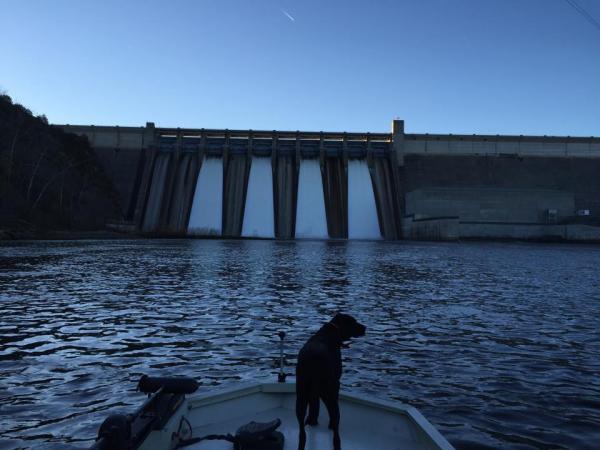 This has been quite a week here on Taneycomo. Trout dying at our hatchery--lethal levels of nitrogen and sulphur in Table Rock's water--zero levels of DO coming through the dam into the hatchery--and high nutrient levels in Table Rock is blamed. I made a couple of trips out to the hatchery on Tuesday after hearing rumors on Facebook about huge numbers of trout dying and big fish kills in the lake. All those reports were bogus--exaggerated as suspected. But trout did die in large numbers and hatchery personnel couldn't do much about it except try to move fish to other raceways where the water was a little better. They have succeeded in saving a vast majority of the fish in the hatchery including most of the brood stock but they have had to change their management schedule to make it happen. Are we out of the woods? Not quite. But cooler temperatures haven't brightened all our faces and cold weather this weekend may turn the tide. As Table Rock's surface temperature drops into the 50's, it should cause the lake to "flip" or turn over. This sends cooler water, high in dissolved oxygen down to the depths of the lake and mixes the layers of water throughout the lake. This should cause the water flowing into Taneycomo to get better--more oxygen and less suphur and nitrogen. As winter and colder temperatures approach, it will get better and better. Another issue was 5 to 7 inches of rain the area received on Tuesday. This brought Table Rock's level up past 917 feet which is a level that the Corp considers the mark between normal winter pool and flood pool. So they needed to release water to keep the level from reaching levels above 917 feet, so much so that they were restricted by their own rules from releasing this using their turbines. They simply couldn't inject enough O2 into the water to keep it above 4 ppm which is their minimum standard. So they had no choice but to spill water over the top flood gates in addition to some through the turbines. They started released yesterday at 4 p.m. and continue to presently. Consequently, this has brought up our DO levels in our lake! Yippy!! That's what the trout think. This morning, my friend Rolan Duffield, as well as guide Chuck Gries, reported trout fishing was excellent! They drifted San Juan Worms and egg flies under an indicator 10-12 feet under an indicator from the dam down to Trophy Run and caught lots of strong and health rainbows. Others downstream reported doing pretty well too. But you had to put up with the strong sulphur odor--yep--rotten eggs! The trout caught up below the dam were spitting up tons of scuds too. I'm sure the running water as displaced them from their resting places along the banks. Not sure how long the gates will be open--hopefully for a few days. But we're over the hump I believe, or at least real close to it.
 -
This has been quite a week here on Taneycomo. Trout dying at our hatchery--lethal levels of nitrogen and sulphur in Table Rock's water--zero levels of DO coming through the dam into the hatchery--and high nutrient levels in Table Rock is blamed. This has been quite a week here on Taneycomo. Trout dying at our hatchery--lethal levels of nitrogen and sulphur in Table Rock's water--zero levels of DO coming through the dam into the hatchery--and high nutrient levels in Table Rock is blamed. I made a couple of trips out to the hatchery on Tuesday after hearing rumors on Facebook about huge numbers of trout dying and big fish kills in the lake. All those reports were bogus--exaggerated as suspected. But trout did die in large numbers and hatchery personnel couldn't do much about it except try to move fish to other raceways where the water was a little better. They have succeeded in saving a vast majority of the fish in the hatchery including most of the brood stock but they have had to change their management schedule to make it happen. Are we out of the woods? Not quite. But cooler temperatures haven't brightened all our faces and cold weather this weekend may turn the tide. As Table Rock's surface temperature drops into the 50's, it should cause the lake to "flip" or turn over. This sends cooler water, high in dissolved oxygen down to the depths of the lake and mixes the layers of water throughout the lake. This should cause the water flowing into Taneycomo to get better--more oxygen and less suphur and nitrogen. As winter and colder temperatures approach, it will get better and better. Another issue was 5 to 7 inches of rain the area received on Tuesday. This brought Table Rock's level up past 917 feet which is a level that the Corp considers the mark between normal winter pool and flood pool. So they needed to release water to keep the level from reaching levels above 917 feet, so much so that they were restricted by their own rules from releasing this using their turbines. They simply couldn't inject enough O2 into the water to keep it above 4 ppm which is their minimum standard. So they had no choice but to spill water over the top flood gates in addition to some through the turbines. They started released yesterday at 4 p.m. and continue to presently. Consequently, this has brought up our DO levels in our lake! Yippy!! That's what the trout think. This morning, my friend Rolan Duffield, as well as guide Chuck Gries, reported trout fishing was excellent! They drifted San Juan Worms and egg flies under an indicator 10-12 feet under an indicator from the dam down to Trophy Run and caught lots of strong and health rainbows. Others downstream reported doing pretty well too. But you had to put up with the strong sulphur odor--yep--rotten eggs! The trout caught up below the dam were spitting up tons of scuds too. I'm sure the running water as displaced them from their resting places along the banks. Not sure how long the gates will be open--hopefully for a few days. But we're over the hump I believe, or at least real close to it. View full article
-
http://www.swl-wc.usace.army.mil/pages/data/plots/pics/scofozdo.jpg O2 is above 7 down here - that's awesome!
-
We did. Caught 2 nice rainbows on a jig. With this cold weather and wind, TR may turn pretty quickly but it's anyone's guess. I'd say they will run till one of tow things happen - Table Rock turns and they get good water or Table Rock's level drops below 917 feet. I'm talking flood gates. They will run water till they get TR's level down past 917 feet.
-
fixed
-
Table Rock is rising and won't crest till its above 917 feet so the Corp has to run enough water to manage the rise. They can't run 4 full units because they can't add enough O2 so they have to spill water over the top to make up for it. Im going to boat up and watch for trouble. Water over the top should be excellent water but the turbine side might be an issue.
-
SOUTHWESTERN REGION Rapid response by MDC statewide hatchery staff is mitigating damageNatural factors causing trout die-off at Shepherd of the Hills Rapid response by MDC statewide hatchery staff mitigating loss. BRANSON, Mo. – An unfortunate combination of late-autumn water conditions has caused a die-off of trout at the Missouri Department of Conservation’s (MDC) Shepherd of the Hills Hatchery. This fish loss is a result of a combination of current environmental conditions that include warm water, low oxygen, high nitrogen, high sulfur levels and excess nutrient content. Hatchery staff will not know the full impact of trout loss for some time as some fish may experience delayed mortality from the stress they experienced at this time. Mortality has occurred in all sizes of fish at the hatchery. Shepherd of the Hills Hatchery, located in Taney County, is Missouri’s largest trout hatchery. It produces 1,250,000 trout annually which are stocked into Lake Taneycomo and other trout areas around the state. Much of the above-mentioned environmental conditions can be traced to the heavy rains, hot temperatures and algae die-off that depleted water quality and caused fish die-off problems at Table Rock Lake this past summer. Shepherd of the Hills receives its water from Table Rock. Fortunately, quick action by MDC hatchery staff is resulting in the bulk of Shepherd’s trout population being saved. Some are being moved to other raceways at the hatchery where the water quality is better; other trout are being temporarily transported to Bennett Spring Hatchery, Montauk Hatchery and Lost Valley Hatchery. The primary cure to Shepherd’s problems will occur when cold weather arrives. “The faster it gets colder, the sooner the water temperature at the surface (of Table Rock) will equal the water temperature at the bottom (of the lake) and allow the lake to mix,” said MDC Fisheries Management Biologist Shane Bush, who oversees fish management at Table Rock and Taneycomo reservoirs. “This will bring better water quality through the dam. This may happen as soon as this weekend with cold temperatures expected.” The hatchery’s Conservation Center remains open to the public from 9 a.m. to 5 p.m. daily, but trout viewing opportunities along the raceway have been temporarily closed to the public. More information can be obtained by calling the Shepherd of the Hills Hatchery Conservation Center, 417-334-4865 or the Missouri Department of Conservation’s Southwest Regional Office in Springfield, 417-895-6880. A combination of natural factors has led to a trout die-off at the Missouri Department of Conservation's Shepherd of the Hills Hatchery in Taney County. Some of the fish are being temporarily transferred to other hatcheries in the state until water conditions at Shepherd of the Hills Hatchery improve. MEDIA CONTACT: Francis Skalicky Media Specialist 417-895-6881 x1641 Francis.Skalicky@mdc.mo.gov STAY CONNECTED: SUBSCRIBER SERVICES: Preferences | Unsubscribe Help | Contact Us GovDelivery, on behalf of: Missouri Department of Conservation 2901 W. Truman Blvd. · PO Box 180 · Jefferson City MO 65102-0180
-
When they run water it's in the evening. And trout don't just get "flushed" that easy. They stick on things, like rocks.
-
 Current River, 2015 Fly Fishing Trip
 -
October 2014 Trip with Matt Green and Alex Turley.
-
Eleven Point River Trip - Fall 2015 from Focal Imaging LLC on Vimeo.
-
The hatchery continues to have troubles today. They are moving trout from Shepherd to other hatcheries in the state - Montauk, Roaring River and Bennett. There is another fictitious rumor going around on FB about the hatchery losing most of their broad stock which wasn't true. They did lose some this morning but nothing that hatchery can't cover. I'm not trying to paint a rosy picture of this situation... I'm trying to keep people from panic and exaggerating the facts. We have 2-3 weeks of this ahead of us and the hatchery is doing the best they can to keep from losing more trout. When man builds dams and create tailwaters, the nature of those tailwaters create water quality issues, especially in the fall months. It's the nature of tailwaters. Not all tailwaters/lakes are not the same either so you can't compare them equally.
-
There is a rumor going around some social media sites about a big fish kill at our trout hatchery. I wanted to post and get out ahead of it. This is what I posted: I just got back from visiting with Clint Hale at the hatchery. They've lost some fish - 2 events in the last couple of days. The numbers are not close to what's been reported (700k) but the situation isn't good. He did not give a number. The water from Table Rock is very high in sulpher and nitrogen - both are lethal to fish at certain levels. They're doing all they can to keep those levels down but for the most part it's out of their hands. All the trout lost are in the 5-inch range. The facility on the east side of the hatchery, the brown trout facility, is in good shape and they've moved fish from the head of the hatchery to the brown facility - it is now full. As for stocking, they continue their normal stocking regiment and are only stocking trout from the Branson Landing down lake. Because of the water quality, it is my guess that none of those fish are moving up lake at all. We are sending all out guest down to that area to fish and they are doing fairly well considering. As for correcting the problem, there's no solution. Our spring rains (which many were of the flash flood type) this year pushed tons of debry into the lake. It's that debry that is decaying and causing the depletion of O2 plus the sulphur and nitrogen issues.
-
Eating today again. No swimming.
-
ok thanks
-
They're eating again today. None swimming. Years ago, I had a bunch of them in an aquarium. Some days they swam all over but most of the time they didn't. They fed on pondweed I'd put in the tank. All the pondweed is gone along our bank now. I wonder how long we'll see them.
-
Shot with a GoPro Black in 4k.
-
-
