
Phil Lilley
-
Posts
19,030 -
Joined
-
Last visited
-
Days Won
132
Content Type
Profiles
Forums
Blogs
Events
Articles
Video Feed
Gallery
Everything posted by Phil Lilley
-
Bull Shoals has produced millions and millions of white bass over the years and is considered one of the top Midwest white bass fishery. It's nothing to go out about any time of year and catch a limit, either trolling or jerking spoons, throwing topwater baits or working a jig or swimming minnow. True, some years are better than others, but Bull is consistently outproducing most Ozark lakes. Bull Shoals has produced millions and millions of white bass over the years and is considered one of the top Midwest white bass fishery. It's nothing to go out about any time of year and catch a limit, either trolling or jerking spoons, throwing topwater baits or working a jig or swimming minnow. True, some years are better than others, but Bull is consistently outproducing most Ozark lakes. First- Bull Shoals. It's not too hard figuring out white bass on Bull Shoals. In Missouri, there are 2 major waterways white bass run up for spawning- Swan and Beaver Creeks. There are other areas whites run on the main lake and other creeks- Mincy being another creek but Swan and Beaver is where you'll find the largest numbers of fish. Conditions to watch- rainfall and water temperatures. Water temp and water flows trigger white bass more than anything, it seems. Sunlight and length of days of course is another but when the time comes, they're looking for that right feeling- 55 degree water. They like dingy water- it gives them more cover and a feeling of being hidden. From what? You and I probably. I've found the best times to find whites up in the creeks consistently is a day or two after a good rain. Creeks come up and get real dirty/trashy. Fish are moving- and feeding. See the night crawlers all over the sidewalks and roads after a rain? You can imagine a ton of worms washing into the ditches, down to the draws and into the creeks. The fish are having a field day. After the rainwater recedes and the creeks settle down a bit, it's time to move in and fish. You're still looking for "colored" water but not "chocolate milk". Did you know--sunlight warms colored water much faster than clear water. Why? Because the pigment in the water catches and absorbs heat, warming the water. Gosh- in both creeks, there's so many conditions to consider. Beaver usually comes on first, before Swan Creek. Whites will move in and out of the creek from the lake early, driving us mad. But early mornings, evenings and late at night are the best times to look. Later they start staying in the creek, staying schooled together, staging, waiting for the right conditions to move upstream to spawn. As Bull Shoals rises with spring rains, it's always a challenge to keep up with where the lake meets the creek. It makes a difference- this line divides moving water from still water. It also dictates where you can run a boat- and not to run a boat. When the lake gets real high, it dictates where you can- and cannot launch your boat. OK- once you've found the ideal conditions, it's time to catch fish. In the creeks, I'm a firm believer most fish like a little current- not a lot of current- a little. Use current to your advantage. Swing a jig, a spinner, a crank bait, a minnow through an eddy or over a drop-off to holding fish. I've seen boats anchor in key spots above holes or eddies as well as people wading where their baits flow down to whites. In still water, it's good to fish close to the bottom. Slow moving soft plastic baits- swimming minnows and grubs, jigs or spoons. I like jigs myself but that's just me. Colors- that's so hard to say. Depends on light, water color and the fish's mood. (I throw the mood thing in just so you won't take my guessing to serious.) Good colors I like- jigs: White, pink, chartreuse, gray, gray with a little red, black at night. Soft plastics: purple, smoke, motor oil, blue flake clear, chartreuse and glitter/clear. At night: Black or purple twin tailed grub worked s-l-o-w on the bottom is a killer when nothing else is working. When the water is clear, try a small Sluggo or 2.5 inch blue floating Rebel Minnow and jerk the heck out of it, pausing for the strike. If you're using a Sluggo, light line is a must. I use 4 lb line- but I use 4 lb with almost every application I've mentioned in this article. Worked the Sluggo in a place where you can see the bait. Most times you will not feel the strike- you have to see it to set the hook. The Rebel you will feel the strike. Helpful hints: Line size is important, as I have mentioned. A good smooth reel and sensitive lets you feel and slightest bump on slow days and nights. And I think the most important thing to keep in mind on slow days or nights- work the bait close to the bottom and s-l-o-w. I've seen more frustrated anglers, in and out of by boat, jeer at me because I'm catching and they're not... why? They aren't letting the bait go to the bottom or they're reeling to fast. If you're jig-head is dragging the bottom- put on a lighter jig-head and reel s-l-o-w. It'll work if they're there. Change colors/sizes often. Change retrieves often. Boat Launches on Bull Shoals- River Run at highway 76 and 160 outside of Forsyth- Corp. Shadow Rock Park off 160 near 76 junction- public. Beaver Creek Park off 160 on V south of Kissee Mills- Corp. Beaver Creek at highway 160, small camp ground- public. K-Dock at the end of K highway off 76 between Branson and Forsyth- Corp. Bait Shops- Tri-Lakes Bait- on 160 in Forsyth 417-546-3928 Beaver Creek Marina 417-546-5121 View full article
-
- 1
-

-
 Bull Shoals has long been a lake known for its great fishing, including a species that you don’t find in many lakes in Missouri — the walleye pike. It’s commonly considered a northern sport fish, sought for its feisty fight and sweet tasting meat. When most of us think of walleye, we think of Canada or Minnesota. I’ve never been to Canada, but I have ventured to Minnesota and Leach Lake where I caught -- and ate -- my first walleye. Many midwestern states have incorporated walleye into their fishery plans. In Kansas, Lake Perry leads the way in popular walleye lakes. Missouri’s bragging rights go to lakes like Stockton. In Arkansas, the Norfork and Greers Ferry are hard to beat. And then there’s Bull Shoals, stuck right in the middle, with a walleye population second to none. What makes Bull Shoals prime waters for our red-eyed fish? Maybe it’s the long, winding shape and its mix of cliffs, mud banks and gravel bottom. Whatever it is, our walleye do very well in the border lake of Missouri and Arkansas. Very few walleye do not naturally reproduce in Bull Shoals. State hatcheries in Missouri and Arkansas keep walleye populations managed by taking mature males and females from the headwaters during spawning times, milking eggs and sperm and returning the brood stock back to the headwaters unharmed. The eggs are hatched and young are reared in the respective hatcheries and then released back into Bull Shoals and other lakes in their programs. Two Mondays ago, I had the privilege and pleasure to work with hatchery workers from West Plains, Missouri, in taking walleye just for this purpose. Anthony A. J. Pratt, fisheries biologist and manager for the fishery on Bull Shoals, Missouri, invited me to take part. A.J. has been very helpful in my fishing reports as well as in providing other great information for OzarkAnglers. We arrived at the meeting place at 6 p.m., the boat ramp at River Run Corps Park, just upstream of the Missouri Highway 76 bridge outside Forsyth, Missouri. Two tank trucks and two pickups, each tailoring 20-foot jon boats full of gear pulled up. The fun was to begin. They unloaded the equipment first, homemade racks to hold walleye for tagging, netted holding tanks, lights, tools and waders. The mission was not only to transport walleye back to the hatcheries but was also to tag walleyes for study. This was something new, added so that fishery biologists can better manage their stockings. I had been on one other electroshock boat — 15 years ago with Gordon Proctor, then Shepherd of the Hills Hatchery manager from MDC. We electroshocked trout on upper Lake Taneycomo. That proved to be an interesting experience being able to see what’s really down there, so to speak. I was excited about this trip. An electroshock boat is just what the name states -- a boat that shocks fish. Electrodes are hung out over and into the water by a long pole that extends some 12 feet in front of the boat. At the back of the boat is the other side of this trap, creating a field of electricity that stuns everything that swims close to it. The electroshock is not meant to harm any fish, but only to cause it to be knocked out for a few minutes, enough time to scoop them up into long-handled nets and place them in a live well inside the boat. As we pulled away from the ramp, I introduced myself to Shannon, my fellow net man, and Chuck, the skipper of this voyage. I could tell that Chuck was a veteran and even knew the channel from the ramp to Powersite Dam, our destination. The lake was low and gravel bars were lurking. Generation from Powersite and additional water spilling over the dam helped water levels a bit, but it still was tricky finding our way in the dark. Shannon was from Doniphan, Missouri. This was his first trip in an electroshock boat, but he seemed confident. We had almost arrived at the spot Chuck had in mind when I felt a jolt from the motor as if we had hit something. Although this was my first time on the lake this winter, I had heard from Buster Loving that it was tough boating to the dam because of the lake’s level. I motioned to Chuck, but he didn’t slow a bit. He later explained that the clutch dog (a gear in the lower unit of the motor) was giving out and had caused the sound. We stopped on the right bank ascending about ¼ mile from the dam. This is where we were to start. The other boat traveled all the way to the rock pile below the spillway. Shannon and I grabbed our nets and stepped up to the front deck. The decks were surrounded by tape-covered rails about waist high — perfect to lean against while dipping fish. The tape kept my belly from sliding from side to side. Shannon stood on a rubber mat which was a trip switch. If he stepped off the mat, the generators would automatically shut off. Chuck also had an emergency switch in case of an accident. I was at their mercy. The water was greenish color but was a little murky. There was steady current but not really fast. I would have considered it perfect current for throwing a jig, but that was furthest idea from my mind … yeah, right. As the spotlights came on and Chuck fired up the generator, my adrenalin started to kick in. Is it sadistic to get excited about seeing some of God’s creatures get zapped? No conviction here. I wasn’t there to see them get zapped but was there to spot them, net them and admire them. The first few fish we saw were white and yellow suckers. Both Shannon and I dove our nets deep for the light-colored figures just out of range for visual verification, bringing them up for inspection. Then I remembered what I was told before leaving the ramp — walleye are easy to identify because their gills flare wide open and stay open as long as they are stunned. That’s when we both saw our first walleyes. Their bellies were whiter than other fish. We saw gizzard shad, buffalo, rainbow and brown trout and carp as well as suckers and walleye. Surprisingly, we saw very few black bass, crappie or white bass until later in the night. In our first run, we covered most of the right bank down to where the gravel bar starts on the same side. I’d estimated our take was 35 walleye with four weighing more than 10 pounds. We had few less than 15 inches. Most were over 18 inches. We headed back down to the ramp. The other jon boat had come and gone and had reported a good haul, also — in my book anyhow. But the sentiment was not shared. A.J. said they had hoped for more numbers but reasoned that it might still be too early. We headed out again back up to the same area and ran the same bank again, but this time we switched sides halfway down and then back to the west bank. We boated further downstream also, moving into the mouth of Swan Creek. The water there was gin clear, but all we saw were more “trash fish” and no walleye. We had picked up about the same number of walleye on this trip, but it took us longer and we had to cover more water to get them. On the third trip we headed across the lake to just opposite the ramp. Immediately we saw a difference in fish. Above Swan Creek we had seen very few small fish — minnows, bass, blue gill — only walleye or the fish mentioned previously. The water was now lit up with small fish, what seemed to be small shad, bass, crappie, blue gill and other fish. Then we saw a school of crappie as we passed a brush pile. Bigger black bass bellied up, one more than four pounds. Shannon netted it and slung it into the tank, following it with a white bass. Why did it suddenly change? I don’t have the answer. Someone has suggested the water issuing from Swan Creek and moving downstream along that bank might have been slightly warmer and, therefore, drew all these fish. We picked up a few more walleye and called it quits. It was close to 10 p.m., and we weren’t collecting enough walleye to make it worth our while. Back at the ramp, A.J. and others, including Bill Anderson, fisheries biologist out of Springfield, were culling walleye for either transport or for tagging and return to the lake. Their projected target was to collect 50 males and 30 females. Making six night trips, they made their quota for brood stock and tagged more than 1000 walleye. Nuts and Bolts It is uncertain how well walleye successfully spawn in Bull Shoals. An ongoing study by the MDC hopes to determine the success of natural spawning. Walleye fry from this spawn will be soaked in a bath of dye, oxitectracyclein, that will turn the inner ear, called the otolith, of the fry pink. These fingerlings will be stocked in late May or the first of June along with other fingerlings from this year’s spawn. During the bass sample, which is taken in April, 100 yearling walleye will be kept and checked for this dye. This will determine whether or not these are natural or hatchery fish. The MDC raises about 660,000 walleye annually. More than 2.6 million eggs will be milked out of the 30 sow walleye taken out of Bull Shoals, taken to Chesapeake Hatchery in south central Missouri for hatching and grown to fry status (up to 2 inches). Then they will be taken to Mammoth Springs Federal Hatchery to be raised to fingerling size (2-4 inches). Bull Shoals receives 440,000 walleye fingerlings, and the North Fork gets 220,000, stocked in late May or early June. Arkansas stocks walleye in both North Fork and Bull Shoals, but it’s uncertain how many are actually stocked because they reportedly aren’t counted. They are reared in earthen ponds near the lakes and released when the ponds are drained into the lakes. After a year in the lake, walleye will measure six to eight inches long. Slow growth, you say? However, it only takes another two years to reach “keeping size” – 18 inches. The state record walleye was caught on Bull Shoals, just below Powersite Dam, on March 26, 1988, by Gerry Partlow. It weighed 21 pounds, 1 ounce.
 -
Bull Shoals has long been a lake known for its great fishing, including a species that you don’t find in many lakes in Missouri — the walleye pike. Bull Shoals has long been a lake known for its great fishing, including a species that you don’t find in many lakes in Missouri — the walleye pike. It’s commonly considered a northern sport fish, sought for its feisty fight and sweet tasting meat. When most of us think of walleye, we think of Canada or Minnesota. I’ve never been to Canada, but I have ventured to Minnesota and Leach Lake where I caught -- and ate -- my first walleye. Many midwestern states have incorporated walleye into their fishery plans. In Kansas, Lake Perry leads the way in popular walleye lakes. Missouri’s bragging rights go to lakes like Stockton. In Arkansas, the Norfork and Greers Ferry are hard to beat. And then there’s Bull Shoals, stuck right in the middle, with a walleye population second to none. What makes Bull Shoals prime waters for our red-eyed fish? Maybe it’s the long, winding shape and its mix of cliffs, mud banks and gravel bottom. Whatever it is, our walleye do very well in the border lake of Missouri and Arkansas. Very few walleye do not naturally reproduce in Bull Shoals. State hatcheries in Missouri and Arkansas keep walleye populations managed by taking mature males and females from the headwaters during spawning times, milking eggs and sperm and returning the brood stock back to the headwaters unharmed. The eggs are hatched and young are reared in the respective hatcheries and then released back into Bull Shoals and other lakes in their programs. Two Mondays ago, I had the privilege and pleasure to work with hatchery workers from West Plains, Missouri, in taking walleye just for this purpose. Anthony A. J. Pratt, fisheries biologist and manager for the fishery on Bull Shoals, Missouri, invited me to take part. A.J. has been very helpful in my fishing reports as well as in providing other great information for OzarkAnglers. We arrived at the meeting place at 6 p.m., the boat ramp at River Run Corps Park, just upstream of the Missouri Highway 76 bridge outside Forsyth, Missouri. Two tank trucks and two pickups, each tailoring 20-foot jon boats full of gear pulled up. The fun was to begin. They unloaded the equipment first, homemade racks to hold walleye for tagging, netted holding tanks, lights, tools and waders. The mission was not only to transport walleye back to the hatcheries but was also to tag walleyes for study. This was something new, added so that fishery biologists can better manage their stockings. I had been on one other electroshock boat — 15 years ago with Gordon Proctor, then Shepherd of the Hills Hatchery manager from MDC. We electroshocked trout on upper Lake Taneycomo. That proved to be an interesting experience being able to see what’s really down there, so to speak. I was excited about this trip. An electroshock boat is just what the name states -- a boat that shocks fish. Electrodes are hung out over and into the water by a long pole that extends some 12 feet in front of the boat. At the back of the boat is the other side of this trap, creating a field of electricity that stuns everything that swims close to it. The electroshock is not meant to harm any fish, but only to cause it to be knocked out for a few minutes, enough time to scoop them up into long-handled nets and place them in a live well inside the boat. As we pulled away from the ramp, I introduced myself to Shannon, my fellow net man, and Chuck, the skipper of this voyage. I could tell that Chuck was a veteran and even knew the channel from the ramp to Powersite Dam, our destination. The lake was low and gravel bars were lurking. Generation from Powersite and additional water spilling over the dam helped water levels a bit, but it still was tricky finding our way in the dark. Shannon was from Doniphan, Missouri. This was his first trip in an electroshock boat, but he seemed confident. We had almost arrived at the spot Chuck had in mind when I felt a jolt from the motor as if we had hit something. Although this was my first time on the lake this winter, I had heard from Buster Loving that it was tough boating to the dam because of the lake’s level. I motioned to Chuck, but he didn’t slow a bit. He later explained that the clutch dog (a gear in the lower unit of the motor) was giving out and had caused the sound. We stopped on the right bank ascending about ¼ mile from the dam. This is where we were to start. The other boat traveled all the way to the rock pile below the spillway. Shannon and I grabbed our nets and stepped up to the front deck. The decks were surrounded by tape-covered rails about waist high — perfect to lean against while dipping fish. The tape kept my belly from sliding from side to side. Shannon stood on a rubber mat which was a trip switch. If he stepped off the mat, the generators would automatically shut off. Chuck also had an emergency switch in case of an accident. I was at their mercy. The water was greenish color but was a little murky. There was steady current but not really fast. I would have considered it perfect current for throwing a jig, but that was furthest idea from my mind … yeah, right. As the spotlights came on and Chuck fired up the generator, my adrenalin started to kick in. Is it sadistic to get excited about seeing some of God’s creatures get zapped? No conviction here. I wasn’t there to see them get zapped but was there to spot them, net them and admire them. The first few fish we saw were white and yellow suckers. Both Shannon and I dove our nets deep for the light-colored figures just out of range for visual verification, bringing them up for inspection. Then I remembered what I was told before leaving the ramp — walleye are easy to identify because their gills flare wide open and stay open as long as they are stunned. That’s when we both saw our first walleyes. Their bellies were whiter than other fish. We saw gizzard shad, buffalo, rainbow and brown trout and carp as well as suckers and walleye. Surprisingly, we saw very few black bass, crappie or white bass until later in the night. In our first run, we covered most of the right bank down to where the gravel bar starts on the same side. I’d estimated our take was 35 walleye with four weighing more than 10 pounds. We had few less than 15 inches. Most were over 18 inches. We headed back down to the ramp. The other jon boat had come and gone and had reported a good haul, also — in my book anyhow. But the sentiment was not shared. A.J. said they had hoped for more numbers but reasoned that it might still be too early. We headed out again back up to the same area and ran the same bank again, but this time we switched sides halfway down and then back to the west bank. We boated further downstream also, moving into the mouth of Swan Creek. The water there was gin clear, but all we saw were more “trash fish” and no walleye. We had picked up about the same number of walleye on this trip, but it took us longer and we had to cover more water to get them. On the third trip we headed across the lake to just opposite the ramp. Immediately we saw a difference in fish. Above Swan Creek we had seen very few small fish — minnows, bass, blue gill — only walleye or the fish mentioned previously. The water was now lit up with small fish, what seemed to be small shad, bass, crappie, blue gill and other fish. Then we saw a school of crappie as we passed a brush pile. Bigger black bass bellied up, one more than four pounds. Shannon netted it and slung it into the tank, following it with a white bass. Why did it suddenly change? I don’t have the answer. Someone has suggested the water issuing from Swan Creek and moving downstream along that bank might have been slightly warmer and, therefore, drew all these fish. We picked up a few more walleye and called it quits. It was close to 10 p.m., and we weren’t collecting enough walleye to make it worth our while. Back at the ramp, A.J. and others, including Bill Anderson, fisheries biologist out of Springfield, were culling walleye for either transport or for tagging and return to the lake. Their projected target was to collect 50 males and 30 females. Making six night trips, they made their quota for brood stock and tagged more than 1000 walleye. Nuts and Bolts It is uncertain how well walleye successfully spawn in Bull Shoals. An ongoing study by the MDC hopes to determine the success of natural spawning. Walleye fry from this spawn will be soaked in a bath of dye, oxitectracyclein, that will turn the inner ear, called the otolith, of the fry pink. These fingerlings will be stocked in late May or the first of June along with other fingerlings from this year’s spawn. During the bass sample, which is taken in April, 100 yearling walleye will be kept and checked for this dye. This will determine whether or not these are natural or hatchery fish. The MDC raises about 660,000 walleye annually. More than 2.6 million eggs will be milked out of the 30 sow walleye taken out of Bull Shoals, taken to Chesapeake Hatchery in south central Missouri for hatching and grown to fry status (up to 2 inches). Then they will be taken to Mammoth Springs Federal Hatchery to be raised to fingerling size (2-4 inches). Bull Shoals receives 440,000 walleye fingerlings, and the North Fork gets 220,000, stocked in late May or early June. Arkansas stocks walleye in both North Fork and Bull Shoals, but it’s uncertain how many are actually stocked because they reportedly aren’t counted. They are reared in earthen ponds near the lakes and released when the ponds are drained into the lakes. After a year in the lake, walleye will measure six to eight inches long. Slow growth, you say? However, it only takes another two years to reach “keeping size” – 18 inches. The state record walleye was caught on Bull Shoals, just below Powersite Dam, on March 26, 1988, by Gerry Partlow. It weighed 21 pounds, 1 ounce. View full article
-
 These are maps of upper Bull Shoals Lake showing depth and fishing spots, draw up by fishermen who know this part of the lake. Click on each images header to download a pdf copy of each map section.
 -
These are maps of upper Bull Shoals Lake showing depth and fishing spots, draw up by fishermen who know this part of the lake. These are maps of upper Bull Shoals Lake showing depth and fishing spots, draw up by fishermen who know this part of the lake. Click on each images header to download a pdf copy of each map section. View full article
-
- 1
-
-
Wanted to share a few videos, done by a church my daughter and son-in-law go to in NW Arkansas. Jimmy is the worship leader there.
-
Yes. That's good water. And in 2 weeks it will be better.
-
We are going to go ahead and have this tournament since our water has improved to the point that's it's not putting a strain on fish. December 12 8 am - 4 pm. Individual contest. Artificial only. No entry fee. We will kick in $100, $60 & $40 for 1st, 2nd and 3rd. It will be a simple format, measure length, total. No pictures, just write it down. We will supply the measuring devices. Catch & release. Ill work up an official flyer.
-
Many are like farm ponds. You got to keep bass in some ponds because there's an abundance of small fish-too many. Keeping bass actually helps.
-
Should be ok. Lots of rainbows to be caught right now - especially down at the Landing.
-
I have a change in my plans. Duane isn't coming so I think I've roped Bill Babler into coming. We'll come Thursday morning early and fish all day. I think we'll probably fish the Norfork Tailwater. Spend the night and fish most of the day Friday but have to head back Friday night. Bill has a guide trip Saturday. I'll still bring chicken for the group - 3 fryers should be enough. If this causes a problem with too few in the lodge Fri-Sat, I'll kick in 2 shares. Having a lodge myself, I'm not about to leave the group short funds. I don't like last minute cancelations...
-
 Just want to provide you with an update and let you know that the Corps is monitoring the weather forecast closely for the weekend and possible impacts to the White River System.The National Weather Service is forecasting a significant rainfall event for the Little Rock District basins; the forecast indicates rainfall amounts of 5-7 inches across the upper Arkansas and White Rivers basins and 7-8 inches across the Little River and Clearwater basins. Little Rock District Lakes/Reservoirs have 95% to 99% of flood storage available to capture runoff, except Clearwater Lake which is at 85%. This should be sufficient storage for this event. We will monitor the rain and lake levels closely as rainfall develops, depending on how the rainfall develops, we expect all lakes to see significant rises, and expect rivers downstream from dams to experience several rises as the rainfall occurs.5-day QPF: http://www.wpc.ncep.noaa.gov/qpf/p120i.gif?1448479231WHITE RIVER SYSTEM. Beaver, and Table Rock remain in their conservation pools, Bull Shoals, Norfork, and Greers Ferry are slightly into their flood pools.Beaver: elev 1120.06 (98.9% conservation storage)Table Rock: elev 916.82 (99.4% conservation storage)Bull Shoals: elev 660.77 (1.8% flood storage)Norfork: elev 557.86 (13.7% flood storage)Greers Ferry: elev 462.38 (1.2% flood storage)Forecasted Pool crests with predicted rainfall amounts:BV - 1125TR - 920BS - 668NF - 565GF - 469Please keep in mind that these are predictions and there are a lot of variables. This is just an FYI in case you have questions on what the lake levels might do if we get the rain they are predicting.Current stage at Newport is 16.39' and falling (12' regulating stage). Will transition to 21' regulating stage December 1st.Current stage at Georgetown is at 16.72' and rising slightly (13' regulating stage). Will transition to 21' regulating stage December 1st.
 -
https://www.youtube.com/watch?v=TNYT-yhr-PM https://www.youtube.com/watch?v=_vZD8ADkeEo
-
Lilley's Lake Taneycomo fishing report, November 24
Phil Lilley posted a article in Taneycomo fishing reports
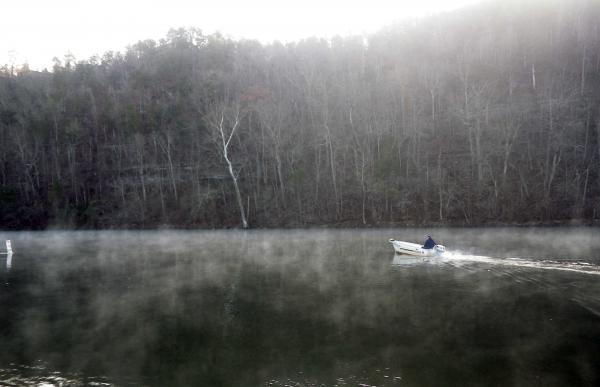 There's a big contrast between a Lake Taneycomo fishing report from last week and this week. We've gone from the edge of disaster to "a bit on every cast". Several things have changed to cause this: We're getting water from the top of Table Rock Lake through the spill gates and we're getting better water through the turbines because Table Rock is starting to "turn over". This sends good, oxygenated water from the top of Table Rock to the bottom regions. It's a natural occurrence that happens each year at this time. The other major thing that's happen is that Shepherd of the Hills Hatchery has had to dump thousands of rainbows into the lake early because of the situation at the hatchery last week. These fish were stocked below Branson and have made their way up lake this week. Fishing reports from the last couple of days are very very good and will probably continue to be good for quite some time. But there's a potential problem I need to address here in my report and will express it to our guests at Lilleys' Landing in the coming weeks. That potential problems is over harvesting and mishandling of trout that are released. Many of us have had bad fishing trips. Fishing is slow and we don't catch and keep our limits, thus we don't go home with the meat we expected to take home. We might have several trips in which we were short of our possession limit. But then comes that trip where we catch a lot of fish, many more than our limit and we're tempted to "make up for" those bad trips and take more fish home than we should. Over harvesting any kind of game is stealing from the fishermen and hunters that come after you. Every fishery is limited to the number of fish, no matter if that number is mind boggling high or not. If one angler catches twice his limit each day he's here, he's taken those fish away from the next person who comes along and fishes the same area. Some thing that's worse is an angler catch-and-killing dozens of trout when the catching is really, really good. It is true, no matter how careful you are when catching, handling and releasing fish, you are going to mortally wound a few fish. But you can great increase your release success rate by knowing how to best handle and release a trout. Don't touch a trout, at all costs. Don't touch them with a dry hand or dry cloth--that's the worse thing you can do to about any fish. It removes the protective slime from the trout's body and it will evidentially die from bacteria in the water. If the hook is close to the outside of the mouth, take a pair of forceps and remove the hook before releasing. If the hook is down inside the fish's mouth, cut the line and release the fish. It has a better chance of survival this way verses trying to remove the hook. Now for my fishing report. The spill gates have been closed. The dissolved O2 coming through the dam has improved to the point that no gates are needed. Once Table Rock's level drops below 917 feet, we should see less generation and probably no flood gates. Stocker rainbows have made their way up lake from being stocked but there's still a lot of trout in the Branson Landing area. Drifting about anything, Gulp Eggs, egg flies, scuds, San Juan Worms, on the bottom is catching lots of rainbows right now. The hot spots have been the Branson Landing area, Monkey Island, out in front of our place and from Fall Creek to Short Creek. One thing Bill Babler pointed out to me is switching from natural baits to artificial baits when the fishing is very good. He did that yesterday while guiding clients. He started fishing the trophy area which was slow for them so they went down to the Monkey Island area and started drifting Gulp Eggs. They caught their limits fairly quick but still had an hour left in the trip so Bill switched to egg flies instead of using the natural, soft scented baits. Couple of reasons why: #1 - cost. You can catch multiple fish on one egg fly. #2 - time and ease. It's much easier taking the fly out of a trout's mouth verses messing with an egg and a bare hook. Plus you can just throw the egg fly back out, not having to put another Gulp Egg on the hook. Fishing in the trophy area is still slow but will improve as the water quality improves in the coming weeks.
 -
There's a big contrast between a Lake Taneycomo fishing report from last week and this week. We've gone from the edge of disaster to "a bit on every cast". Several things have changed to cause this: We're getting water from the top of Table Rock Lake through the spill gates and we're getting better water through the turbines because Table Rock is starting to "turn over". This sends good, oxygenated water from the top of Table Rock to the bottom regions. It's a natural occurrence that happens each year at this time. There's a big contrast between a Lake Taneycomo fishing report from last week and this week. We've gone from the edge of disaster to "a bit on every cast". Several things have changed to cause this: We're getting water from the top of Table Rock Lake through the spill gates and we're getting better water through the turbines because Table Rock is starting to "turn over". This sends good, oxygenated water from the top of Table Rock to the bottom regions. It's a natural occurrence that happens each year at this time. The other major thing that's happen is that Shepherd of the Hills Hatchery has had to dump thousands of rainbows into the lake early because of the situation at the hatchery last week. These fish were stocked below Branson and have made their way up lake this week. Fishing reports from the last couple of days are very very good and will probably continue to be good for quite some time. But there's a potential problem I need to address here in my report and will express it to our guests at Lilleys' Landing in the coming weeks. That potential problems is over harvesting and mishandling of trout that are released. Many of us have had bad fishing trips. Fishing is slow and we don't catch and keep our limits, thus we don't go home with the meat we expected to take home. We might have several trips in which we were short of our possession limit. But then comes that trip where we catch a lot of fish, many more than our limit and we're tempted to "make up for" those bad trips and take more fish home than we should. Over harvesting any kind of game is stealing from the fishermen and hunters that come after you. Every fishery is limited to the number of fish, no matter if that number is mind boggling high or not. If one angler catches twice his limit each day he's here, he's taken those fish away from the next person who comes along and fishes the same area. Some thing that's worse is an angler catch-and-killing dozens of trout when the catching is really, really good. It is true, no matter how careful you are when catching, handling and releasing fish, you are going to mortally wound a few fish. But you can great increase your release success rate by knowing how to best handle and release a trout. Don't touch a trout, at all costs. Don't touch them with a dry hand or dry cloth--that's the worse thing you can do to about any fish. It removes the protective slime from the trout's body and it will evidentially die from bacteria in the water. If the hook is close to the outside of the mouth, take a pair of forceps and remove the hook before releasing. If the hook is down inside the fish's mouth, cut the line and release the fish. It has a better chance of survival this way verses trying to remove the hook. Now for my fishing report. The spill gates have been closed. The dissolved O2 coming through the dam has improved to the point that no gates are needed. Once Table Rock's level drops below 917 feet, we should see less generation and probably no flood gates. Stocker rainbows have made their way up lake from being stocked but there's still a lot of trout in the Branson Landing area. Drifting about anything, Gulp Eggs, egg flies, scuds, San Juan Worms, on the bottom is catching lots of rainbows right now. The hot spots have been the Branson Landing area, Monkey Island, out in front of our place and from Fall Creek to Short Creek. One thing Bill Babler pointed out to me is switching from natural baits to artificial baits when the fishing is very good. He did that yesterday while guiding clients. He started fishing the trophy area which was slow for them so they went down to the Monkey Island area and started drifting Gulp Eggs. They caught their limits fairly quick but still had an hour left in the trip so Bill switched to egg flies instead of using the natural, soft scented baits. Couple of reasons why: #1 - cost. You can catch multiple fish on one egg fly. #2 - time and ease. It's much easier taking the fly out of a trout's mouth verses messing with an egg and a bare hook. Plus you can just throw the egg fly back out, not having to put another Gulp Egg on the hook. Fishing in the trophy area is still slow but will improve as the water quality improves in the coming weeks. View full article
-
Error when trying to open topics
Phil Lilley replied to moguy1973's topic in Messages for, and from, the Admin
No such thing as a simple update.... It all blew up. But it's all back. -
Got a text from MDC. O2 is up to 1.5 ppm at 130 feet. The lake is turning
- 1 reply
-
- 1
-
-
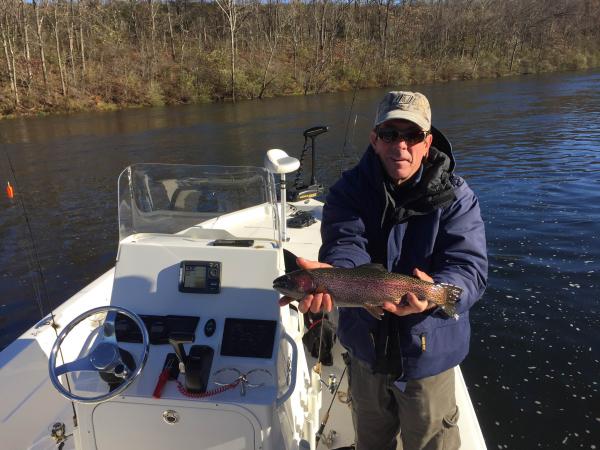 Same generation and flood gates today. They're bumping generation up from 40 to 90 megawatts at times sending Taney's level to 709 feet which is a lot of water. Table Rock's level has crept down from 917.3 to 917.2 feet. I got out this morning and drifted from the dam down to Short Creek with a friend of mine. He was breaking in a new boat and wanted "help". We tried white 1/8th ounce jigs and each caught a rainbow - at the same time. Switched to a egg/scud combo on a drift rig and caught 4 more rainbows between Lookout and Fall Creek. Then caught a couple of more before picking up at Short Creek. Bill Babler struggled this morning on his guide trip up lake but went down to Monkey Island and said his clients caught 40 rainbows. They were drifting with the same egg/scud rig plus he said they used and caught fish on orange, pink, white and green Gulp eggs. Very good fishing, he reported.
 -
Same generation and flood gates today. They're bumping generation up from 40 to 90 megawatts at times sending Taney's level to 709 feet which is a lot of water. Table Rock's level has crept down from 917.3 to 917.2 feet. Same generation and flood gates today. They're bumping generation up from 40 to 90 megawatts at times sending Taney's level to 709 feet which is a lot of water. Table Rock's level has crept down from 917.3 to 917.2 feet. I got out this morning and drifted from the dam down to Short Creek with a friend of mine. He was breaking in a new boat and wanted "help". We tried white 1/8th ounce jigs and each caught a rainbow - at the same time. Switched to a egg/scud combo on a drift rig and caught 4 more rainbows between Lookout and Fall Creek. Then caught a couple of more before picking up at Short Creek. Bill Babler struggled this morning on his guide trip up lake but went down to Monkey Island and said his clients caught 40 rainbows. They were drifting with the same egg/scud rig plus he said they used and caught fish on orange, pink, white and green Gulp eggs. Very good fishing, he reported. View full article
- 1 reply
-
- 1
-
-
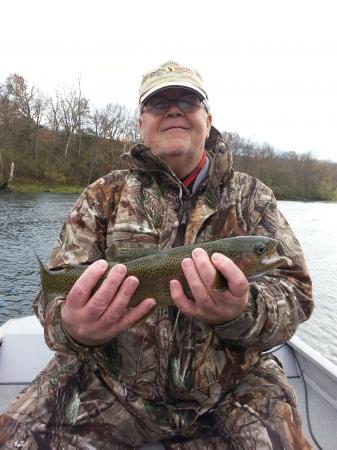 Same generation and flood gates today. Very cold and windy so tough fishing conditions but there were a few boats out. Dissolved oxygen levels remain very good, especially down away from the dam as the water mixes. The water coming out of the turbines is still quite low in O2 but the water coming over the top is rich in oxygen. The sulphur smell as all but gone away. Color of the water in the lake is green and fairly clear. Hasn't looked this good in a couple of months. MDC has continued to stock rainbows in the Branson Landing area. We have been sending people down that way for a couple of weeks to find fish and they've done very well. Freshly stocked rainbows tend to chase things so I'd throw a spinner, spoon or a small crank bait. This also works well because of the windy conditions. Trolling would be good too. I couldn't get a reading of the water coming from Table Rock in to the hatchery today... the hatchery manager, Clint Hale, got married today so they were down to a skeleton crew. I did want to mention that before they started running the flood gates we were warning anglers that if they were catching trout and releasing them to take special care of them because of the water quality being so bad. The rainbows I caught yesterday up close to the dam showed a lot of strength and stamina, evidence that at least while the gates are open, our trout are in very good shape. This doesn't mean you shouldn't take good care of a fish you're intending to release. But it does mean that, for now, our fish are very capable of handling a good fight--and keep on going!
 -
Same generation and flood gates today. Very cold and windy so tough fishing conditions but there were a few boats out. Same generation and flood gates today. Very cold and windy so tough fishing conditions but there were a few boats out. Dissolved oxygen levels remain very good, especially down away from the dam as the water mixes. The water coming out of the turbines is still quite low in O2 but the water coming over the top is rich in oxygen. The sulphur smell as all but gone away. Color of the water in the lake is green and fairly clear. Hasn't looked this good in a couple of months. MDC has continued to stock rainbows in the Branson Landing area. We have been sending people down that way for a couple of weeks to find fish and they've done very well. Freshly stocked rainbows tend to chase things so I'd throw a spinner, spoon or a small crank bait. This also works well because of the windy conditions. Trolling would be good too. I couldn't get a reading of the water coming from Table Rock in to the hatchery today... the hatchery manager, Clint Hale, got married today so they were down to a skeleton crew. I did want to mention that before they started running the flood gates we were warning anglers that if they were catching trout and releasing them to take special care of them because of the water quality being so bad. The rainbows I caught yesterday up close to the dam showed a lot of strength and stamina, evidence that at least while the gates are open, our trout are in very good shape. This doesn't mean you shouldn't take good care of a fish you're intending to release. But it does mean that, for now, our fish are very capable of handling a good fight--and keep on going! View full article
-
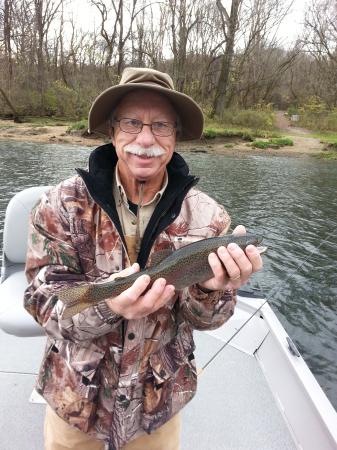 I thought I'd post daily for a while to give updates on the water condition-- and also the fishing. Today, the water in the lake looked so much better. It has that greenish look again, not the dark brown we've been seeing for a month. The Corp bumped up generation this morning to 110 megawatts and the level made it up to 708 feet but only for a couple of hours. Then it went back down to 706 feet, 45 megawatts, and stayed there all day. Of course they're still running 4 flood gates. The hatchery reported the water temperature dropped another degree today. I didn't ask what it was but it's probably about 57 degrees now. That's a good sign - something's moving above the dam! With the real cold weather this weekend, Table Rock just might flip! No bad reports from the hatchery. They have everything under control, if there's such a thing. Very few boats on the water today but those who did get out fishing was pretty good. I saw one group with rainbows at the dock at dusk with their limit of pretty nice rainbows. They said they caught them up just below Fall Creek. But most boated down to the Landing and caught fish there too. I got out for the last 90 minutes of the day. Drifted from the cable below the dam down using a drift rig, 1/8th ounce bell weight and a duo of flies-- an egg fly and a scud. The best was the scud, catching a total of 6 rainbows. It was a #14 orange scud. The egg caught a couple. The trout were about 12 inches and in good shape. Did catch one rainbow on a sculpin 1/8th ounce jig. It was bigger - about 17 inches and very fat. The lead image is of one of our vets who participated in our Healing Water Event earlier this week. Guide and image compliments of Chuck Gries.
 -
I thought I'd post daily for a while to give updates on the water condition-- and also the fishing. Today, the water in the lake looked so much better. It has that greenish look again, not the dark brown we've been seeing for a month. The Corp bumped up generation this morning to 110 megawatts and the level made it up to 708 feet but only for a couple of hours. Then it went back down to 706 feet, 45 megawatts, and stayed there all day. Of course they're still running 4 flood gates. I thought I'd post daily for a while to give updates on the water condition-- and also the fishing. Today, the water in the lake looked so much better. It has that greenish look again, not the dark brown we've been seeing for a month. The Corp bumped up generation this morning to 110 megawatts and the level made it up to 708 feet but only for a couple of hours. Then it went back down to 706 feet, 45 megawatts, and stayed there all day. Of course they're still running 4 flood gates. The hatchery reported the water temperature dropped another degree today. I didn't ask what it was but it's probably about 57 degrees now. That's a good sign - something's moving above the dam! With the real cold weather this weekend, Table Rock just might flip! No bad reports from the hatchery. They have everything under control, if there's such a thing. Very few boats on the water today but those who did get out fishing was pretty good. I saw one group with rainbows at the dock at dusk with their limit of pretty nice rainbows. They said they caught them up just below Fall Creek. But most boated down to the Landing and caught fish there too. I got out for the last 90 minutes of the day. Drifted from the cable below the dam down using a drift rig, 1/8th ounce bell weight and a duo of flies-- an egg fly and a scud. The best was the scud, catching a total of 6 rainbows. It was a #14 orange scud. The egg caught a couple. The trout were about 12 inches and in good shape. Did catch one rainbow on a sculpin 1/8th ounce jig. It was bigger - about 17 inches and very fat. The lead image is of one of our vets who participated in our Healing Water Event earlier this week. Guide and image compliments of Chuck Gries. View full article
-
I thought I'd post daily for a while to give updates on the water condition-- and also the fishing. Today, the water in the lake looked so much better. It has that greenish look again, not the dark brown we've been seeing for a month. The Corp bumped up generation this morning to 110 megawatts and the level made it up to 708 feet but only for a couple of hours. Then it went back down to 706 feet, 45 megawatts, and stayed there all day. Of course they're still running 4 flood gates. I thought I'd post daily for a while to give updates on the water condition-- and also the fishing. Today, the water in the lake looked so much better. It has that greenish look again, not the dark brown we've been seeing for a month. The Corp bumped up generation this morning to 110 megawatts and the level made it up to 708 feet but only for a couple of hours. Then it went back down to 706 feet, 45 megawatts, and stayed there all day. Of course they're still running 4 flood gates. The hatchery reported the water temperature dropped another degree today. I didn't ask what it was but it's probably about 57 degrees now. That's a good sign - something's moving above the dam! With the real cold weather this weekend, Table Rock just might flip! No bad reports from the hatchery. They have everything under control, if there's such a thing. Very few boats on the water today but those who did get out fishing was pretty good. I saw one group with rainbows at the dock at dusk with their limit of pretty nice rainbows. They said they caught them up just below Fall Creek. But most boated down to the Landing and caught fish there too. I got out for the last 90 minutes of the day. Drifted from the cable below the dam down using a drift rig, 1/8th ounce bell weight and a duo of flies-- an egg fly and a scud. The best was the scud, catching a total of 6 rainbows. It was a #14 orange scud. The egg caught a couple. The trout were about 12 inches and in good shape. Did catch one rainbow on a sculpin 1/8th ounce jig. It was bigger - about 17 inches and very fat. The lead image is of one of our vets who participated in our Healing Water Event earlier this week. Guide and image compliments of Chuck Gries. View full article
-
For those who didn't know Harvey, he was an ambassador for fly fishing in SW Missouri. He lived in Springfield and was part of that fly fishing community for many years. He will be missed.
