


Sam
-
Posts
1,026 -
Joined
-
Last visited
Content Type
Profiles
Forums
Blogs
Events
Articles
Video Feed
Gallery
Everything posted by Sam
-
fishinwrench, that's real interesting info about the whites. Thanks for posting it! We lived on the west coast for awhile and I did a lot of ocean fishing then. White bass, in my opinion, behave more like some salt water fish - they run in schools, move around a lot, go on "feeding frenzies" and then often turn off all at once. That's just like fishing the Pacific coast for some of the active species - chasing seagulls and surface boils where fish and birds are tearing into anchovies. Fun! My old fishing partner could never understand that white bass don't 'scope well when they're up on flats - "Nope, nothing here!". I always figured that as fast and active as white bass are, they aren't going to hold still and let a boat go right over them in shallow water - by the time the transducer on the back of the boat goes over where they were, they've already moved!
-
I'm not defending or criticizing any stocking programs, I don't know enough about them. Point was - animals, even down to the level of fish, show a surprising amount of individual behavior and preferences that make it hard to predict just what they'll do. You can generalize and be right about fish behavior patterns in certain conditions - but as far as narrowing that down for sure to a certain trip, or day, or bait, or presentation, etc., well that's where things get uncertain. That's why it's called "fishing" and not "catching". Ain't it grand?
-
Texas isn't tampering with DNA, they're just incorporating the biggest fish they can find into their bass stocking program. There's nothing wrong with selecting good genetics to carry on. If you were raising tomatoes, cattle, or anything else, you'd do the same - save the seeds out of that BIG 'mater for next year!
-
I think that's right. I read an interesting article a long time ago that was written by a biologist in charge of the brooder bass program in Texas. Texas raises big Florida-strain bass to stock in some of their lakes, and they've constantly tried to increase the potential size the stockers they raise can grow to. They had a program (and maybe still do) asking anglers who catch a bass weighing (I think) 9 lbs. or more to take care of it, keep it alive, and give it to their conservation department to use those good genetics for breeding. The fella who wrote the article I read was responsible for taking care of the big 'ol sows they'd been given in a hatchery environment that was pretty natural - a series of connected ponds with brush and rocks for cover and some forage food for the bass. In time, he got to know those fish personally of course, and the point of the article was that he'd been surprised to learn that they were distinct individuals, each with their own preferences, behaviors, and almost ...... personalities! Some preferred rocks for cover and that's where they stayed, some preferred brush or trees, some ate crawfish almost exclusively, some preferred minnows, some worms and insects. Some of them ate something every day or several times a day, others only fed once every two or three days. They were active at different times, too - some preferred night, and some morning or evening twilight. There were some general similarities in behavior - none of the big bass was most active in the middle of the day, though they could get active then real quick if something special like a frog came by. Low pressure and approaching storms made them all more active and prone to feed, too - but a lot of their behavior was according to each individual fish and real hard to predict in general for the whole bunch. I think that's kinda the way all of God's creatures are, don't you?
-
Phil, this video increased the circulation of the Ozark Anglers forums a bit. An old crappie-fishing buddy in South Carolina emailed me yesterday, saying he'd seen film on Fox News about Rockaway Beach flooding. I missed that story on Fox, but I emailed back explaining about our Lake Taneycomo being a cold water lake/river between Tablerock and Bull Shoals and how it's a trout fishery. I included a link to the video you'd just posted showing the high water at Lilley's Landing and you catching that trout out your window. My friend got a big kick out of that and he forwarded my email to members of his crappie fishing club. Those folks really enjoyed it, and now several say they've bookmarked ozarkanglers.com to follow the articles and posts here, and I think some fishing vacations to the Ozarks may result.
-
Congrats - that's a real rare deal you ran into there. I've crappie-fished Tablerock Lake for many years and never yet had a trip where even half my catch was made up of Black Crappie, as ALL those are. Usually about 4 out of 5 coming out of Tablerock are White Crappie, in my experience. Nice bunch of fish!
-
Yes, it's an early Bomber. Those were my dad's favorite "plug", and he sure could catch bass on 'em. I looked it up, and the Bomber Bait Company started in 1946 in northern Texas and for about 20 years they produced only these popular Bomber lures. Early models were metal and wood and they switched over to plastic but retained the metal dive plate sometime in the '60's. Bomber Model A's are still made of course, but they run frontwards and are all-plastic including the dive lip. As a kid I remember looking in my dad's tackle box and wondering why those lures were made to go "backwards". No matter - they caught bass.
-
Thanks for the report, Hammer time. That's an Arkansas Blacknosed Crappie, and I love 'em. To me, it always seems like something extra is going on when we catch those - good fishing, and good luck. They're native to the White River, and that includes Tablerock Lake, of course. Here's the scoop on them from crappie101.com: "The Black Nosed Black Crappie as we call them were first described in the White River Basin of Arkansas. They have been found in 13 other states. The black stripe is the result of a recessive gene, which breeds true when using black stripe brooders. There are all kinds of claims about them being sterile, or hard fighters and such. No conclusive evidence has ever been found to support any such theories. They breed just like regular black crappie. I believe the black stripe adds to the excitement when reeling one in and anglers get an adrenaline rush when they see one, resulting in all kinds of euphoric claims. Do not be confused, some people are using black nosed black crappie in hybridization research which results in hybrid crappie with black stripes (to indicate a successful cross, gene expression of a recessive gene from one parent). Therefore some hybrid crappie have been stocked with the black stripe and some people confuse the black stripe thinking it is the result of hybridization. Bottom line, in order for any crappie to have a black stripe it must have a black nosed black crappie parent."
-
Good things about my aluminum boat: It's light, trailers easily, I can launch and load it real easy by myself with or without a ramp, and I can pull the motor up and use the trolling motor to go up shallow creeks during the white bass spawn and sucker run. Bad thing about my aluminum boat: In the wind it'll scoot backwards and sideways faster than it has ever moved forward.
-
Well, that makes sense. OK.
-
I'll stop in again, but if this has turned into just a "Bass Chat" I won't stick around. Crappie, walleyes, white bass, etc. hold more interest for me - and some of us are actually kinda disappointed when we find we're reeling in a green or brown fish instead of something we were looking for. There's a new guy in my group of friends who thinks Texas Holdem is the only kind of poker game there is, too. Just sayin'.
-
I dunno about that - if fishing gets too bad I won't go fishing. I think any body of water will always support as much life as conditions allow. That capacity depends on many things - the season, depth, dissolved oxygen, nutrients, amount of sunlight received, temperature, lots of variables. But life always exploits available resources to the fullest, so a square acre (let's say) of Bull Shoals water will always support as much life as it's capable of at any given time, no less, no more - all the algae, crawdads, frogs, mud turtles, carp, gamefish, zebra mussels, and everything else. You see where I'm going with this. If an acre of lake is supporting a ton of zebra mussels, then it ISN'T supporting a ton of other life that would be there if the ZM's weren't - and some of that loss is bound to come from the species we like to fish for.
-
For about 25 years, upper Bull Shoals from Powersite Dam down to the AR line has been my hidey-hole where I get away from the crowds and boats on Tablerock, usually launching from K Dock. I know every bit of that part of the lake, but I've stayed away this year except for some walleye trips in February. I stayed away because of extreme high water since the spring/ early summer rains, but now there's those zebra mussels. We saw ZM's in February, a few, but I guess they really multiplied over the summer. So far as future fishing there, I just don't know. We'll see what next season brings - I'll sure miss Bull Shoals if it's ruined, and I'm sure the mussels will get in all the other lakes around here too, soon. crappiefisherman, I sure like the picture you used. I think that's George Nelson from "O Brother, Where Art Thou" - just don't call him 'Baby Face'.
-
Boat on Springfield lake
Sam replied to ryan's topic in Fellows Lake, Springfield Lake, McDaniels Lake
I stopped by the lake on my way home from Springfield yesterday. The boat ramp by the boathouse is chained off so a trailer can't be used, but there are spaces left between posts where a small boat can easily be dragged in between and lifted onto a pickup truck. While I was there an older fellow was taking his 10' aluminum jon boat with an electric trolling motor out. He said he'd mostly caught and released bass in the 12"-15" slot limit, but he had a stringer with some smaller bass and some humongous big bluegills, all dead. I noticed he had a minnow bucket. The survival chances of released gut-hooked bass caught with minnows is a whole different issue, in my opinion - so much for that slot limit doing much good! Drove around to the ramp by Hwy. 65 and it's all busted up. What really makes it unusable, though, is the concrete barricades that have been placed to block what's left of the ramp area and bank. There again, space has been left to drag a small boat around the barricades but there's no way at all to launch with a trailer. It looks to me like someone has decided not to have any trailered boats on that lake, regardless of motor size. -
Boat on Springfield lake
Sam replied to ryan's topic in Fellows Lake, Springfield Lake, McDaniels Lake
I think everybody agrees that this shallow city lake with a beautiful park on one bank and a National Cemetery on the other shouldn't have big motors run on it, with the noise, wakes, speeding boats, and safety issues big motors would cause. No one wants that. My point is that a motor that's not started, is kept raised out of the water, and has no prop attached or even present on the boat, can't cause any of the problems (noise, wakes, speeding, safety) the motor size-limitation ordinance was enacted to prevent. In fact, a bass boat running with an electric trolling motor is silent, non-polluting, and not annoying to be around at all - unlike the small gasoline motors that are specifically allowed by the ordinance. From aarchdale's post, above, it sounds like those in charge of the lake are showing the common sense to enforce the PURPOSE of that ordinance - to prevent the noise, wakes, speeding, and safety hazards that would be caused by running large motors. If they're not using a poorly-worded law to cite people for a technical violation even though they're doing no harm, well, good for them! Oh, 'hung on a rock', I always release all bass. I don't think I'd want to eat fish of any species from Lake Springfield anyway, so you don't need to worry about me thinning the herd out. -
I love big Redear Sunfish, but I've read that studies show ZM's aren't a preferred food of Redears. They'll eat Zebra Mussels, but several articles said Redears aren't a "panacea" against ZM infestation because they prefer lots of other foods instead, when available. BUT - there are studies showing that Blue Catfish really chow down on Zebra Mussels! In some infested lakes in Arkansas, ZM's were found to be 57% of the Blue Cats' diet in the warmer months, spring through fall. One 16" Blue Catfish caught in a survey had 134 Zebra Mussels in its' stomach! That AR study found that when the water gets warm and oxygen levels drop, Blue Catfish don't have much energy to chase active prey like shad. Instead they stay fairly inactive and close to beds of mussels, laying on the bottom and taking full advantage of the easy buffet. The Conservation Department is worried about, and has reduced limits on, Blue Catfish anyway because they're so long-lived, are slow to reproduce, and people like to catch and keep them. They're a desirable fish and native to Missouri - why not give them a boost by hatching and stocking LOTS of Blue Catfish around the state, especially where Zebra Mussels are present? Blue Cats are slow-growing, but in time such a program might really help.
-
Boat on Springfield lake
Sam replied to ryan's topic in Fellows Lake, Springfield Lake, McDaniels Lake
About those ramps - as you can see from the picture, my boat is an aluminum 17' Tracker and it doesn't weigh much. With my 4WD pickup, I sometimes launch it on other lakes without a ramp - all I need is a gently-sloping bank or beach that lets me back into the water. The City of Springfield is all about regulation and control though, and they'd never stand for someone just putting their boat in the dang water in a non-designated spot without benefit of a government ramp, parking lot, rest room, etc. As a teenager I used to fish the James / upper Lake Springfield from the bank - there was so little traffic we'd just park on the shoulder of eastbound Hwy. 60 by the bridge and walk down to the river. As well as fishing I'd always have a pistol on my hip for bullfrogs and snakes - bullfrogs for eating and snakes just to get rid of. Boy, wouldn't they have a fit about that today? Things change, and there are more people, more rules, and less freedom and common sense now. I probably better not launch my boat on Lake Springfield after all, even after putting the motor in a non-operating condition. If I did, some knucklehead would probably write me a ticket anyway. -
Boat on Springfield lake
Sam replied to ryan's topic in Fellows Lake, Springfield Lake, McDaniels Lake
The current lack of a trailer ramp puts an idea of mine on hold, but eventually I'm going to find out whether that ordinance limiting outboard motors to 6 h.p. on Lake Springfield outlaws OPERATING or POSSESSING a larger motor on the lake. If the ordinance was written with the intention of not having wakes, motor noise, and speeding boats on that lake (which I certainly agree with), then any violation should be in OPERATING a big motor there, not just having one - and certainly not in having a motor that can't be run. Yes, I understand that some people would cheat and if they're allowed to float a boat with a bigger motor in operating condition there they'd run the motor. There are always some jerks who'd do something like that, and those are the jerks who'd deserve a ticket. Fine with me - I'd disable my motor to show I'm not running it. My boat (pictured) would work real well on Lake Springfield once we have a trailer ramp again. I could fish all day using only the electric trolling motor and still enjoy having all my fishing gear in compartments and a rod locker, swivel seats, live well, icebox, depth finder, and safety lights. My batteries can run all day, easy, without charging - and my top speed would be a silent 5 mph, not bothering anybody. So when there's a ramp again, I'm thinking about leaving my 50 h.p. motor kicked up out of the water, removing the prop and leaving the prop and keys at home, and covering both the top and bottom ends of the big motor with black trash bags secured with duct tape. In that condition, surely a cop with any sense at all would agree that I couldn't use that motor even if I wanted to, and not write me a ticket for a violation. If I'm wrong about that, then surely a judge would see it my way - a motor that can't be run isn't a problem. What do you think?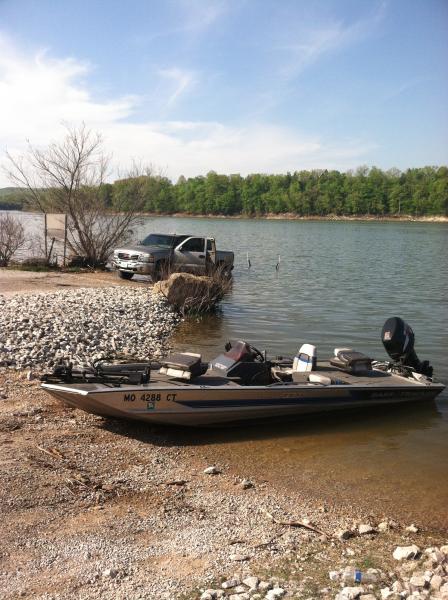
-
When we first started hearing about Zebra Mussels spreading from the Great Lakes region, the reports were so bad that I expected fresh water fishing around here would hardly oullast me (I'm over 60). All the articles talked about these things filtering out all the plankton, starving everything up the food chain including top predators, and lakes and rivers finally ending up with crystal-clear water supporting little life except for the mussels. Turns out, that's not exactly true. This thread caused me to do some online reading about the effect of Zebra Mussels on fisheries, and I found that the comments from fishermen in heavily-infested areas are very mixed. ZM's change fisheries for sure - and they fray braid and cut fishing lines too, but exactly how they change the fishing seems to be different in different places. If we had our 'druthers', I think we'd rather not have them - but we're going to have to put up with them and they don't mean the end of all fishing like some early reports said. Worst thing about it in local lakes is that I think we'll miss out on the only real benefit Zebra Mussels have brought to fishing in other places. Some fishermen up around NY, PA, and OH talk about smallmouth populations and fishing getting a LOT better since the ZM's came. Trouble is, they say that's because clearer water has allowed sunlight to penetrate deeper into their lakes, causing the weedbeds their smallies use for cover to grow and expand into areas where weeds couldn't grow before. Won't do us any good - we don't have water weeds!
-
Above and below Lake Springfield dam
Sam replied to Kolt89eu's topic in Fellows Lake, Springfield Lake, McDaniels Lake
As you unhook bass just run your finger along the top of their tongue. Smooth tongue = Largemouth, sandpaper patch on tongue = Spotted (a.k.a. Kentucky) bass. Smallmouth bass are brown of course, and don't have a stripe on their sides at all. Those are some very nice bass, BTW. -
Thanks for bringing up the chat room, Champ188. I didn't know about it. I just tried it and found no one there, so I left - but now I know how to get there and I know it's a feature that'll come in handy at times.
-
I'm thinking fishing is a lot safer, cheaper, and more wholesome hobby than trolling for strippers in Florida. What's the limit on them, anyway? LOL
-
White bass, a.k.a. sand bass in Oklahoma. I've been looking for those. With so many shad in the upper James River arm right now, you'd think white bass would be busting into them on the surface. I enjoy "chasing the boils" when that happens.
-
What is the problem with kayak fisherman?
Sam replied to OzarksExtremeOutdoors's topic in Table Rock Lake
I'd never crowd anyone in a kayak - I figure that's like a motorcycle on the highway, give 'em extra room because they're more vulnerable than folks in larger vehicles/boats. I'm mostly a crappie fisherman, and the part of boating courtesy I have the most trouble with is being careful to not "cut someone off". That is, so many bass fishermen just go along and pound the banks, it's sometimes hard when I get to a spot to tell if that's what a boat is doing - and if they are, which way they're going. I try not to get in anyone's way. A few of 'em take that to ridiculous lengths, I think. A few times, not often, I've come from the main lake straight in to some crappie brushpile I know and there's a bass boat down the bank a ways - 100 yards or more. Well, I can't tell at first if they're sitting still or moving, or if they're moving which way they may be going along the bank, so I'll go to my brushpile. They're quite a long ways off, and may not even be coming my way. Sure enough a couple of times, 10 minutes later if they do get closer, I've been told "You cut us off.". I always say sorry, I didn't mean to - but if they were 100+ yards off when I pulled in there (and I wouldn't pull in to a bank otherwise), I really think that's a bunch of bull. That's the exception, though - most folks I encounter at the lake are real nice and I don't get in anyone's way if I can help it. -
I'll add that lots of bass were up by those rocky banks, too - spitting out little crawdads as they got unhooked. Fishing with those small tubes, we caught and released short Kentucky bass, ranging from little-bitty up to 14" all day long. One of them sure wasn't a Kentucky, though. As I brought in a perch splashing on top of the water, a bucketmouth black bass of a size I haven't seen in years grabbed the perch and stripped off about 10' of line from my ultra-light in the time it took my jaw to drop. The bass wasn't hooked, the perch was, and I couldn't have handled that fish on such a light rig anyway - but the encounter sure was fun! That big mama will win BB in a tournament for somebody, and it's good to see (and get your rod nearly taken away by) a largemouth of that size.

