


mojorig
-
Posts
434 -
Joined
-
Last visited
-
Days Won
1
Content Type
Profiles
Forums
Blogs
Events
Articles
Video Feed
Gallery
Everything posted by mojorig
-
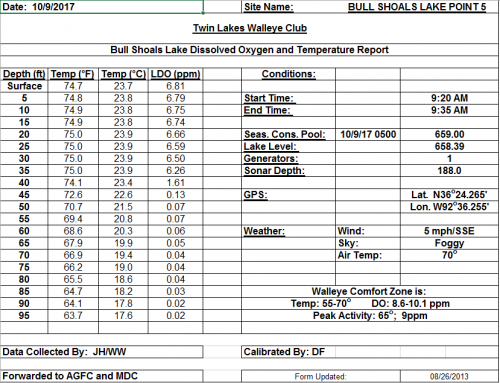
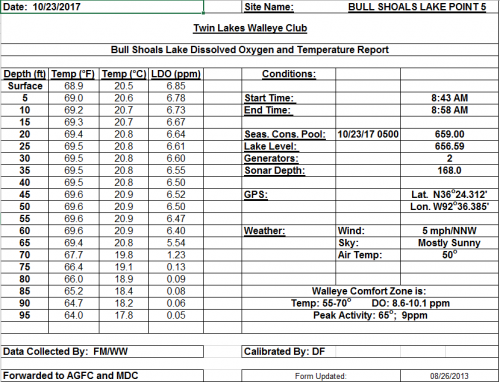
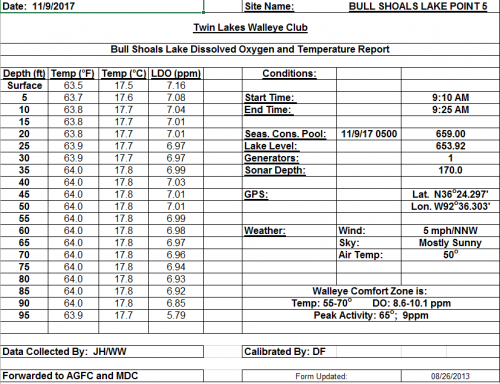
I know this thread has gotten way off course but I just wanted to add some more info to the original conservation about turn over (destratification). This is from Bull Shoals Lake but I bet readings would be very similar to TR. This data was collected by the Twin Lakes Walleye Club at Point 5 on Bull Shoals Lake. The first reading was taken on Oct 9th. At that time, the thermocline was around 35-40 feet deep. The club then took readings on Oct 23rd, again at Point 5. At that time., it appears the lake was in the process of turning over in that area of the lake. You can see the thermocline was now at 65 - 70 feet deep. Finally, the club took readings yesterday (11/9). You can the process of the lake turning over was complete at Point 5. I hope this helps people visually see what is meant by the lake turning over. Thanks, Jeremy
-
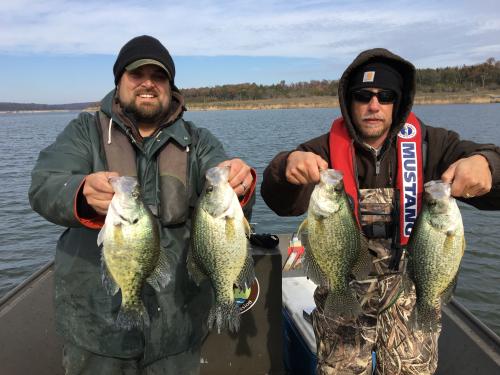
This fall, we have been trying to sample the crappie population in Bull Shoals Lake using lead nets. Traditionally, it has been very difficult to collect crappie from Bull Shoals Lake. This year, we are finally having some success. We have been setting nets in East and West Sugarloaf arms of the lake. Yesterday, 80% of the crappie we sampled (64 out of 80 fish) were 10 inches and longer. Overall, 67% of the crappie sampled have been 10 inches or larger (204 out of 304 crappie). We caught these four crappie in the same net. The smallest was white crappie on the far left that went 13.1 inches. The three Black Crappie measured 14.4 in, 14.4 in and 14.6 inches. We also caught two more 14+ inches in two other nets.
-
- 9
-

-

-
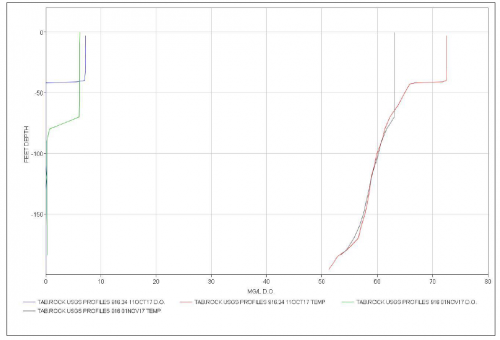
It appears you still have a little bit to go on TR before the lake has completely turned over. As OP mentioned, the lake turnover begins in the creek arms and slowly moves down the lake. I have attached DO and Temp profiles from the TR Dam sent to us by the USACE. Once the temperature is uniform from surface to bottom, then the turn over will be complete. Here is a time series showing the changes in water temperature over time in 1995 at the Norfork Lake Dam. Sorry, I don't have one of these for TR. I got this from a presentation by a limnologist to the Twin Lakes Walleye Club and Norfork Lake Striper Club about Bull Shoals Lake and Norfork Lake. For that year, you can see that the turnover was almost completed at the dam on Nov 7th.
-
No worries, we appreciate you getting the word out about this meeting!!
-
If anyone has any questions about this meeting, feel free to holler at me. We are the ones that arranged for the speaker to attend.
- 1 reply
-
- 1
-
-
If anyone has any questions about this meeting, feel free to holler at me. We are the ones that arranged for the speaker to attend.
-
Holler at us if you need anything AGFC fisheries related concerning the area and the lake. We would be glad to help whether it is about fishing or scuba diving. I have a lot of family members that live or lived in that area of the lake. My grandpa guided out of Hwy 125 (Peel) Boat Dock for many years. Thanks, Jeremy
-
MoCarp, MDC is raising Black River Strain of Walleye to be stocked in the Black River drainage only.
-
Bill is correct that Norfork Lake has had this regulation since 2009. At that time, the Norfork Lake Striper guides and anglers were the ones pushing for this regulation for Norfork Lake.
-
Excellent stuff, MoCarp!!! I like coming on here and learning new stuff!!
-
Yea, Blue catfish love ZM. We have reports of live ZM as deep as 80 ft on Bull Shoals Lake. Bull Shoals Lake Boat Dock found them while retrieving items in their cove.
-
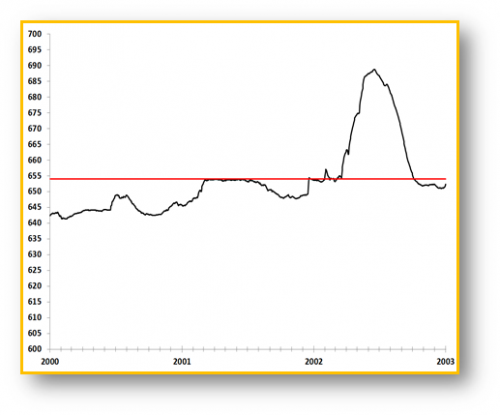
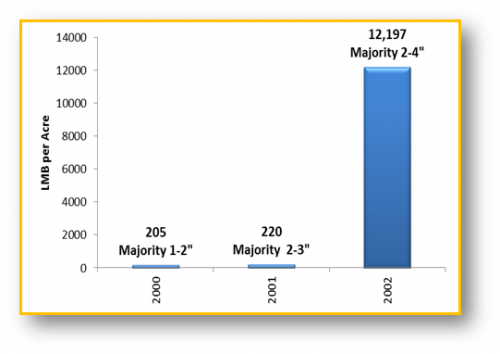
Here is another illustration of the benefits of high water. Yes, I cherry picked this from a presentation. The first graph shows the hydrograph from 2000 through 2002. As you can see, 2002 was a typical high water year. Waters goes up in the spring and doesn't come back to normal until the fall. We believe strong year classes of most sportfish are produced when the water stays in the bushes until the end of August. The second graph shows the results from rotenone samples for those 3 years. This graph shows the estimated number of Young of the Year (YOY; spawned that year) largemouth bass (LMB). You can see in 2000 (low water year) and 2001(normal year), approximately 205 and 220 YOY LMB per acre were collected and they ranged in size from 1-3 inches. You can see that the majority of the LMB in the low water year was smaller than the normal year. This likely resulted in lower overwinter survival of LMB for the low water year. During the high water year of 2002, approximately 12,197 YOY LMB (55 times more LMB) were collected ranging in size from 2-4 inches. The larger size means overwinter survival was likely higher.
-
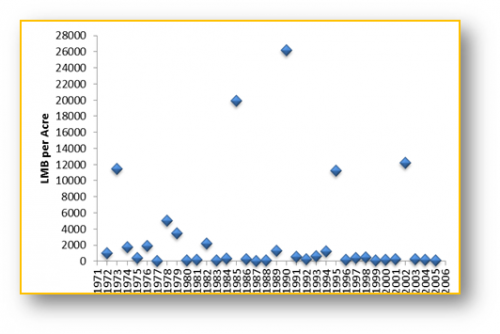
Yes, we stocked 408,400 RE sunfish into Bull Shoals Lake in 2015/16. We plan on raising a crop of RE every third year in the Nursery Pond. In the past, AGFC stocked Norfork Lake with lots of RE but they really never took off. RE really do well in lakes that have some vegetation. Ham had a good review of the year. We have received several comments like Number 5 about the lack of zebra mussels. We will hold back our opinion until the lake gets back to normal pool or even below it. ZM really love that 25 to 30 ft range. High water does great things for Bull Shoals Lake. We realize it makes access difficult and even makes fishing tough. However, the long-term impacts benefit us all. Here is a graph showing the number of LMB per acre collected in old rotenone samples on Bull Shoals Lake. You can definitely see the high water years in that graph.
-
LOL, yes! I probably should have used my words better (My wife tells me that quite often, lol). A better description might have been " due to more water being released through the dam to evacuate water from the flood pool." Here is a little more technical description sent to us when I experienced one of these kills for the first time: "From what I've seen and studied, is, that the higher the pool is at, at the onset of thermal stratification plays a critical role. There's only a finite amount of cold, oxygenated water under the thermocline once it's set up. If the pool is in flood stage at this time, when the flood pool is evacuated by releasing water through the penstock, a substantial amount (the volume of water in the flood pool) of that cold oxygenated water is evacuated from the system. We've seen that wet years (high pool levels in the spring when thermal stratification sets up) are related to poor lower DO seasons in the tailwater below compared to dry years when the thermocline sets up when the pool is at or less than conservation pool elevation."
-
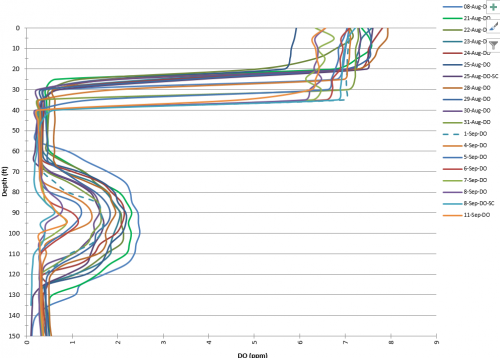
Increased nutrients do contribute to the issue but the biggest contributor is the high amount of generation. The high generation removes the deep refuge of oxygenated water that the Striped Bass use during the late summer months.You can see how the bubble of DO collapses over time. It appears these kills occur when the bubble decreases below 1.5 ppm, which has typically occurred on Labor Day weekend during these high water events. This publication explains some of the general components that occur during a late summer Striped Bass kill like the ones that occur on Norfork Lake. Click Here for Publication
-
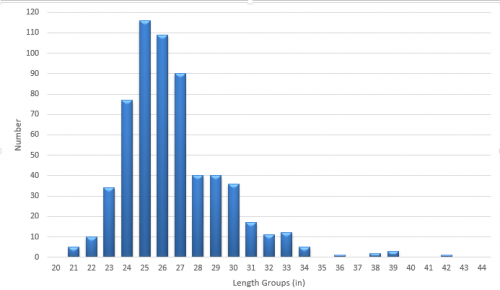
Quick update that we sent out to the Lake Norfork Striper Club (minus the figures): We wanted to give everyone a quick update about the Striped Bass Kill on Norfork Lake. As of Monday (9/11), we have suspended our efforts to collect Striped Bass and DO/Temp readings. The deep bubble of DO is likely gone by this point (Figure # 1). Paul and Cody only saw one Striped Bass on Monday. It was too far gone to be collected. Combining this information with reports of Striped Bass being caught up the lake, we believe this Striped Bass kill is pretty much over. Thus, we will be suspending our efforts and moving on to sample crappie in Bull Shoals Lake. We wanted to give a quick recap of what we collected. As you can see in Figure #2, most of the fish collection occurred on Monday 9/4 and Tuesday 9/5. Overall, we measured 663 Striped Bass ranging in size from 19.5 in. to 42.9 in. (Figure #3). We realize this count is not a true reflection of the actual size of the kill. It is likely just a reflection of the amount of fish we could see. Of those 663 fish, we removed otoliths from 469 Striped Bass. As mentioned in previous emails, we are unable to compare this kill to previous kills due to the difference in the amount of effort during the kill. However, we believe this was a substantial Striped Bass kill.
-
We suspect that we are on the down hill side of the kill. Yesterday, we only picked up 35 or so fish. Of those fish, less than 5 were fresh (red gills). Every year around the end of September, a high percentage of the Striped Bass leave the dam area and head to pass the state line. We are unsure why but we watch guide reports to see when that shift is occurring. You are correct about determining the impact of the kill. It would only be a guess. It would unlikely be an educated guess either. If we were to make a wild guess, it would likely be in the double digits. The reason for that guess is we know we didn't pick up all the dead fish. Some were too far gone. Others got washed into the briars and bushes due to heavy wind and wave action and we just missed them. Finally, not all dead fish float. In fact, studies have shown less than 50% of the fish actually float. So with that being said, we only saw a fraction of the Striped Bass killed.
-
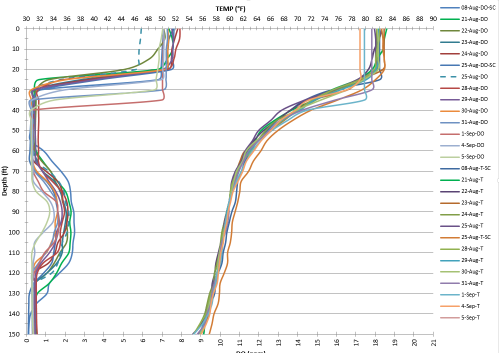
Yes, most fish are found around thermocline (20-30 feet) except for Striped Bass and an occasional Walleye and Hybrid Striped Bass. I have attached a graph that has Temperature and DO. It is very messy. Once a Striped Bass reaches age-3 (about 20 inches), they can't tolerate the water temperature in August and September at the thermocline. These Striped Bass move toward the dam and occupy the deep bubble of DO that has cooler water temperatures that they can tolerate. Basically, they are choosing comfort instead of food. However, in a high water year, lots of generations cause this bubble to collapse. This results in these Striped Bass kills. The USACE at the dam will be dealing with the low DO issue until the lake turns over around late October/early November. It is going to be a long fall for them.
-
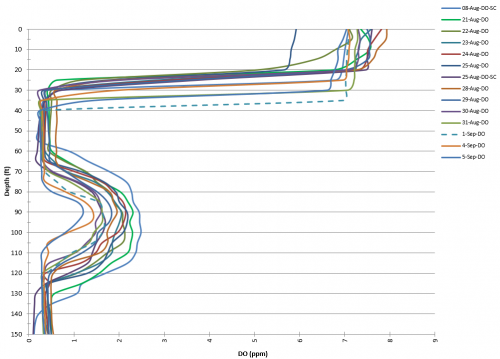
Yes, there is a Striped Bass kill occurring at the Norfork Dam. We knew it was coming. We have been out every weekday since August 21st collecting dissolved oxygen readings and Striped Bass. I have attached a graph showing DO levels at the dam. You can see the deep water refuge for Striped Bass has collapsed. It is called a "Temperature-Oxygen Squeeze." This is fairly common during a high water year on Norfork Lake due to high generation and organic loads. Some reason these kills always occurs on or around Labor Day. These fish kills are mostly Striped Bass with an occasional Hybrid Striped Bass or Walleye (less than 10 of these have been observed). Similar kills have occurred in 2002, 2004, 2011, and 2015. This year, the major portion of the kill occurred Sunday Night (9/3) and Monday (9/4). We have picked up 621 Striped Bass (see length frequency below). Of those 621, 141 were collected on Monday (9/4) and 228 on Tuesday (9/5). We are measuring each fish that are not too far gone and have removed otoliths from over 500 fish to be aged. We plan on being out there every day this week and then shifting to every other day for the next week or so.
-
Yep, we are starting to receive calls about these on Bull Shoals. I suspect we will receive calls about them on Norfork Lake soon. You should hear some of the descriptions of these by callers. It can be very entertaining at times.
-
Welcome!! If you have any questions about the fisheries in NC AR, you can holler at us. We enjoy talking about fishing!!
-
I got mine on eBay from the guy that runs Joe bass. I believe Sportsmans Factory Outlet in Springfield already has them too.
-
They are all ready for sale. Ive had these colors for about 3 weeks now.
-
The day this article started circulating, we received two phones call from people that were very concerned, lol.
-

AGFC D-2 Fisheries 2017 First Biannual Newsletter
mojorig replied to mojorig's topic in Lake Norfork
During normal generation, it appears the lake can drop 0.10 to 0.20 feet per day. The USACE is forecasting Norfork Lake to be back to normal on October 14th. On a side note, we realize that the high water makes it difficult for users to get on Norfork and for anglers to fish it. However, our data has shown that high water past the end of August significantly benefits the sport fish populations in the lake (except for larger striped bass).


