
Phil Lilley
-
Posts
19,030 -
Joined
-
Last visited
-
Days Won
132
Content Type
Profiles
Forums
Blogs
Events
Articles
Video Feed
Gallery
Everything posted by Phil Lilley
-
Actually they haven't ran water at Table Rock Dam the last couple of weekends. They are running water during the week though.
-
That's what this is... a fishing report, not a catching report. Got skunked. Fished from about 4 till dark. Tried from the dam at Powersite to Barker Hole. All my spots. Water temp colder than Sunday - 49 most places.
-
I don't think there's even a topo map of Taney... good luck finding one.
-
It was ugly... if Butler could have just even made 1 or 2 key 3's towards the end, they could have pulled it off. Great exposure for the school and coach. Class act. Hope we see them again next year in the tournament.
-
I think so. MDC protects them up in Swan during their spawn.
-
Yea Martin but I bet you're hitting the fence rows later this week for those sh'rooms!!
-
After the spawn, we usually catch walleyes with big bellies and find fat in them. Here it's the first of April and you wouldn't think you'd find a sow full of eggs on the main lake but we did and she was. I was surprised. I'm not saying I would have released her if I knew she had eggs... it wasn't mine to release anyhow - it was Tom's. Did catch a short walleye too- about 12 inches.
-
I have several articles on jig fishing on this site. Start there. I have an old video too. Need to do more. Planning on it this summer. Float or not to float- depends on conditions, not what's the best. Need to know how to do both.
-
Learn to fish with jigs.
-
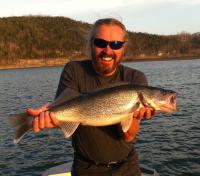
Put in at River Run about 5. Tried the rock pile- nothing going on there. Tried the high dirt banks on the west/channel side- nothing. Tried the Willow Bank- nothing. Went down to Barker and fished the outside bend. Found some dirty water and caught 3 nice whites, a short crappie and walleye and then Tom hooked this walleye. About 24 inches. Just before dark we went up to the mouth of Swan and tried it there- Tom caught 2 more nice whites. All on either motor oil/red glitter or electric purple swimming minnows. Hardly anyone out- on the banks or boats. Was surprised.
-
Yea- it didn't come right up but it's working for me on the forum too. The mom just fed the one day old eaglet for the first time a few minutes ago. Pretty amazing.
-
 <table border="0" cellspacing="0" cellpadding="0" width="100%"> <tr> <td><p>Blue Ribbon Fly Shop Dry Fly Series - Part Two: Sulphurs and Crane flies</p> <p><em><img src="http://forums.ozarkanglers.com/images/2011/855.jpg" width="310" height="102"></em></p> <p><em>Using one pattern to fish two of the most significant big fish hatches in the Ozarks</em></p> <p>First off, it is important to understand that certain insects have 'regional' names that depict what they actually are. Sulphurs are a perfect example of this phenomenon in dialect. In the Ozarks, a small to medium-sized yellow mayfly is usually referred to as a "sulphur", but in other parts of the country, this exact same insect is called a Pale Morning Dun (PMD). Regardless of what they are called, this bug has a reputation for bringing very large fish to the surface, and they can be found in almost any coldwater fishery. On the other hand, a crane fly is always a crane fly, but they do vary in size quite drastically, depending on the particular river.</p> <p><strong>Sulphurs</strong><strong> </strong></p> <p align="center"><img src="http://forums.ozarkanglers.com/images/2011/854.jpg" width="310" height="242"></p> <p>This hatch usually starts to show up on the White River in the middle to the latter part of April, but the timing of their emergence depends on air temperatures as well as the weather conditions. If the spring has been warm and sunny, look for sulphurs to start coming off earlier than they would than if temperatures have been cold with cloudy skies. Also, a brisk wind can literally blow the duns off the surface, which will abruptly put an end to the dry fly action. Sulphurs typically range from a size #14 down to a size #20, but on the White, the bigger varieties seem to work the best. Their bodies are normally yellow (but not always), and their wing colors range from clear to off-white. Sometimes, the underside of their body can be off-white, as well.</p> <p>On the Norfork, sulphurs usually start hatching in the beginning of May if the water is low. Because the dynamics vary so much when comparing the 'Fork to the White, you will rarely see any sulphurs on the Norfork if there is any water running at all, except in a few slack water areas behind islands, and the fish don't pay much attention to them over there unless the river is dead low. Because the White is a much wider river that runs relatively slow in the pool sections when there are two to five generators in operation, it is common to see sulphurs blanketing the water in certain spots, even during relatively high flows. Unlike on the Norfork, quite a few fish will come to the surface to grab a sulphur on the White when the water is running, and it is very possible to have a good day fishing the surface during a myriad of different conditions on that river. Still, when most anglers think of fishing with dries, they envision working a soft riffle or run on foot, and the most productive sulphur fishing on either river is going to happen when the water is falling or dead low.</p> <p>There are many productive spots on both the White and Norfork to get in on a sulphur hatch, and typically, the best zones are going to be away from the dams. Although there are exceptions, you will start to see more and more sulphurs on the White from Gaston's Resort down to the Narrows, and once you get to Wildcat Shoals, the dry fly fishing is typically prime all the way to Buffalo City. Although there have been instances where a heavy hatch of sulphurs started coming off in the Dock Hole on the Norfork, the real action normally takes place from McClellan's Shoal all the way down to its confluence with the White.</p> <p><img src="http://forums.ozarkanglers.com/images/2011/656.jpg" width="250" height="210" hspace="4" vspace="4" align="right">The sulphur hatch is just like any other mayfly hatch; which means fishermen need to expect the unexpected. There will be times where our trout will hit any fly that even closely resembles this insect with reckless abandonment, and there will also be periods when the fish will become somewhat selective. As previously mentioned, sudden brisk winds can blow almost all the bugs off the water, which will often cause the trout to move to the bottom to feed on nymphs. Another predicament occurs when the sulphurs only remain on the water for a split-second before flying away, and there will even be times when they will not even be on the water at all, but they can still be seen flying around. There are reasons for all this behavior, but for the sake of simplicity, the best situation from a fishing perspective is when sulphurs are coming off and end up staying on the water for a long time. If this happens, there will likely be fish rising all over the place. </p> <p>The White River and Norfork Tailwater are not well known for 'masking' hatches, but it is important to pay close attention to how the fish are feeding, especially before a hatch is likely to take place. If the rises are such that you don't see any part of their mouth breach the surface (but you can see their body and fins), the trout are probably keyed-in on emerging nymphs. For this reason, look for mayfly nymphs near the surface in slow water, and if there are quite a few moving around, a dry/dropper rig is likely going to be the most effective setup. Although the bodies of the adults are yellow, the nymphs are brown, so keep this in mind during the fly selection process. A standard pheasant tail works well as a sulphur emerger in sizes #16 and #18, but don't be afraid to try a variety of different patterns.</p> <p>As far as imitating the sulphur duns, any number of yellow or pale yellow mayfly dry flies will do the trick; White River Basin trout do not rely on adult insects for sustenance, so they rarely get overly selective during a good hatch. The key is to make sure that your fly is floating high on the surface, and you should be in business. It is not uncommon for sulphurs and caddis to hatch simultaneously, but these trout are extremely opportunistic, so they often feed on any adult insect that happens to be floating by - in a way, you can "pick your poison" on these rivers.</p> <p>Many of the locals and guides have a special place in their heart for a sulphur emergence. This hatch is known for fooling some of the wiliest fish on both rivers, and sulphur imitations are relatively easy to see compared to the midges and Blue Winged Olives that are effective most of the year. It is difficult to plan a trip to the White or the Norfork just to fish dry flies, but if you do find yourself wading either river from late April through July, make sure that you come prepared. When the fish are 'on', it's possible to get a rise on literally every cast, and there are times when a sulphur dun pattern will catch more fish than any other fly in your box. Exceptional dry fly opportunities do not occur all that often in the Ozarks, but when they do, the surface fishing is as good as it gets.</p> <p><strong>Crane flies</strong></p> <div align="center"> <table border="0" cellpadding="0" width="320"> <tr> <td width="320"><p align="center"><img src="http://forums.ozarkanglers.com/images/2011/855.jpg" width="310" height="102"> </p></td> </tr> <tr> <td><p align="center"> Crane Fly Larva</p></td> </tr> </table> </div> <p> </p> <p>Unlike sulphur mayflies that go through an entire aquatic lifecycle, crane fly pupa and larva actually emerge from wet banks before taking flight. For these reasons, fishing with crane fly nymphs and emergers doesn't often produce very well, as the fish rarely get a glimpse at these morsels. Our adult crane flies are about the same size as sulphurs, but they do have long long legs; in a way, they resemble a large, yellow mosquito.</p> <p>Crane flies are extremely inept at flying, and this is their biggest downfall. It does not take much of a breeze to cause these insects to start cart wheeling on the water's surface, and at that point, they are an easy meal for the fish. There are very few crane flies on the White, but they are common in the catch and release area of the Norfork. It is easy to recognize when the trout are keyed-in on this bug because the rise forms will be aggressive and 'splashy'; similar to when there are egg-laying caddis bouncing on the surface.</p> <p>On some waterways where the fish see a lot of crane flies, it may be necessary to tie a leggy pattern to fool the most discriminating of fish, but on the Norfork, almost any sulphur imitation will do the trick. The Norfork crane flies are quite small compared to the bigger specimens that are found on other river systems. Since the Ozark version is diminutive and is almost the exact same color as the sulphurs, anglers have the opportunity to basically fish two hatches at once. If the fish are slurping sulphurs, a dead drift presentation is the way to go, but when the breeze kicks up and crane flies start getting 'trapped' on the water, the only change needed is to apply some movement to the fly (skating). On many days, a simple sulphur pattern is all that is needed to effectively fish two hatches.</p> <p><strong>Thoughts on 2011</strong></p> <p>At the time of this writing, it is not clear whether or not there will be an abundance of dry fly opportunities this year, but regardless, if you are going to fish the White or Norfork from April through July, it is critical to have a good selection of sulphur (PMD) patterns. Hatches on these rivers are usually simultaneous, with caddis, midges and sulphurs all coming off at the same time, so any pattern that can effectively imitate more than one insect will make the dry fly fishing experience easier and more enjoyable. There is no reason to carry 1000's of flies with you when fishing the Ozarks - it is smarter to concentrate on stuffing your boxes with a bunch of the standards that will always work. The White and Norfork are not technical fisheries and the trout are feeding machines. Having the proper presentation that best imitates what the fish are feeding on is paramount than the actual fly used. This concept holds true for both nymph and dry fly fishing.</p> <p><strong>Updated Report for early April</strong></p> <p><em>Recent rains have the lakes in a state of flux, but the excellent fishing continues</em></p> <table border="0" cellpadding="0" width="500"> <tr> <td width="649"><p align="center"><img src="http://forums.ozarkanglers.com/images/2011/861.jpg" width="464" height="263"></p></td> </tr> <tr> <td><p align="center"><em>Mike M. a repeat client, threw streamers on this trip and was rewarded with this fattie that breached the water multiple times.</em></p></td> </tr> </table> <p><img src="http://forums.ozarkanglers.com/images/2011/850.jpg" width="250" height="431" hspace="5" vspace="5" align="right">Rarely are water conditions on the White River and Norfork Tailwater such that there are flows that will make everyone happy, but such is the case right now on both rivers. Although the region has seen some steady and moderate rain events of late, both lakes are still below power pool, so the Corp of Engineers is basing their release patterns based on power demand and they also seem to simply be moving water around. On the White, flows have ranged from high (up to six units worth of water) to dead low, and this has kept the fish fresh, active and strong. Norfork was low for the majority of March, and that river was in need of a flushing because the fishing was starting to get stale. Currently, releases in the one-unit range are occurring most mornings and evenings over there, and this has really rejuvenated the entire river - especially the lower end that was in need of some good water. </p> <p>March came in like a lamb and out like a lion, and a string of cool, cloudy and rainy days made the fishing a bit unpredictable. The caddis are starting to pop on sunny days, and the fish are taking notice, but if the clouds come in or the wind started kicking, the surface activity has been shutting off like someone turned a switch. Fortunately, there are quite a few sunny days in the extended forecast, and this should mean that we will see our first steady dry fly action on the White, especially on days when the water is low and temperatures are warm. It is still a little early for the caddis to start really hatching on the Norfork, but if April is dry, by the third week of the month, it should also be a 'bug factory', with caddis, craneflies, sulfurs (PMDs) and midges hatching, sometimes all at the same time. One thing that gets overlooked quite a bit on both rivers is that these are relatively 'new' fisheries from a coldwater perspective, and the aquatic life is constantly defining itself. Every low-water year, it seems that anglers report seeing new species of mayflies and other insects, so it is wise to be prepared with a variety of patterns in an array of different sizes and colors. The bugs mentioned above are pretty much staples, but never rule anything out - if you think you are seeing some Hendricksons or other types of mayflies, you probably are, and the massive flooding in 2008 was a good thing from a hatch perspective because it gave the rivers a good 'cleaning'. Free-flowing rivers flood pretty much every year, and this process adds diversity to the overall aquatic biomass. Since our flows are radically different from one year to the next, and heavy flooding is quite rare, the White and Norfork are constantly changing. In ten to twenty years, it's possible that the insect life will be far more diverse than it is now. It is really quite interesting to be able to witness the evolution of our fisheries, and it also keeps fly fishermen on their toes. </p> <p><img src="http://forums.ozarkanglers.com/images/2011/851.jpg" width="250" height="154" hspace="5" vspace="5" align="right">Until the dry fly fishing really starts to get rolling, be prepared to fish a variety of nymph patterns - water levels will usually dictate what flies are going to produce the best. We have been doing well on patterns in sizes #14 to #22, depending on flow rates and where we are fishing. Caddis pupa imitations like Minch's Hare and Copper along with standards like bead head caddis have been hammering fish of late on the White. Also, our new tungsten beaded Prince Nymph and standard versions of this same fly are producing quite regularly. Small streamers like 56'ers (green and orange variations) as well as cone head olive Wooly Buggers are turning some nice fish, especially during periods when flows are moderate. The fly shop is also fully stocked with many varieties of soft hackle patterns, and using these flies is a good way to scratch your dry fly 'itch' during times when the caddis are not hatching but the nymph forms of this insect are active. Basically, the way to fish a soft hackle during such conditions is to tie a single pattern to the end of a 5x or 6x leader that has about three feet of tippet attached. Look for slow-moving areas where fish are feeding just below the surface and then make a long cast, allowing the fly to 'swing' into the feeding lanes while stripping your line and softly at various speeds. Often, you will get the pleasure of actually seeing the fish rise to eat your offering, and using a soft hackle presentation is always a good way to catch lots of fish right before a major hatch is about to crank up. </p> <p><img src="http://forums.ozarkanglers.com/images/2011/852.jpg" width="250" height="131" hspace="4" vspace="4" align="right">On the Norfork, small midges, scuds and sow bugs have been the ticket, and in general, the fish are pickier over there than they are on the White, especially on calm days. This is because the 'Fork gets the brunt of the wading pressure, and the bigger fish have seen it all. Now that higher flows are starting to get a little steadier on the Norfork, you will need to be extra aware that the water could come up at any time. One unit running on this narrow tailwater is quite a bit of flow that can result in a one to three-foot rise. If you do get stuck on the wrong size of the river or a long way from your vehicle, accept the fact that you may have a good walk ahead of you - never try and cross this river if the water is running even just a little bit. Most of the time, a boat (or car) will come along and give you a lift back to your access. In general, you don't want to venture very far downstream of where you are parked, and walking more than a quarter mile upstream is asking for trouble. Feel free to stop into the shop and we will show you how to safely approach this tailwater safely by making sure you know the major landmarks not to wade past.</p> <p>We are now adding a new feature to the first of the month newsletter which is intended to provide synapses of what to expect for that particular month based on the fishing, water conditions and weather of years past. Hopefully, this will make it easier to decide what month is best for the type of fishing you like to do, but please keep in mind that this section is just a general summary; things can (and will) change, but it still will provide a good overall idea. Please let us know what you think, and as always, we hope to see you all on the river or in the fly shop this spring.</p> <p align="center"><strong>For daily river updates, visit the Event section on the right-hand side of the home page @ <a href="http://r20.rs6.net/tn.jsp?llr=poq6jhcab&et=1105026564040&s=1720&e=001D8IO0iQOyckOmPYghfOHRrC9hHAxhXsCLDwj3bYfHlyi5pAGBIuaeEEaul1WHyPszaWM7AWfx4bFnxNk_SyWF2HcU_kUSPaMVMJfAnC9N4WkgwtjF-3_5LxyjBztZQCn">www.blueribbonflyfish.com</a>. Guide trip inquiries may be directed to blueribbonflyfish@hotmail.com or by calling the shop @ 870.425.0447</strong></p></td> </tr> </table> <table border="0" cellspacing="0" cellpadding="0" width="100%" bgcolor="blue"> <tr> <td><p align="center"></p></td> </tr> </table> <table border="0" cellspacing="0" cellpadding="0" width="100%"> <tr> <td><div> <p><strong>April Fly Fishing</strong></p> </div> <p><em>P</em><em>ossibly the best overall month for fishing the White River and Norfork Tailwater</em></p> <p><img src="http://forums.ozarkanglers.com/images/2011/853.jpg" width="250" height="188" hspace="5" vspace="5" align="right">While many tailwater trout fisheries around the country are just starting to thaw out and fish well, things have already been going strong on the year-round White River and Norfork Tailwater for two solid months. This is one of the many unique features of these two rivers where water temperatures vary little throughout the year. For this reason, it may seem like the quality of the fishing wouldn't change much from month to month, but this couldn't be further from the truth. Factors like air temperature, the length of the days, barometric pressure and precipitation can all make a difference, and April is the first month of the year where the dynamics to become extremely favorable for both anglers and the trout they are trying to catch.</p> <p>The steady and strong winds of March start to dissipate in April, which makes the fishing experience more comfortable, and for the first time all year, temperatures start to become steadily warmer with highs typically in the upper 60's to the upper 70's. Couple this with longer days due to daylight's savings time, and for the first time since the previous fall, long and warm days begin to become predominant. Some potential visitors to the area are put off by increased chances for rain, possibly because of the old adage that April showers bring May showers, but because of the geography of northern Arkansas and the typical positioning of the jet stream this time of year, May and especially June are statistically wetter months. This does not mean that April is dry, but when it does rain, it is srarely an all day event is likely y occue. Of course, precipitation varies from year to year, but April in theatisuvaalh Ozarks is not typically as wet as what is experienced in other parts of the country.</p> <table border="0" cellpadding="0" width="500"> <tr> <td width="649"><p align="center"><img src="http://forums.ozarkanglers.com/images/2011/856.jpg" width="500" height="191"> </p></td> </tr> <tr> <td><p align="center"><em>One of Forrest's clients nailed this big boy on a caddis @ Rim Shoals recently.</em></p></td> </tr> </table> <p>>From a fishing perspective, April is perhaps the best overall month of the year. Wherein March is usually "condition dependant" as far as fish activity goes with low-water and breezy days being the best; in April, the bite shifts, and the trout seem to be consistently active no matter what the water conditions are. If the rivers are low, expect a phenomenal experience, but high water is also usually excellent, as well. With slightly warmer river temperatures, the White and Norfork's aquatic biomass seems to really come to life, especially with respect to minnows, crayfish and sculpins, and with all this 'big' food becoming available, many of the larger fish that have spent the winter and early spring spawning become very active. Therefore, April is also a great month to hook into one of the river's famous predators, and the overall quality of the fish seems to spike during this month.</p> <p>March is one of the two busiest months on the White and Norfork as far as crowds are concerned (October being the other) because of the combination of spring break and the fact that a March fishing trip to the Ozarks is the perfect cure for cabin fever. Although April is far more favorable with respect to conditions than March, it is common to see surprisingly few people out on the water, especially during the week. This decrease in pressure also bodes well for finding active fish, thus making April the perfect month to sneak away from work for a few days during the week and get into some of the best fishing of the year anywhere in the country.</p> <table border="0" cellpadding="0" width="500"> <tr> <td width="649"><p align="center"><img src="http://forums.ozarkanglers.com/images/2011/857.jpg" width="440" height="331"></p></td> </tr> <tr> <td><p align="center"><em>Guide Pat Moore and a colorful Wildcat Shoals brown. </em></p></td> </tr> </table> <p>Tailwater fisheries are typically known for their nymph fishing, but as April wears on, there can be some great hatches of caddis and sulphurs (PMDs). This activity will be strongest on the White, and there will be days when the surface of the water will literally be a carpet of insects. So, if you feel that you missed out by not getting to the White or Norfork so far this year, think again. The lakes are still a few feet low, so there will almost always be some good wading conditions somewhere unless heavy rains start to fall. If you are an opportunistic angler who keeps an eye on the weather, you'll take notice that now is the perfect time to take a trip to the Ozarks for some fly fishing. If (or when) the lakes do get high, the number of low-water opportunities will drop of significantly, but in April, that is of little consequence because the fish are most likely going to be active on all water conditions.</p> <p>If you only have one chance a year to trout fish in Arkansas, April is a safe bet. Still, as you will see in next month's newsletter, May is not too shabby, either, but April definitely takes the cake.</p></td> </tr> </table>
 -
Well I thought it would play live. Here's the link to the site- http://www.ustream.tv/decoraheagles
-
Pretty cool stuff. I've been watching for a couple of days. There's some "best of" youtube videos too. Go to the site to find them. <object classid="clsid:d27cdb6e-ae6d-11cf-96b8-444553540000" width="480" height="296" id="utv998840"><param name="flashvars" value="autoplay=false&brand=embed&cid=3064708&v3=1"/><param name="allowfullscreen" value="true"/><param name="allowscriptaccess" value="always"/><param name="movie" value="http://www.ustream.tv/flash/viewer.swf"/><embed'>http://www.ustream.tv/flash/viewer.swf"/><embed flashvars="autoplay=false&brand=embed&cid=3064708&v3=1" width="480" height="296" allowfullscreen="true" allowscriptaccess="always" id="utv998840" name="utv_n_970925" src="http://www.ustream.tv/flash/viewer.swf" type="application/x-shockwave-flash" /></object><br /><a href="http://www.ustream.tv/" style="padding: 2px 0px 4px; width: 400px; background: #ffffff; display: block; color: #000000; font-weight: normal; font-size: 10px; text-decoration: underline; text-align: center;" target="_blank">Free Videos by Ustream.TV</a>
-
Thanks for the pics and report. I don't think it's any different on any fishing forum. If anyone, including myself, post a report and show/say that I kept a trophy fish, especially a rainbow or bass, something will be said by a few on the board. It's just the nature of forums. And it's not just keeping fish- it's handling fish, where you fish, how you fish, what bait you're using, what you're wearing... well may be not that bad. There's always going to be a few who call you out on something but behind them there's going to be dozens who appreciate the report, even those who aren't registered members who can't post. But if you do post that you've kept a fish, don't be surprised or offended if someone says something... cause they probably will.
-
Truman's a crappie catchin' lake, isn't it? I've never fished there. I have fished below the dam. I've heard the arms are the best areas.
-
Thanks for the report. It really is good when ppl post reports even when you don't find fish. I think it's going to take a few warm days- and nights- to bring the whites back into the creeks.
-
There's one thing to know about forums... you're not going to be cut much slack at times. This forum is all about education. Unfortunately, sometimes the teaching is pretty harsh. Don't take is personally. Thanks for the report.
-
That's Bull Creek. 160 crosses it at Walnut Shade and F Highway crosses it near the "town" of Bull Creek. Don't know about access to the creek at 160- I think you can get to it right there at the bridge. Off F, drive into the gas station and straight on back thru the trailers to a parking lot near a pavilion. You can park there and walk back to the creek. Bull Creek empties into Lake Taneycomo. Bear Creek empties into Bull Creek.
-
He's lucky he wasn't caught. Both agents have been over there watching - almost every day last week when they were running good. They mainly catch people double dipping- catching a limit, taking them home and then returning to catch more.
-
Rapala of course. Pointers, rouges. About any stick bait you'd use for bass.
-
I use my spinning rods (Falcon blanks), Lilleys' LT6 rods- 6' med lite action and Presidents 6725 reels.
-
Stripers - Bull Shoals Fishery Meeting
Phil Lilley replied to Phil Lilley's topic in Upper Bull Shoals
I spoke to a couple of biologist- both from MO and ARK at the meeting. They are suggesting stocking 19k 2-inch fingerlings in 2012- that's less than 1/2 fish per acre compared to Norfork, Beaver and another lake in ARK who stock 7 per acre. AJ Pratt said they would pull the plug on the stocking if they saw it wasn't working. They wouldn't be suggesting this unless they believed the lake could sustain the additional fish population. There wasn't that many people at the meeting- may be 20. But I left before 7 pm. I left a comment card. -
<p><img src="http://forums.ozarkanglers.com/images/2011/3-20-500.jpg" width="500" height="158"></p> <p>I was reminded of a fishing fact this past week. Fish don't like high blue skies and high pressure for an extended period of time. My last report I spelled that out and fishing didn't get better till this cold front rolled in and brought rain, wind and cold temperatures. <br> Now, they're running water alittle more often- that 25mw generation all day trend has started again. Table Rock has bumped up 6 inches from the rain yesterday and is still well below what it usually is for the beginning of April. This is good for boaters but not so good for those who want to wade below the dam. <table> <tr> <td><img src="http://forums.ozarkanglers.com/images/2011/3-21a.jpg" width="250" height="167" hspace="3" vspace="3"></td> <td><img src="http://forums.ozarkanglers.com/images/2011/3-20b.jpg" width="250" height="167" hspace="3" vspace="3"></td> </tr> </table> <p> Bill Babler, one of our guides, ventured out yesterday in the cold and rain. While the water was not running mid to late morning, they fished up below Lookout using olive/orange head micro jigs under an indicator 6 feet deep, using 2-pound line and they caught many rainbows in the 15-19 inch range, beautifully colored up and fat. He said they finished their trip drifting night crawlers below Fall Creek after the water started and caught plenty of nice rainbows to fill their limit. </p> <p>Bill is also throwing crank baits, like the pointer shown in the image above, and catching some nice browns lately. He's going out early when the water is running and fishing bluff, channel banks from the dam down to Branson. When throwing crank baits, you'll see and have quite a few "follows" and hits but hooking and keeping browns and rainbows on the line to the net is difficult. Try casting and jerking the bait down, then use a stop and go retrieve, letting the bait suspend in the water between jerks. Did I mention using suspending baits? Water running, darker times of the days or cloudy and rainy days are best times to target browns.</p> <p>This brown was caught and released last week. It was 25 inches and weighed about 8 pounds.<br> Another guide, Steve Dickey, says he’s been alittle frustrated with generation patterns lately. “It messes with the trout when they keep turning the water off and on, varying the flow all day”, said Dickey. But despite these conditions, trout fishing has been good, according to Steve.</p> <p>He’s been fishing mainly the trophy area and using a variety of techniques. Best fishing is when they’re running water. His best scud is a #14 or #12 dark possum brown scud under an indicator using either an egg fly or a white chammy worm as an atrractant, getting the flies to the bottom with a split shot. When the water is off he’s throwing a black #18 zebra midge, copper head under an indicator. He said a client caught a 5-pound rainbow on the zebra last week.<br> I touched on this in my last report and it still holds true. Those who add a couple of feet of 2-pound line will catch more fish, especially if the water is not moving. This goes for those using live bait and throwing small jigs. If you're casting lures like spoons, spinners and small crank baits, you can get away with using 4-pound line.</p> <p>Some of the guys this past weekend boated down and fishing up some of the creeks downtown including Turkey and Roark. They threw spinners and cleos and did pretty well on rainbows. Now white bass will move into Roark Creek when the water warms up again and they’ll take a white jig, small crank bait or a white rooster tail. Usually you’ll find them in there early and late in the day.</p>
-
Stripers - Bull Shoals Fishery Meeting
Phil Lilley replied to Phil Lilley's topic in Upper Bull Shoals
I'm going to the meeting tonight and then driving to below Powersite and do some fishing. I lean to the side to not stock stripers. The lake is a good fishing lake now. Good crappie and whites are making a big comeback. Good bass and good walleye. Some stripers but not enough for anyone to make a special trip to fish for them. You have Norfork and Beaver is you want to go for stripers- but these lakes are not in Missouri. Now, if MDC is going to put stripers in the lake, why not stock hybrids too? If you're going to do it, go for it all! Not saying I'm for it BUT if you're going to add the big, aggressive stripers, I would vote for adding hybrids too. I'm sure MDC knows if the lake can sustain additional fish populations, numbers. I'd be concerned they would overpopulate the lake and we'd lose some of what we have now to big fish populations.
