


fishinwrench
-
Posts
26,548 -
Joined
-
Last visited
-
Days Won
364
Content Type
Profiles
Forums
Blogs
Events
Articles
Video Feed
Gallery
Everything posted by fishinwrench
-

New tool for the shop.
fishinwrench replied to fishinwrench's topic in Tips & Tricks, Boat Help and Product Review
Heck yeah! Bring it and we'll go sling some bass bugs. -
New tool for the shop.
fishinwrench replied to fishinwrench's topic in Tips & Tricks, Boat Help and Product Review
I have 3 trucks with 4L60E's, I need your # in my contacts list !! 😊 -
Impressive! Cables actually don't "wear out", the outer casing either rots away or the silicone lube inside them dries out and gets crusty causing them to get real stiff.
-
New tool for the shop.
fishinwrench replied to fishinwrench's topic in Tips & Tricks, Boat Help and Product Review
Just finished up an Optimax with an exploded compressor. Still have a Merc 150 EFI with a broken crankshaft, a Merc 90 Bigfoot with a mysterious miss (sometimes), a control cable swap and tune-up on a Tohatsu 3 cylinder, an old Johnson GT150 that is running rough and burning too much fuel, a Merc 130 with tilt/trim problems, and an old Charger trailer that needs wheel bearings. Oh, and a Ranger that needs new carpet (mine). All are awaiting the end of my nap. Anybody need some part-time work? Preferrably before the phone rings again. ☺️ -
New tool for the shop.
fishinwrench replied to fishinwrench's topic in Tips & Tricks, Boat Help and Product Review
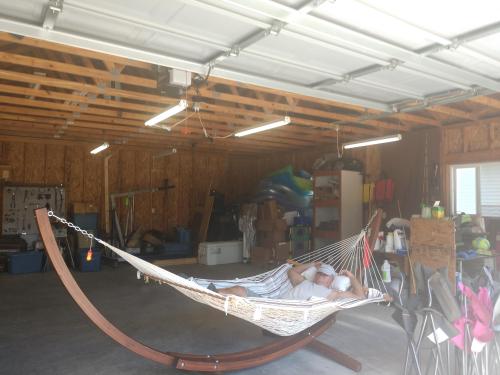
It's a new age Creeper. 😊 Actually it is my wife's birthday present. I only got to test drive it because I put it together. 🙄 -
This should speed work up around here exponentially!
- 11 replies
-
- 12
-

-

-
Because everyone wants their boat to drive like their car. Race cars don't have power steering. The biggest problem will come as the boat ages. Not everyone gets a new boat every 6-8 years, and hydraulic steering works fine until all of a sudden it doesn't. I just am programmed to look at it from a durability/dependability point of view. I won't "work on" a hydraulic steering system for liability reasons, if any part of the system needs service then I replace the entire system. I won't replace a seal, cylinder, bushing, bracket, or hose. It's all or nothing.
-
As I posted earlier, the benefit of cable steering is twofold. #1. You are in direct contact with the steering arm, so any slop or binding is obvious, and you're more likely to know when there is a problem in the steering system. And you'll know it before the boat ever leaves the trailer. #2. Cables only last 5-7 years before they begin to get so stiff that they have to be replaced, so you are forced to service the steering system before catastrophic failure like "total loss of control" happens. I've seen stuff like batteries shifting and kinking a hydraulic steering hose, then when the steering wheel was turned the hose ruptured. Motor can now flop around freely with no control. I've also replaced a system after a guys kid got in his boat while on the trailer and cranked the wheel while the motor was secured by the transom saver. It cleanly broke the flat cylinder mount. What if it had only cracked, and the kid never said anything??? Or how about the guy at Truman on a windy day whose boat drifted back into a tree, motor hits tree but hydraulic steering kept the motor from turning sideways... Something had to give, and it was the hydraulic cylinder bracket. If it had been Cable steering the motor would have been shoved sideways against the stops and nothing would have broken. Sure it's great to be able to steer the motor with your pinky finger, but don't ignore the fact that the reason that is possible is because of the assisted torque of the hydraulics. I can lift my truck off the ground with one finger too if using a hydraulic jack. You don't think the same type of force can break a 3/8" bolt or a 3/16" plate of steel? I'm here to tell ya YES IT CAN. You can hold the motor from turning with a cable system and you can't crank hard enough on the steering wheel to break anything. The connection between your hands and that motor is way more reliable and durable with cables.
-
I assume a company like that has a "shop" with quality folks trained in Automotive and Marine mechanics? Some specific Amphibious watercraft knowledge? I noticed as that duck was going down the engine and outdrive was steady running with no signs of steam from a flooded engine compartment, and no heavy smoke from overly rich exhaust. If they are still old military design then I assume the marine engine is the old 4 cylinder Crusader inboard with a piped intake. I'd love to interview the maintenance crew and peruse their records. https://www.telegraph.co.uk/news/2018/07/20/tourist-boat-capsizes-missouri-mass-casualties-feared-storm/
-
Hmm. Not sure what good any of that is gonna do, but maybe the lesson to be learned is to not put yourself (and your kids) into a contraption like that regardless of how fun it looks. The ones they used to have here were open on top. I don't think I'd even want to get into one where it was like a sealed capsule.... that's just ignorant IMO, probably hotter than hell on a Summer day and I fail to see the allure of paying a nickle to ride in one. I feel the most sorry for the kids whose parents planned their day of "fun". One year old infants don't enjoy "vacations" at all.
-
Weren't those things originally military craft designed for beaching in a heavy surf?
-
This is a lawyers dream. You know as soon as the news got out every one of them slid to the edge of their seat and started laughing like Renfield.
-
Looks fine from here.
-
What I would do, is ditch the hydraulic system and go back to the good old dependable dual cable rack system.
-
You listed 3 things that "she doesn't understand". If she doesn't understand how much you're worth then how can she know whether or not you get more gas money or not? Tell ya what I don't understand.....Is why you don't snatch that check book back from her before she understands how easy it would be for her to split with all the money. 😅
-
At one point the captain had to of thought to himself "Dang, this is getting sketchy". At that point he should have ordered everyone to put on a PFD, and then radioed/called to report that he was concerned and may need some help. Maybe (hopefully) he did. But failing to do so indicates that he was not a "Captain", he was just some dude driving a boat.
-
Did everyone on the Duck get killed? The Captain and all of the passengers?
-
Oh here we go, strapped for gas money again. You should rig up one of those scooters like the folks use around here to go back and forth to the bar. 🛵
-
What the heck? No PFD's? They don't just up and sink like a stone.....it takes a minute or two, right?
-
Assuming that you are referring to Hybrid Stripers.... I'm pretty sure they have been stocked in Grand lake for quite awhile. I remember seeing Jimmy Houston chasing surfacing schools of "wipers" on Grand many years ago.
-
Let's see the list of favorite mouse patterns. The Morish Mouse (with the foam across the back) is the only one I've ever tried to use. Never caught anything on it.
-
Have you absorbed this yet ?
fishinwrench replied to fishinwrench's topic in New News and General Discussion
Well, nobody has called him out for lying yet. -
Ok fine, I'll take 19.5 for the Stratos 😎
-


