
Phil Lilley
-
Posts
19,032 -
Joined
-
Last visited
-
Days Won
132
Content Type
Profiles
Forums
Blogs
Events
Articles
Video Feed
Gallery
Everything posted by Phil Lilley
-
5 mega watt flow - 1,750cfs ( and DO levels)
Phil Lilley replied to Brian K. Shaffer's topic in Upper Lake Taneycomo

-
5 mega watt flow - 1,750cfs ( and DO levels)
Phil Lilley replied to Brian K. Shaffer's topic in Upper Lake Taneycomo
Beat me to the post... I've never seen it. It's a minimum flow rate they tested back in the 90's. They said at the time that this flow would be too hard on the turbine blades to maintain... but they've ran 35 mw alot since them which is pretty low flow. 5 mw is crazy. I fished the trophy area below Lookout yesterday and the flow seemed to be more than I would expect at 5 mw. -
We're blessed with some nice trout.
-
Awesome! Making memories.
-
Yeah- if anyone gets stuff like this, let me know. This person joined recently. I should have nixed them but sometimes it's hard to tell.
-
Lilley's Lake Taneycomo fishing report, November 1
Phil Lilley posted a article in Taneycomo fishing reports
 If you like to fish Lake Taneycomo with no generation, then you've been loving the last five months. There have been a handful of days when the water ran all day. Most days, it has been off a majority of the time. These conditions are a favorite for fly fishers, especially those fishing immediately below the dam. I like it because I can fly fish a lot of places from my boat, in various ways, trying out dry flies, streamers, and stripping film flies as well as midges and scuds under a float. With the water off, dock fishermen have an easier time, too. They aren't fighting the current and catching trash floating down the lake on the lines. If you like trolling, I think it's more effective to do this when the water is off, although it's not exclusively done during these periods. Our water temperature is 53 and has remained steady for the past three months. The dissolved oxygen content is also good -- with no affects to fish appetites or their ability to fight. I haven't had any fish struggle to regain strength when released, but I also haven't caught any really big trout lately. I have seen a lot of big browns and a few big rainbows caught up close to the dam on social media. They have been caught mainly in the outlets, it appears, although I have seen a few anglers poising down by what I would call the old Rebar Hole riffle. Some have been caught on the Taneycomo Sculpin, designed and tied by Leonard Keeney. He sent me some images the other day that explained what he was fishing and why. Note the color of the sculpin he photographed in the water. Leonard claims, and I concur, sculpin turn various colors throughout the year depending on their environment and their life cycle. According to Keeney, sculpins just spawned in our lake and that is why they are a gold variant color. I've seen them in their dark green colors--almost a black. They also have an incandescent green lining at times. All these are considered when Keeney ties his sculpins as well as when fishes them. Sculpins sit on the bottom of the lake, most times motionless. When they move, they dart, fast, then come to a quick stop, motionless again. They sit up high on their pectoral fins when resting. We use this knowledge when working a sculpin fly. It's a stop-and-start retrieve with quick, short strips. In my experience, the trout will take the sculpins when they're resting, and the strike is very aggressive. We use sculpin flies in various colors and sizes. These flies are tied with lead eyes which makes them heavy, so I would suggest using at least a 6-weight, 9-foot rod with heavy tippet (8-10 pound fluorocarbon.) Keeney offers the following colors - gray, cream, purple, dark olive, light olive, black, gold variant, olive variant, sculpin, chinchilla, sand variant, ginger, red, white, brown and blue. There are two main sizes-- #6's and #8's. All are stocked in our fly shop. I am just now experimenting with throwing a sculpin. From my boat, I find water that's less then three feet deep and gravel bottom. Below the dam you'll find many areas that fit this description. The fly is tied with the hook up so that when it is retrieved, it doesn't tend to catch the bottom. I believe a jig can be used in the same way, using a spin cast rig. But the jig, at least the way our jigs are designed, will tend to get snagged on the bottom more often, as well as pick up green moss, which lessens the chance of getting bit. Speaking of jigs, we haven't been throwing jigs very much, but when we do we're using dark colors--black, sculpin/black, sculpin and brown. And maybe we should experiment with some new colors like gold (gold variant.) Jigs under a float are working, especially if there's a chop on the surface. Use micro to 1/32nd-ounce jigs on two- to four- pound line in the same colors I mentioned. Fish them at least four-feet deep up to eight feet, depending on where you're fishing. I've been fishing a combo fly rig, using a peppy scud under a zebra midge all under an indicator. I'm using 6x fluorocarbon tippet with a #12-#14 scud and a red or black #14 or #16 midge, fishing it anywhere from three- to seven-feet deep, depending on the depth of water. I am not fishing the scud on the bottom, but about a foot from the bottom in most cases. Most of the time I'm catching them on the scud, but there are some days they hit the midge just as often. The few guides who are working right now report fishing night crawlers from Fall Creek to Cooper Creek on the bottom using four-pound line. We've seen a few big rainbows caught this way, some longer than 20 inches. The Berkley pink worm under a float has also done quite well -- again with four-pound line and fished five- to eight-feet deep, depending on the depth of water.
 -
If you like to fish Lake Taneycomo with no generation, then you've been loving the last five months. There have been a handful of days when the water ran all day. Most days, it has been off a majority of the time. These conditions are a favorite for fly fishers, especially those fishing immediately below the dam. I like it because I can fly fish a lot of places from my boat, in various ways, trying out dry flies, streamers, and stripping film flies as well as midges and scuds under a float. With the water off, dock fishermen have an easier time, too. They aren't fighting the current and catching trash floating down the lake on the lines. If you like trolling, I think it's more effective to do this when the water is off, although it's not exclusively done during these periods. Our water temperature is 53 and has remained steady for the past three months. The dissolved oxygen content is also good -- with no affects to fish appetites or their ability to fight. I haven't had any fish struggle to regain strength when released, but I also haven't caught any really big trout lately. I have seen a lot of big browns and a few big rainbows caught up close to the dam on social media. They have been caught mainly in the outlets, it appears, although I have seen a few anglers poising down by what I would call the old Rebar Hole riffle. Some have been caught on the Taneycomo Sculpin, designed and tied by Leonard Keeney. He sent me some images the other day that explained what he was fishing and why. Note the color of the sculpin he photographed in the water. Leonard claims, and I concur, sculpin turn various colors throughout the year depending on their environment and their life cycle. According to Keeney, sculpins just spawned in our lake and that is why they are a gold variant color. I've seen them in their dark green colors--almost a black. They also have an incandescent green lining at times. All these are considered when Keeney ties his sculpins as well as when fishes them. Sculpins sit on the bottom of the lake, most times motionless. When they move, they dart, fast, then come to a quick stop, motionless again. They sit up high on their pectoral fins when resting. We use this knowledge when working a sculpin fly. It's a stop-and-start retrieve with quick, short strips. In my experience, the trout will take the sculpins when they're resting, and the strike is very aggressive. We use sculpin flies in various colors and sizes. These flies are tied with lead eyes which makes them heavy, so I would suggest using at least a 6-weight, 9-foot rod with heavy tippet (8-10 pound fluorocarbon.) Keeney offers the following colors - gray, cream, purple, dark olive, light olive, black, gold variant, olive variant, sculpin, chinchilla, sand variant, ginger, red, white, brown and blue. There are two main sizes-- #6's and #8's. All are stocked in our fly shop. I am just now experimenting with throwing a sculpin. From my boat, I find water that's less then three feet deep and gravel bottom. Below the dam you'll find many areas that fit this description. The fly is tied with the hook up so that when it is retrieved, it doesn't tend to catch the bottom. I believe a jig can be used in the same way, using a spin cast rig. But the jig, at least the way our jigs are designed, will tend to get snagged on the bottom more often, as well as pick up green moss, which lessens the chance of getting bit. Speaking of jigs, we haven't been throwing jigs very much, but when we do we're using dark colors--black, sculpin/black, sculpin and brown. And maybe we should experiment with some new colors like gold (gold variant.) Jigs under a float are working, especially if there's a chop on the surface. Use micro to 1/32nd-ounce jigs on two- to four- pound line in the same colors I mentioned. Fish them at least four-feet deep up to eight feet, depending on where you're fishing. I've been fishing a combo fly rig, using a peppy scud under a zebra midge all under an indicator. I'm using 6x fluorocarbon tippet with a #12-#14 scud and a red or black #14 or #16 midge, fishing it anywhere from three- to seven-feet deep, depending on the depth of water. I am not fishing the scud on the bottom, but about a foot from the bottom in most cases. Most of the time I'm catching them on the scud, but there are some days they hit the midge just as often. The few guides who are working right now report fishing night crawlers from Fall Creek to Cooper Creek on the bottom using four-pound line. We've seen a few big rainbows caught this way, some longer than 20 inches. The Berkley pink worm under a float has also done quite well -- again with four-pound line and fished five- to eight-feet deep, depending on the depth of water. View full article
-
Problem uploading images 10/28/2023
Phil Lilley replied to BilletHead's topic in Messages for, and from, the Admin
I had some trouble last week. Rick found something the first time but the next time he didn't. Then it worked. It seems to be sporadic. It's an AWS thing (Amazon). -
Thanks!!
-
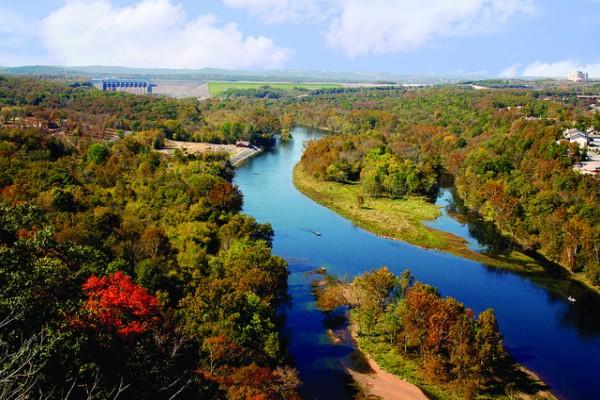
I tried to find a winter image to show less trees... but this isn't too bad.
-
Lilley's Lake Taneycomo fishing report, October 6
Phil Lilley replied to Phil Lilley's topic in Upper Lake Taneycomo
You know when you walk across the outlet, you're "kicking" up bugs for the guys downstream. Maybe he was trying to kick for himself. -
I found a small fly box yesterday with a few of Rolan's scuds in it. Scuds that he tied. I'd forgotten how different they are from any scud we tie or have tied. It was a #12 tied on a 3769 TMC hook, straight back. He ties all his scuds on this style hook. I added it to a #16 black zebra yesterday on One Cast. Bright sun but chopped surface. Fish were actively moving and feeding. I fished it off the bottom suspended, like Rolan does most of the time. They bit it really well. I'm going to have to show this to some of my tyers and have them duplicate it. Sparse and prickly is a good description.
-
Lilley's Lake Taneycomo fishing report, October 6
Phil Lilley replied to Phil Lilley's topic in Upper Lake Taneycomo
Thanks for sharing. -
Lilley's Lake Taneycomo fishing report, October 6
Phil Lilley replied to Phil Lilley's topic in Upper Lake Taneycomo
I haven't set foot wading below the dam this year. Not sure why except I don't want to join the crowds. I need to go up there and at least see how the lake has changed. It looks like the flow at Rebar has changed since last year. It splits up going the old channel as well as over the middle bar. How did you fish and where? Tim Homesley has been sending me pics for 2 weeks of the fish he's catching. He starts at outlet 1 and sight fishes down to outlet 2. I think he uses various types of mega worms. That would be fun. -
Lilley's Lake Taneycomo fishing report, October 6
Phil Lilley replied to Phil Lilley's topic in Upper Lake Taneycomo
I will also add that bass fishing is pretty good mid and lower lake. A guy posted some impressive pics on FB. Said he caught them on topwater not that far down from the Landing. Early AM -
Lilley's Lake Taneycomo fishing report, October 6
Phil Lilley replied to Phil Lilley's topic in Upper Lake Taneycomo
I would add a couple of things. With the weather shift we should see more wind. I don't think I've ever seen a full month of September with virtually no wind except for a storm. Wind really helps the daytime bite, no matter what you're using to catch trout. A chop on the surface enhances the jig-and-float bite, the jig bite in general, stripping streamers, soft hackles and cracklebacks and throwing jerk baits. It doesn't hurt the dry fly bite either. Black is still the best color for jigs, under a float or thrown straight. -
We’re planning on videoing him tying one soon
-
Lilley's Lake Taneycomo fishing report, October 6
Phil Lilley posted a article in Taneycomo fishing reports
 by Blake Wilson Fall has officially descended on the Ozarks area after September stayed unseasonably warm. A recent front has brought the desirable fall temperatures with a two-week forecast of lows at night in the 40s. We should expect to see the leaves make their beautiful color transition in the middle of October. Fishing for the month of September was still on par with August. There were still days where the trout just did not want to eat, accompanied by days when they ate well. Water temperature is still holding at 51 to 52 degrees early morning, rising to 54 or so by the end of the day. Oxygen levels are being well-maintained, with an average of four parts per million most of the time. There have been some nights that the records show lower than that, but for the most part, they were good for this time of the year. While there were not quite as many trophy catch & release certificates issued in September, that did not stop some very impressive browns from making the trophy board. Featured in photos here are two 30-plus browns caught in one night of fishing with Leonard Keeney and his sculpin patterns. Since the browns have moved up for their annual mating pattern, many big ones are being spotted and caught both day and night wading below the dam. Capt. Brett Rader of Chartered Waters Guide Service reported that he has switched from his small mini-jigs to fishing a double scud rig in the shallow water of the trophy area in the last week or two. Nightcrawlers are still reigning supreme in the bait world here on Lake Taneycomo. I have also had success recently adding yellow PowerBait with nightcrawlers. Others, too, have reported success with just the yellow PowerBait. The 1/32-ounce Lilleys jig in black combinations and sculpin has continued to catch fish consistently, day and night. Capt. Steve Dickey and other guides also indicate that first thing in the morning the bite is still the best. Keeney’s sculpin streamers have been working round the clock, producing both numbers and quality fish below the dam when the water is off. The late evening and night bites have been good on jerkbaits and 1/32-ounce jigs over the last few weeks, with the jigs surpassing at night; however, both have been successful. As the temperatures drop, we should expect to see less water generation in the afternoons — and potentially days in a row with no generation at all. Please don’t forget good fish handling techniques this time of year! Keep your fish in the water following their fight so they have ample time to recover before you release them.
 -
Lilley's Lake Taneycomo fishing report, October 6
Phil Lilley posted a topic in Upper Lake Taneycomo
by Blake Wilson Fall has officially descended on the Ozarks area after September stayed unseasonably warm. A recent front has brought the desirable fall temperatures with a two-week forecast of lows at night in the 40s. We should expect to see the leaves make their beautiful color transition in the middle of October. Fishing for the month of September was still on par with August. There were still days where the trout just did not want to eat, accompanied by days when they ate well. Water temperature is still holding at 51 to 52 degrees early morning, rising to 54 or so by the end of the day. Oxygen levels are being well-maintained, with an average of four parts per million most of the time. There have been some nights that the records show lower than that, but for the most part, they were good for this time of the year. While there were not quite as many trophy catch & release certificates issued in September, that did not stop some very impressive browns from making the trophy board. Featured in photos here are two 30-plus browns caught in one night of fishing with Leonard Keeney and his sculpin patterns. Since the browns have moved up for their annual mating pattern, many big ones are being spotted and caught both day and night wading below the dam. Capt. Brett Rader of Chartered Waters Guide Service reported that he has switched from his small mini-jigs to fishing a double scud rig in the shallow water of the trophy area in the last week or two. Nightcrawlers are still reigning supreme in the bait world here on Lake Taneycomo. I have also had success recently adding yellow PowerBait with nightcrawlers. Others, too, have reported success with just the yellow PowerBait. The 1/32-ounce Lilleys jig in black combinations and sculpin has continued to catch fish consistently, day and night. Capt. Steve Dickey and other guides also indicate that first thing in the morning the bite is still the best. Keeney’s sculpin streamers have been working round the clock, producing both numbers and quality fish below the dam when the water is off. The late evening and night bites have been good on jerkbaits and 1/32-ounce jigs over the last few weeks, with the jigs surpassing at night; however, both have been successful. As the temperatures drop, we should expect to see less water generation in the afternoons — and potentially days in a row with no generation at all. Please don’t forget good fish handling techniques this time of year! Keep your fish in the water following their fight so they have ample time to recover before you release them. View full article -
Emergency broadcast theories
Phil Lilley replied to fishinwrench's topic in New News and General Discussion
I turned my phone off, just so mine wasn't dinging with the others. I was in a CAM meeting. But then after I turned mine back on - they got me. -
Should be good
-
Yes sir. Even lead soap.
-
Our next project will be a 3/16th jig. And I do want to do a 1/4rd ounce too. Tony - I don' t know. I think he throws a 1/6th some.
-
We will have to relabel alot of things!


