


tjm
-
Posts
4,680 -
Joined
-
Days Won
5
Content Type
Profiles
Forums
Blogs
Events
Articles
Video Feed
Gallery
Everything posted by tjm
-
I'd probably count the entire Osage drainage as Central Mo. Slice the state in three pieces there wouldn't much of it in the south portion. I guess the fact that they showed the Mo loop of the White that they are saying there are some there but not as many as in the Green shaded area. My mistake on that., But those are still outside my normal fishing area, which explains me not understanding the WB/Hybrid?Mutt distinctions.
-
MDC where to find white bass map doesn't even show them in SWMO The possession limit almost means you have eat them as you catch them. Rigging and carrying three rods is more work than I'm up for, casting jigs on fly rods ain't fun to me especially if the effective "drift" is only a couple seconds before taking in all that line for another cast. But loading and hauling and launching a boat is really over my "work limit" . Y'all have "fun". And Thanks for the education, y'all probably saved me a horrible experience.
-
I don't think I've ever seen a white bass alive, my son in law used to chase them on Beaver and I've eaten some. I don't think I realized how hard you guys work to catch them.
-
Is the bigger fly that much harder to sink? the material buoyancy overcomes the added hook weight? is that because the boat is moving?
-
I know he uses LOZ, I had not heard that was Hell. But, it's a pattern that I don't use much and the different weights for different hooks also triggers my curiosity. The bigger hooks should sink faster with the same weight just because the bigger hook weighs more. and for the few times I use the pattern bead chain worked better for me than even the lightest lead bar bells. So, just guessing it could be a size thing for looks, but then brass would work, so .... I like to learn, even if I may never use the knowledge.
-
How deep are you going with these?
-
Then again maybe I don't need to take cat fish on the fly, that looks a little complicated for me. And hard to cast?
-
Tap's Bugs are about my only deer hair fly. For big flies Decievers, Seaducers and such suit me. I don't aim for big bass though, I doubt I ever caught one much over 19" and when they get turned loose anyway it's just another fish. I do want to find a catfish fly that works and I may have to turn to hair for that.
-
I think that public access is all that any of us can use unless we knock on doors and seek permissions. There must still be a lot of the Illinois that is accessible by boat? Wedington? maybe the boatable river in that area. It's been years since I fished NWA, but I used to find wading access on the Osage and on Spavinaw. I know a lot the places I went back then are developed now, so no specifics, except get a map and start driving around like I did back when. Check out the AGFC website for fishing spots https://www.agfc.com/en/fishing/where-fish/public-fishing-areas/
-
Make a mixture of 1 quart 3% hydrogen peroxide (fresher is better), 1/4 cup of baking soda, and 1 to 2 teaspoons of liquid dish soap . wash the skunk smell off. A chemist is said to have come up with this mix. I used acetone to wash one years ago and that took the smell away too. Skunk tail was suggested as a polar bear substitute back when I took all those fly tying magazines.
-
And Dale never caught many critters? I know he's written stories about trapping. I didn't think he had ever committed to it full time. He knows the Waddell who claimed 927 coyotes, maybe he can confirm or disprove it, I was going by the reports.
-
Was that at night? These critters sleep days. The trouble with your 400 yard square scenario is that you were trying to get the coyotes to go where you want them and the trappers were going to where the coyotes wanted to be. Usually to where they were yesterday and will return to from habit. Think about casting into the Walmart parking lot for bass as opposed to fishing into a brush pile in 12' of water.
-
Guessing where a critter will step in the next 48 hours is a lot easier than guessing where it will be standing for a clear shot in the next hour. and the traps work while you are someplace else doing something else. I can set traps in 40 or 50 guess spots but I can only watch one calling spot. Although to be fair the guys in those pics were using very effective lures that drew the predators in and subtly guiding where the foot would be placed. Animals often step in exactly the same spot each time they walk or run a path and with some thought and practice traps can be set "blind" and be very effective. If you walk with the same stride from house to shop every day you likely step in the same foot prints each time, because your steps start in the same place and each is just like the yesterday's. Study coyote tracks in the snow and you will find that three or more animals running together form a single file and each steps exactly in the leader's foot prints, so that only a single line of tracks cross a field but several lines of tracks separate from it when they spread out to hunt. For fur sales the hunted coyotes or 'coons are almost always near worthless because of the shot holes, I can sew a hole up on a green hide and it will look fine as a dry fur out pelt but when it's tanned the holes may tear out and when the tanned pelt is cut into strips for use half of it is wasted. Think about coats as being made by sewing wide zonker strips together, that's how you get a garment that has the same texture and color throughout. The same coyote taken by trap should have no hole any where.
-
Trees ain't really very productive. Ponds, streams, prairies, crop fields are all better for fur than trees. But, no, the critters aren't that concentrated and the successful trappers move frequently. And only put sets where they will produce, kinda like fishing brush piles. The need to move constantly is why most trappers stay hobby trappers, any section of land can only support profitable trapping for a few days. Then since most wildlife activity is nocturnal or crepuscular and picnics are mostly diurnal, they seldom overlap. There is work to trapping if you want to make it profitable, but not really any more work than pouring concrete or logging. I suspect that even boat repair requires some effort, and a strong work ethic if you want to make it a business rather than a hobby? In today's markets only ADC trappers are making any money and much of that work is repair and exclusion. However that wasn't always the case as the guy in the coyote picture said in a forum discussion several years ago about when an old photo of his catches was taken- " right in the boom, when 40 red fox bought a brand spanking new full size 4 by 4 truck. " 40 fox would pay for a 4X4 about 1980 and he took about 5-600 per year in Indiana back then. This guy paid for his DVM degree bought a farm and planted it in Christmas trees with trapping money.
-
There are hobby fishermen and there are commercial fishermen, there are hobby trappers and there are commercial trappers. Although with no market place it's hard to sell fish. No hobby trapper ever paid for a farm by trapping and from the tales I hear and read most hobby trappers work harder at it than the pros and rarely break even. No hobby fisherman ever paid for a boat by fishing but the pros do it all the time.
-
I tried that last year and had the slickest clean ground I've ever seen, it stayed that way for two or three weeks and then it came back twenty eleven times thicker with brand new weeds, I think that weed burner heated up and hatched seeds that had been dormant for decades. Hope you have better luck with yours.
-
Another of the concrete guys season pics, 2007 maybe, 1202 red foxes, 90 days. And you can be assured he took a number of incidental coons, skunks etc. For several years Phil would make these house and driveway "barn pictures" at season end on the trapping forum. The late Pete Leggett took 1,220 fox in a 53-day trapping season in 2001 at age 76.
-
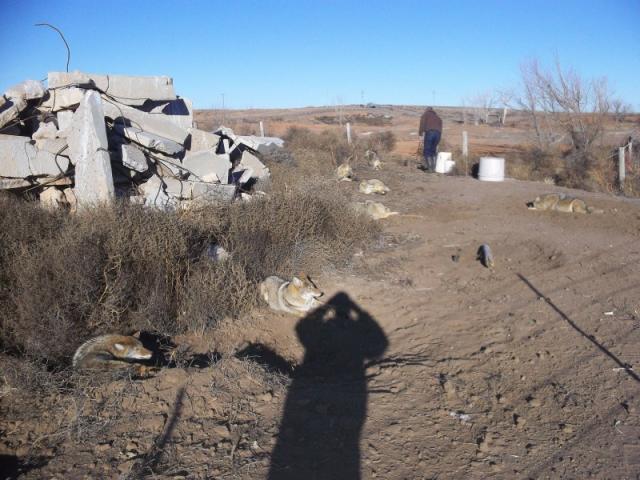
I have never known anybody that could repair a boat motor in less than a year. Same thing. I can't fly an airplane but I believe some people can. I never went full time trapping, six traps at a time was my norm even though I own ~160, but there were days when a ten minute trap check was equal to a few hours on the construction site. If your pals weren't working full time at it they weren't working it right to make money. If they were holding green fur over in the freezer they were probably being docked when they did sell and if that was many years ago in Mo. they would have been violating the law. We just got the right to hold fur past seasons end a few years ago. Stolen from the internet, about a concrete finisher in Pa. Phil's 2017-18 season pic The guy in the picture below with seven coyotes visible and three more behind the concrete pile is a veterinarian from Indiana that killed about 600 that year two months in western Ks. @ $90 ea. IIRC, on 24 hour checks. The shadow taking the picture is a "student" riding with him to learn.
-
Yes, it was. Several hundred trappers were "getting rich" in those years. With the inflation calculation ~$42K-$141K in today's $$ But the 1000 coon number is from Iowa and I'd guess 500 a more realistic number for Mo, and we can go with the low end pricing so $15K still >$42k in today's money . For 2-3 months work, the rest of the year could still be used to repair boats or run a veterinary practice. Mo has ~33,830 miles of state highways with 10,400 bridges and most all that ROW is free to trap, all the National forest is open to trap, most Conservation areas are open to trap with a special use permit, nearly every farmer will allow trapping. Obtaining enough land isn't really a problem. Best I recall traps back then were less than $3, so with purchased lures @$1 a bottle $2-300 would set a line up. Pickup a couple of large freezers so you don't have to scrape and stretch every night and use any car or truck as the transport. All the money after the first week is profits.
-
have you ever trapped full time, putting up the fur?
-
Camping with accessible fishing walking distance
tjm replied to BrianJenn's topic in Bennett Springs State Park
Actually it jumps from $13 for basic to $30 for the sewers in CG1 ~$17/day more and you are still in the tent. Assuming that you want to be in the park, you can examine the maps and chose the sites most likely. BSSP website Park map this will show how the park is laid out, it doesn't show that most of it is steep hillside. CG #1 map the only sites close to the water, RV hook up sites and tents pay full price or did back when. CG #2 CG #4 CG #5 Interactive map lets you zoom in and switch from road to aerial views the aerial zoomed in lets you see trees on the camp sites, CG#1 is right near where the spring joins the Niangua River. -
Back when we had a fur market, making enough money to buy a farm with fur wasn't all that uncommon. My 12 year old pal sold about $1,100 of trapped furs in 1963, shipped most of them to St. Louis and the rest to some place in Louisiana by Greyhound Bus. I help him a little now and then, so know that he was on his own mostly. That would be ~$9000 in today's money, and he never missed school. Coons in some places in the early '80s were bringing $30-50 each and 1000 coons over three months is not only possible but Larry up in Iowa has done it season after season. Posted lots of pictures to the 'net of his operations. A few trappers consistently caught about 600+ per year of red fox or coyotes when there was a market, a Waddell from Mo set out to take a 1000 coyotes a couple years ago and just made about 927 if memory serves. Out west when this country still had a big wool industry, damage control operators got paid more for trapping pups in the dens than the adults fur would bring. The guy in RI that I mentioned quit carpentry to trap, told me that he made a little over $7000 in two months trapping an urban area, his first season. He had one 'coon that sold for $70 locally, so more than that for the raw fur dealer when it got to NYC. But rolled up frozen hides usually sold for about half what a stretched and dried hide brought. You couldn't ship rolled and frozen and the dressers don't want them green either. Hunted fur is usually worth a lot less than trapped fur. So there are limiting factors. And not everyone will work 16-20 hours a day in freezing conditions for two or three months just so they can take the other nine months off. I sat in a buyers shed once when two old guys brought in right at 300 striped skunks and about 30 mink and a few odd by catch and the season wasn't over yet. When the market died about '86-7 a local fur buyer here told me he had over $3 million in unsold furs in NYC cold storage from the year before. On the other hand I can't imagine enough broken boats for a man to make a living just repairing them. Yet many people seem to.
-
It's magic hydrophobic fumed silica, used most for thickening epoxy, about a dollar an ounce when bought in bulk (3-4qts) vs seven$/ounce at the fly shop or forty bucks per ounce as feather powder at Cabela's. The ~$1 per ounce jar of Albolene from Walgreen's is a lifetime supply and if soaked into the fly at the bench only requires a squeeze with the chamois leather to be back on the water, so I never got around to buying the Frog's Fanny. I expect that one ounce of it would be a life supply for me.
-
If you got a can of Camp Dry laying around or even Scotch Guard, pin a hand full of those fresh tied dries to the inside of a box or some place where they cant' fly off and soak them with that stuff, when it gets dry it might be pretty water repellent. I've read numerous times that George Gherke took a jar of Albolene and thinned it to make Gink. I don't know if that is true or not, but I use the Albolene full strength and it works for me. Keeps the hands nice and soft too.
-
US Trucker Convoy coming through Springfield next week
tjm replied to netboy's topic in General Chat
so, all the stuff that was coming in from Asia this week is going through DC first?


