

WestCentralFisher
-
Posts
250 -
Joined
-
Last visited
-
Days Won
8
Content Type
Profiles
Forums
Blogs
Events
Articles
Video Feed
Gallery
Everything posted by WestCentralFisher
-
I get it. Been there. When I was in college the only smallie stream I had access to regularly during the semester was the insanely polluted one in town that in retrospect I'm very surprised had any fish, let alone the few snallies it had. I worked in the Ozarks most summers and made the absolute most of it. Good memories
-
Good stuff. It's always fun looking back on the season when its done, or as close as it'll get. Looks like you had some good times. There might be something to calling it a season while the fish are still readily biting, though I've never been able to pull that off. There is always that one, sad trip, usually in late October where I realize the smallmouth fishing has finally gone off for the year. Every year I know it's coming, and yet every year it still comes as kind of a shock when the fish suddenly aren't where they're supposed to be, or if they are, I can't catch them. It can sometimes literally happen overnight. Last year, it happened to me on the Gasconade. It was a beautiful fall day, but the fishing had just turned off like someone shut off the faucet. Although, by way of a counterpoint, my best day of smallmouth bass fishing last year was on the winter solstice. It was just one of those beautiful, warm winter days where I got on the water because it was too nice not to, with zero expectation of success. And then I stumbled right into what must have been an epic wintering hole. One of those days where you stop fishing after an hour because even with careful C&R you worry if you keep going, you might actually catch so many fish any level of accidental mortality might have a real effect. I'm basically incapable of calling it a year and not fishing for more than a few weeks at a time, so it's always a search for those sorts of rare days.
-
There are gravel bars all along the Current and Jacks. The answer to that question amounts to what kind of experience you want. A NPS/private campground will allow you relative ease and convenience but more people and noise. A gravel bar especially in October will give you all the solitude and quiet you could want, but you better have everything you need and if you tip the canoe and lose something life gets hard. I greatly prefer gravel bar camping, and usually do that if I'm with people who are at least somewhat experienced outdoorsmen, but it depends on the situation. I'm planning to go down to that area this weekend and we're staying in a campground with lots of amenities, but that's because we'll have people in our party that aren't very experienced paddlers, and I don't want to deal with the fallout if they flip a canoe and lose a water filter on day 1, or what have you. If you want a site at a NPS campground next weekend, reserve it now, and even then you're going to have to take what you can get. Since those are weekdays you ought to be able to find something
-
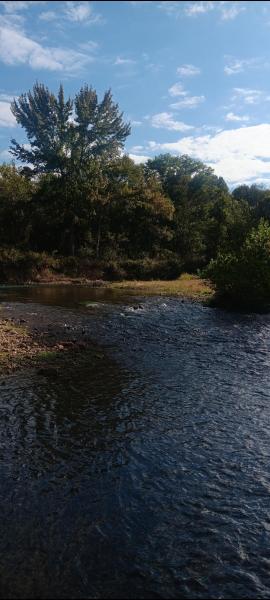
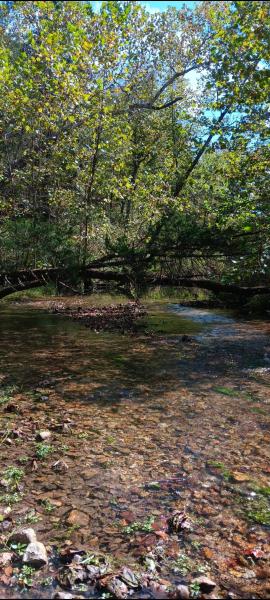
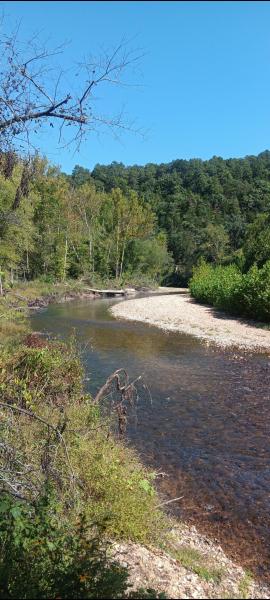
After about 6 weeks of conditions decidedly not suited to chasing wild trout, a little rain earlier in the week, a cool morning, and a day off led to me getting on a couple spring creeks today. The first creek I fished is one of the larger ones of its kind in Missouri. It has both wild trout and stocked trout in various sections, and is generally my old reliable. I started the day off in the wild trout water, and after one glance at the creek, I put away my spinning rod and got out my 3 weight. One of the more impressive mayfly hatches I've seen in Missouri was coming off, and the fish were rising like crazy. I'd love to tell you I caught trout hand over fist, but that wasn't quite true. I didn't have the right fly pattern in the box, I experienced some of what you'd have to call operational challenges, and generally did not get mixed up with Brad Pitt in A River Runs Through It. Still, small, stupid trout exist, and I caught a few of them. My own struggles aside, it was lovely. I then went a few miles downstream to another access. This isn't really wild trout water, and doesn't have blue ribbon protections, but the stocked trout were still fun to catch. It still looked awfully trouty down there (see above), but naturally there were far fewer fish. I finally left when I went back to the car to get a drink of water, and an unmarked white van pulled up. We were pretty far down a real secluded Forest Service road, and it might have been just fine (people are allowed to go fishing in unmarked white vans) but it still felt like my cue to move on. Next up was a smaller creek a few miles away. As soon as I found the creek and spring that fed it (and that took some doing, as it turned out; always a great sign), I caught little rainbows more or less effortlessly on a little Panther Martin spinner. I called it a day when I caught a "good one" which on this creek was an 8 incher. Wild trout and spring fed creeks are good for the soul.
-
- 7
-

-
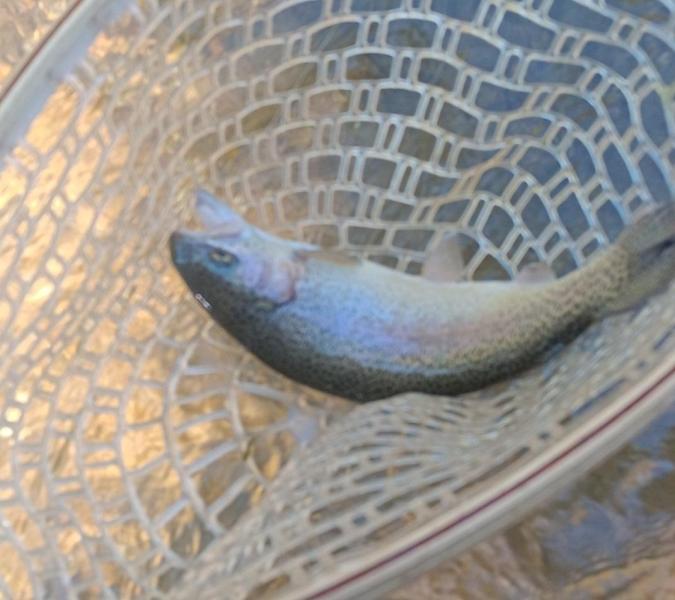
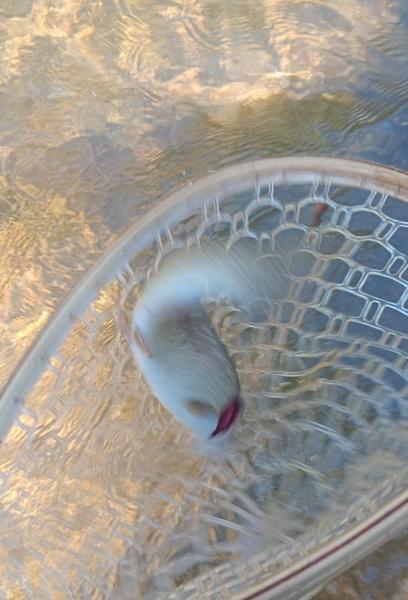
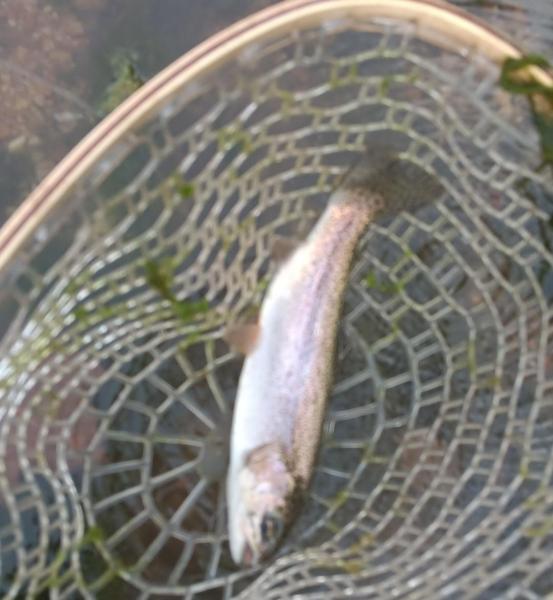
This rainbow was seriously unhappy about being in a net. 😆 🤣
-
Fair enough. The difference in viewpoint just boils down to exact location. The streams in my area (north-central Missouri Ozarks) have technically risen, but in the sense that the streams that had been flowing at like 70-80 CFS are now 100-120. We got quite a bit of rain too, but it was steady rather than downpours, and the dry soil mostly just sucked it all up. Obviously very different over your way.
-
The rain is much needed and will be a good thing for our rivers and creeks. It also may mess with my Friday trout fishing plans, but if I'm lucky I may also catch the creek while it's on the drop but still the cloudy green color that tends to make the fish go nuts there.
-
Suitable Flow Rate for Trout Fishing ?
WestCentralFisher replied to 2sheds's topic in Eleven Point River
The Greer gauge is useful in a very specific way, but not so much as a direct indicator. I've noticed the following pattern on the Eleven Point (Bardley) gauge after a big rain: 1. The initial rise, which hits the Bardley gauge some number of hours after the rain hits, depending on where exactly the highest rain concentration is. This rise is the result of runoff 2. The initial fall, which can take place over hours or days following the rise 3. A second, smaller, but often still pretty significant rise after the initial decline. Depending on the situation, this can be enough to turn the stream back to being muddy and blown out, or it can be barely noticeable except for maybe turning the water a darker shade of green. This can be as delayed as a few days later, and is the result of the event impacting the spring system. This is where the Greer gauge can be an advanced indicator of the river being blown out. Obviously it will eventually show on the Bardley gauge, but later. It's not unique for springs to be lagging indicators of precipitation events, but the Eleven Point is somewhat unusual in that it is so very reliant on one specific, very large spring. Rivers like the Current have similar trends, but it's muddied (some pun intended) because they are affected by many different spring systems that may behave differently. My source for this is that this concept once buggered up a would-be float trip for us on the Eleven Point. The initial crest and decline occurred, flows were fine, it was bright sunny in the whole aftermath, and then when we got there the river was muddy and blown out anyway. We ended up on the upper Jack's, which was a great outcome, but I still remember the initial disappointment keenly. I also really like looking at and analyzing river flow graphs, for some reason that I'd struggle to adequately explain. -
-
The fishing is definitely weird right now. My home creek hasn't really been fishable for over a month now. I've been over there a few times without a fishing pole to look around, and the bass are stacked up in the few places with enough water, food, and oxygen. It's mildly concerning. They're pretty vulnerable. So I've been driving to streams with good, consistent spring flow, because with our wet spring and early summer, they seem to have decent flow. Even that has yielded pretty mixed results, and I've had a lot of slow days recently. This trip wasn't what you'd call planned. I had a few hours and really needed to get out of the house. This creek is just about an hour from home, so it's definitely worth more exploration. Just when the weather finally cools down.
-
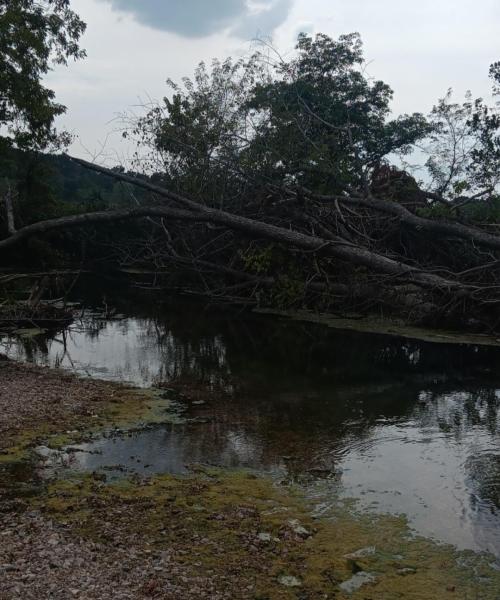
The trip started off looking like a classic bust, though to be fair, there were never high expectations. It had been too hot and dry for too long to expect very much. The creek access I meant to go to initially didn't pan out. It apparently was a half of a mile from the parking lot to the stream with no obvious trail. If it had been 20 degrees cooler, that would be no problem, even welcome because of the solitude it would promise. At a stifling 95 degrees, it didn't seem too appealing. I crossed the same creek a mile later on the main road, and it was clear it wouldn't have mattered. It wasn't exactly dry, but the riffles were a pitifully shallow flow across wide gravel, and the pools looked stagnant and more apt to bullfrogs than smallmouth bass. On to plan B. This creek, at minimum, would actually have some water in it. It has more consistent spring flow, and even a virtually rain-free month would have far less effect on it. But there was no guarantee it would be any good. This is known as a combination of an occasional put and take trout stream, with warm water fish supplementing the fishing the rest of the time. In regard to the trout, the phrase "it gets fished out a couple days after they stock it" tends to come up a lot in the discourse around it. This is a creek I've heard of, but never bothered to fish. It has a reputation as a creek you might stop at if you're passing through, but nothing more. You may know which one it is by now based on what I've said, but I bet many of you have never actually fished it, either. It's just that kind of creek. It was smallmouth bass I'd be targeting, since it was almost certain at this time of the year that the stream hadn't seen a stock truck in a long time. At first glance, it looked more like a long, narrow pond than a spring-fed creek. With slow, deep flow, and almost no current, it had an overall feel that said "frog water" more than anything. I noticed two large fish, and they were both gar. Nothing against what is ultimately a feisty, native fish, but this was not the best sign. Nonetheless, I was there, so I tied on a spinner and got to work. The dead water seemed to be full of gar and longear sunfish, but not much else. I was just about to bag it when I finally worked my way to a pool with a nice, oxygenated riffle leading into it, and good current. Smallmouth bass were stacked up there, and after a couple lure changes, I finally hook and land two of them. Both are nearly identical, perhaps 14 inches. They're no trophies, but fine fish for a creek like this, and well worth getting big, goofy grin over, especially when caught back to back. I then get another strike, and to my surprise, this one's a trout, maybe 11 inches. I feel a little bad. The water seems pretty warm, and I hadn't seen a single trout or any evidence of their continued existence. In fact, I had pretty well forgotten this was even a possibility. It soon became clear the fish wasn't going to survive release. It wasn't how I drew things up, but I had a cooler in the car with some ice, and, well, I'd bought a trout stamp for just this sort of potential occurrence. If I'm not careful, this sort of thing can really bother me, but then these trout are put in this creek with largely this outcome in mind. He'll taste great with butter, lemon juice, and a side of fried potatoes. I broke down my rod, left the creek, and drove to a nearby gas station to get more ice to keep the fish cold. I didn't exactly feel guilty, but it put me off wanting to haul more fish in. I then drove upstream to look at the spring, for no other reason than I didn't feel like going home just yet. It was beautiful, in that aquamarine-colored, almost otherworldly way any good-sized Ozark spring is. I probably could have caught a couple more trout up there in the colder water, but I wasn't sure what the point would be. I'd already figured out what's true about most second-rate streams. There's probably a reason they're not famous, but it's rarely completely true when people say "Oh, it gets fished out a couple days after they stock it."
-
Suitable Flow Rate for Trout Fishing ?
WestCentralFisher replied to 2sheds's topic in Eleven Point River
The White Ribbon section seems to have more consistent trout fishing now. The blue ribbon area has some really nice fish, but it's possible to go a good while in between hookups. -
Good luck! Water is very low up there and very clear. A lot of the water seemed pretty dead, but good spots were full of fish...just not always easy to catch in those conditions. Weeds were a major problem up there, so anything higher in the water column is likely to make for an easier time.
-
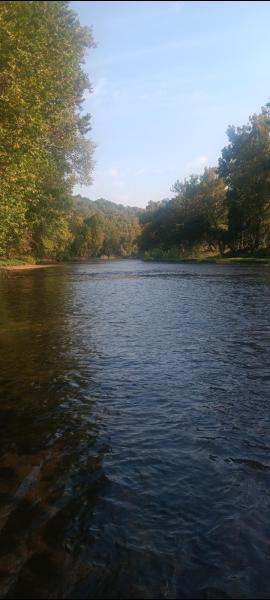
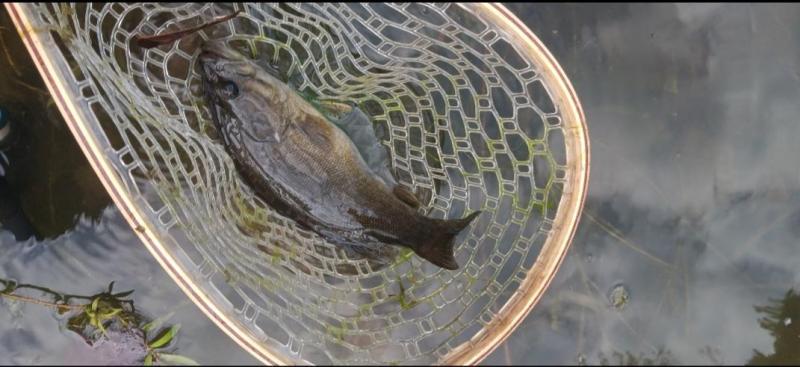
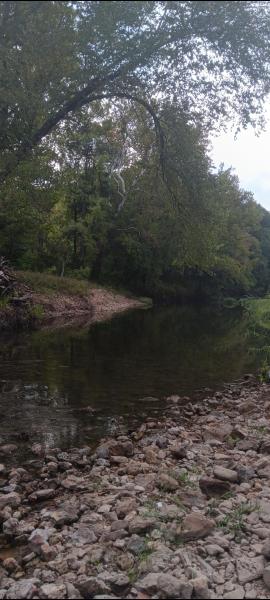
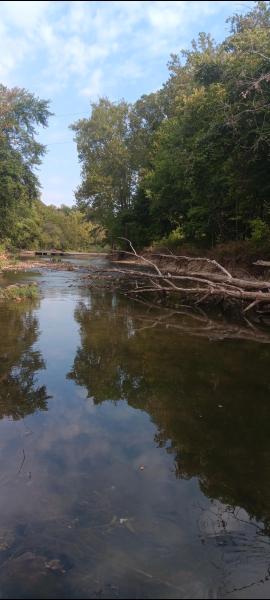
Got back on the river, this time wading at a couple accesses sites. Both trout water and smallie water. Trout fishing was a little slower than usual, but still caught enough to be happy. Maybe 6-8 in an hour and half. Smallie fishing upriver was slower yet, but got one pretty nice one. Got a picture, but it didn't do it any justice. Caught lots of goggle-eye in both sections. Another good day on the river.
-
You can catch loads of trout on spinners, for sure. My go to is a little Panther Martin, but rooster tails work great too. I'm a spin fisherman primarily, who will go to a fly rod when needed. Low, clear water for wild or at least stream resident trout, a #16 or 18 generic nymph under a little foam strike indicator will fish circles around spinners most times. But on the same creek, if the water is up and even the tiniest bit stained, give me the spinner and I'll catch fish all day long, and bigger ones on average, too. With freshly stocked fish, again, give me a spinning rod.
-
Sounds like a great trip. After a hook related incident requiring some minor self-surgery on the Niangua last week, I am seriously considering smashing down barbs.
-
I've fished quite a few of them, and you will 100% notice the effects, and it will probably bum you out. But the streams are still pretty as ever, and there seem to be plenty of trout around if you look. If anything, some of the streams that are usually more or less put and take offer a pretty fun challenge since fish aren't absolutely everywhere this summer. That was the case on the Niangua last week. Instead of them being stacked everywhere like many years, I really did have to read the water, and it felt like more "real" fishing to me than when they're just aimlessly wandering around even in the dead water that shouldn't really hold feeding trout.
-
Thanks for the report. We went back for the first time after the flood this summer expecting things to be slow, but there were plenty of fish and the park generally seemed about as nice as ever. You could see the after effects, of course, but mostly it's the same old place. It made me very happy to see. I've always said that Montauk, especially in the fly section and around the campground, is the only trout park that feels like a real honest to goodness trout stream, rather than a trout-based theme park.
-
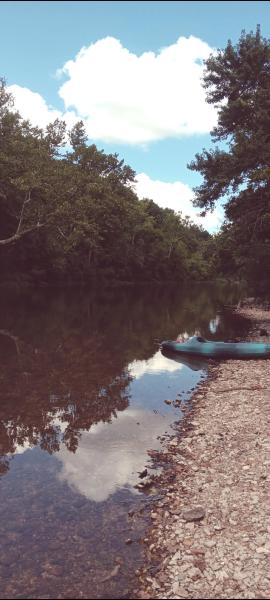
Stopped to take a few more casts just before the end of a float trip.
-
Be careful releasing a shark
WestCentralFisher replied to Quillback's topic in General Angling Discussion
Well, based on the story we're commenting on, and a million other ones like it, sometimes you actually have to say the things out loud that you'd hope would go without saying. 😆 -
Be careful releasing a shark
WestCentralFisher replied to Quillback's topic in General Angling Discussion
I personally am shocked that holding a ~4 -foot shark by its mouth ended poorly. I've caught a number of small sharks accidentally while fishing for other species. Never been bit or come real close. They key is nice, long forceps and keeping your hands away from the business end to the maximum extent possible. -
Yeah, I saw just enough of them that it piqued my interest, but they didn't seem very widespread or abundant. It just looks like great smallmouth water honestly much more than it resembles a trout stream, so it was hard to get out of that mindset. But yeah, most of my successful smallmouth fishing has been above Bennett or around Leadmine.
-
Floated today from a couple miles below Bennett to a couple miles below Barclay. It was lovely. Great weather, virtually empty river. There was one couple I ran into twice, otherwise I had the river to myself. Fishing was spotty. In this case, that's not a nice way of saying it stunk, it was just really hit and miss. There would be a mile or two that would go by that you'd swear only had chubs and bluegill, then a random school of fat goggle-eye, then a big pocket of rainbows. I felt like I was struggling in the catching department (the fishing was great all day) more often than not, and yet the good bits were really good, so numbers wise it ended up being a much better than it felt like at times. Outside of chubs (and my gracious, this river has no shortage) rainbows made up the bread and butter, but where the goggle-eye schooled up, they were easy pickings. I also caught one 9 inch brown, and one little smallmouth. I was trying to target smallies with increasingly larger crankbaits to scare off the trout as the day went in, because I kept seeing them. But I just kept catching more trout instead. Very tough stuff, I know. The scenery was mostly nice, except above and around Barclay, where it is excellent. Floating was very easy. There was one spot where I kinda sorta had to paddle hard to avoid running into some dead fall, but it was extremely straightforward. Never had to get out and drag, but the river is pretty darned low. Anyway, beautiful, quiet day on the river. Can never have too many of those.
-
Leadmine Boat Ramp to Mill Pond Road Access
WestCentralFisher replied to GotaFish's topic in Niangua River
Thanks for the report. Headed to that area tomorrow, hoping the cooler weather yields some decent fishing (or at least more pleasant fishing conditions) -
Suitable Flow Rate for Trout Fishing ?
WestCentralFisher replied to 2sheds's topic in Eleven Point River
900 is just fine. It'll be a bit high, and water may be cloudy, but super fishable at that level. If the trout fishing is super slow, there are at least a few smallies from about Mary Deckers on down in just about every deep hole. Throw a spinner or little rebel craw and you'll catch some of both. Put a little splitshot 18 inches up the line.


