


dgames
-
Posts
231 -
Joined
-
Last visited
Content Type
Profiles
Forums
Blogs
Events
Articles
Video Feed
Gallery
Everything posted by dgames
-
Major hatch activity for me this weekend. Fished at the narrows, tucker shoal and wildcat over the weekend. Best day was Saturday. I actually started off that day with a soft hackle and only got one fish in about 20 or 30 minutes. Switched to a bright green bodied elk hair caddis dry with a green bead head caddis pupae dropper and tore them up for the next several hours. Was doing well enough on the Elk hair that I eventually got rid of the dropper and kept catching fish every few casts on the dry. Was an awesome day. I am not sure why they weren't hitting the soft hackle well for me.
-
Wind River range in Wyoming might be a good option. World class climbing and scenery and plenty of streams off the beaten path. I don't know about cabins there, the only time I went we backpacked.
-
Did you hammer them?
-
Lir Water Response Form Senator Coburn
dgames replied to DaddyO's topic in Upper and Lower Illinois River (OK)
This is awesome. Hats off to Scott Hood, he has really worked hard on getting a long term solution for the LI. -
All you Tulsa area LI fishermen, I encourage you to come to the Tulsa Flyfishers meeting this Thursday evening. The program speakers are Stan and Carolyn Parker, owners of River Run Outfitters which is a fly shop and guide service on Taneycomo, In addition, Scott Hood is planning to have a presentation on fishing the Lower Illinois. Hope to see a bunch of you there and put faces with the names on this board.
-
Kept My First Fish. Also Think Last.
dgames replied to Haris122's topic in General Angling Discussion
Had to laugh at this one. -
Commercial Leaders - Do You Use Them?
dgames replied to Jack Jones's topic in General Flyfishing Topics
Do you straighten your leaders before you use them? You probably already know to do this, but If not, try stretching the entire length of the leader a foot or two at a time by pulling on it. Do this at the start of each fishing day or whenever putting on a new leader. -
Commercial Leaders - Do You Use Them?
dgames replied to Jack Jones's topic in General Flyfishing Topics
I don't try to build my own. Almost all of my fly fishing is for trout using nymphs or dry flies. For basic mono tapered leaders, I typically buy 7.5' 5x leaders and use tippet to turn into more of a 9' leader. As I get tangles and change tippet, I use 5x, 4x and eventually 3x to replace butt section that is lost before I eventually replace with new. I have also used 5' furled leaders and like them. Another product that I really liked was a 5' airflo light trout polyleader (http://www.rajeffsports.com/polyleaders.php) . To either of these, I add 5x or smaller tippet. Regarding peoples comments on 7x, I use 7x fluoro tippet quite often to my bottom fly and have good results. As long I am gentle on the hookset, I don't have much issue with breakoffs. -
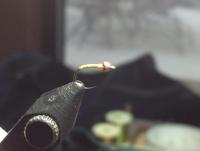
If you ever order fly tying stuff online, Feathercraft has it. Here is their description, color 5 Olive. For the LI, I use size 16 on tiemco 2488 or 2499spbl hooks. MIDGE FLASH MIDGE FLASH will remind you of Krystal Flash, but a mere fraction of the diameter. Smallest twisted mylar flash available. Can be used on the smallest trout flies, to large saltwater streamers where a more subtle accent is better. Try it! COLORS: (1)Pearl, (2)Cream, (3)Tan, (4)Rootbeer, (5)Olive, (6)Pink, (7)Peacock, (8)Lt-Blue-Dun, (9)Fl-Yellow, (10)Fl-Chartreuse, (11)Yellow, (12)Purple, (13)Black, (14)Fl-Fire-Orange, (15)Baitfish-Blue, (16)Copper, (17)Red, (18)Gold, (19)Silver $3.95/PAK OR Any 5-PAKS $18
-
here is a pic
-
Here is a link to a pretty good article on this from the Tulsa World earlier this month. http://www.tulsaworld.com/sportsextra/article.aspx?subjectid=2&articleid=20120722_29_B9_CUTLIN880082
-
Hot Weather Fishing...
dgames replied to TheTugistheDrug's topic in Upper and Lower Illinois River (OK)
I did ok on the back side of the island a week ago using an yellow/olive midge with copper bead. -
Yes, touching or even overlapping turns of the midge flash so that you just see the yellow thread through the midge flash and then at the bead where you tie it off and whip finish. The midge flash coated abdomen ends up kind of having a glow to it when the sun is out. I tie mine on tiemco 2499spbl hooks in size 16. Tiemco 2488 size 16 would be pretty equivalent. I coat mine with zap a gap and I would guess sally hansons would be comparable. I didn't do well on that midge a week ago saturday either, but for some reason yesterday it was the effective again. I was catching some fish with the bead head pheasant tail (kind of adapted from your hare&copper where I use a pheasant tail abdomen and then used the h&c's looped brown/red dubbing mix for the thorax- also 16 on the 2499s). It seemed to pick up with the midge, but I was also probably getitng to the better holes on the back side, so it could have been that I was just fishing better spots.
-
Went this morning. Parked at the bottom end of the gravel lot and started in the hole at the bottom end of the island. Worked my way up the backside of the island and I got really lucky and got to fish all the spots. No other fly fishermen were back there. There was one group of bait fishermen, but they moved out before I got up to them. Caught multiple fish at pretty much all the spots on the backside. Started off with a small bead head pheasant tail and did ok with that. Switched over to my favorite olive midge and that did really well. Last weekend they didn't want anything to do with the midge, but different story today. It actually rained on me a little bit which was kind of nice as it kept the temps down. After I reached the top of the island, there was a family fishing the kiddie hole, so I went to the slow water above. Stayed there about 20-30 minutes and only got one fish there. Headed back down to my car for a drink and then ended the afternoon by messing around in the riffle water a few hundred feet below the rock weir at the bottom of the island. Caught several there including a couple on my dry fly indicator. Used a humpy as the indicator today instead of my usual stimulator and I was impressed how well it stayed afloat the entire day.
-
First Timer...access Help Requested
dgames replied to sjacks12's topic in Upper and Lower Illinois River (OK)
I think Marval is obligated to let fishermen access for free since the state stocks at the site. Having said that, I really never fish there because I don't want to mess with the check in procedure and probably more because I don't know that water as well as at Watts and the gravel lot below the dam. T&M gravel - my understanding is that T&M closed this access about a year ago after they suffered some vandalism. To reach this water now you have to either wade down from Watts or up from Marval. Watts is the paved parking lot downstream from the gravel lot that fishfeeder mentioned above. It is at the end of rd 0990. There are good spots both upstream and downstream of the parking lot at Watts. My experience is that when the fishing is good, there are lots of productive spots at any of these accesses and you just need to keep moving. -
I had conditions kind of like this below BSD a week ago Saturday where the fish were really spooky. I found if I positioned myself well upstream of the fish, cast quartering downstread and then fed line out to get a good long downstream drift, I could minimize spooking of the fish.
-
The last couple of years I am getting in 2-3 days a month which is the most I have even been able to do. My kids are now college age, so I have more free time than I used to have. Most of my fishing is all day or half day trips to the lower Illinois which is 1hr 15 minutes from my house. A few times a year I get to MO or AR, usually to trout fish as well.
-
Numbers of fish to a large degree depends on the waters you fish. In my opinion, the Lower Illinois where I have had big numbers, when it is good, is easier to catch large numbers than a lot of other places. If someone has a really good day on the LI and get near 100, that is probably comparable to 40 or 50 on the white or 25 or 30 on a tougher place like the NFOW based on my experience.
-
I have had some days I was pretty sure I was around 100, but it is hard to keep count to be sure. Had one on a Cotter to Ranchette float in the 90s and one on the NF tailwater back when you could access at McClellans. Now, when I go to Mtn Home area the fishing seems much tougher than it did in the 90s and 20-30 is more normal for a full day. However, it seems like I catch bigger fish there now. In the last year or so, I have had a couple on the Lower Illinois. The latest was on the first low water day after about a month of constant generation. The fish hadn't really seen flies in a while, and they keep stocking during generation, so there were ridiculous numbers of fish in the river since the catch & keep fishermen hadn't had a shot at them yet. I fished 2 different access points that day and it was a weekday, so I was hitting pretty virgin water all day. I often would get strikes on several consecutive casts when first approaching a run, so the numbers can add up pretty quickly.
-
I will definitely have to try that. Is there any reason you choose a Stimulator? Correct me if I'm wrong, but is that a stonefly imitation? Do we have stoneflies here? I can definitely echo the part about the delicate presentation. When I was out yesterday I would cringe when the rig made the nice plop going in. How many nymphs do you run under it? And do you tie onto the bend of the dry or from the eye? Other big bushy dry flies work fine. I use a stimulator most of the time because they float well and seem to be a good attractor dry fly pattern. I have also used smaller flies, like an elk hair caddis when there is a caddis hatch. You just can't hang as much weight off of it in the form of a dropper fly. Midges would fish fine under an EHC. Another advantage of bigger dries is being able to see the fly. If you go too small and the water is choppy, it can be hard to see a smaller fly. I mainly use one nymph and I tie it to the bend of the hook. I suppose it would work from the eye as well, but I have just never done it that way.
-
Several reasons I like using a dry fly for my indicator. It isn't because I have anything against indicators. I use thingamabobbers if I am in really fast deep water where I need a lot of weight or where I wouldn't be able to see the dry fly. NFOW and spillway creek at Broken Bow are two examples of where I have trouble using the dry dropper. Anyway, back to the reasons for the dry fly. First, it is much easier and more pleasant to cast. You don't get nearly the tangles that you get when you have an indicator swinging around. Second, I am a believer in having as light of line as practical between my indicator and nymph. Heavier line slows the sink rate of the nymph and I believe it leads to more underwater drag. Most indicators, other than the palsa stick ons don't stay in place on 5x or smaller. With my stimulator, I usually use 7x for my dropper and I believe this give me the best drift possible. Third, I feel like I can detect drag on the dry fly that is sitting up on its hackles better than I can on an indicator sitting low in the water. A drag free drifting dry fly has a certain look to it and just feel like I get locked into a good drift on the dry better than I can with a hard surfaced indicator. Fourth, if you are fishing to skittish fish, the dry fly indicator gives a much more delicate landing and presentation than plopping down a hard indicator. Finally, I think the dry fly is a little more sensitive than other indicators. I feel there are some takes that I can see on the dry that I would miss with a conventional indicator. There are down sides to the dry as indicator. The two most obvious are that there is a limit to how heavy of flies you can use and you have to re-tie knots to adjust depth. On the LI, the flies I would be normally choosing can all be floated by a well hackled size 12 stimulator, so fly weight isn't an issue for me there. Re-tying isn't really that big of an issues there either as I seem to get locked into a dropper length that works and end up keeping it there quite a while. In fact, I would say I spend less time re-tying than most indicator fishermen because of the reduced tangles. Oh, I forgot one of the other benefits of the dry dropper. I usually catch a few fish on the dry fly which I kind of consider 'bonus' fish. Late last week I fished the White below Bulls Shoals for a couple days and caught several fish on the indicator dry fly, including a gorgeous 16" cutthroat at the narrows.
-
Nick, I fish the Lower Illinois pretty regularly and would recommend using an indicator of some kind. So much of the fishing holding water on the LI is really slow water which would make high sticking pretty difficult I would think. In addition, the low visibility of the water make sight fishing impractical, at least for me it would. I have success using a stimulator dry fly as my indicator with 7x fluoro tied to the bend of the stimulator hook and a bead head fly as my dropper. I find that I use a shorter dropper than you would normally think you need. With a layer of moss on the bottom of so much of the stream, you really can't drag the bottom there. I usually try to keep my fly drifting 6 or 8 inches above the bottom. If there is significant surface feeding on midges, I will shorten my dropper even more and use a midge maybe a foot to 15" below the surface. I have actually done really well fishing this short dropper rig in the big deep hole downstream at watts. It amazes me that even though the water is 6 or 7 ft deep, I am catching fish just below the surface. As far as mending and drift, I really just concentrate on keeping my dry fly drift drag free and that keeps the dropper drift drag free as well. I visualize how a small leaf would drift on the surface, unattached to anything, and try to make the dry do the same thing. To do this, you just have to make sure you never have tension in the last few feet of the leader. My general method is to cast quartering upstream. I pull in slack as the fly is drifting back towards me and also reach towards the fly to keep as much line as possible off the water. Just as the fly is drifiting about even with me, I will make a mend to where I flick my fly line and the butt of the leader upstream of the fly. As it drifts downstream, I then make little flicks to feed slack back out to the fly to allow it to drift downstream of me without tension. It is helpful to get put a sizable piece of slack around the tip of your fly line with your first mend and this will allow you to make subsequent mends without disturbing the fly. Try to avoid as much as possible what I call a J curve, where your line points downstream and makes a 'J', curving back upstream to the fly. If you have this, you almost certainly have drag and it is time to pick up for the next cast. The trickiest part of this is the mend to throw your line upstream of the fly as it is going past you. It is critical that your fly line is floating really well in order to make this mend with minimal disturbance to the fly. I apply dry fly floatant to the last few feet of my fly line as well as the butt of my leader to make this mend as easy as possible. If the line starts sinking through the day, apply more floatant. Finally, when you are getting a good drag free drift, develop a mind set where you expect a strike. WIth the stimulator as the indicator, it will simply disappear. Anticipate this and then calmly lift up to set the hook. If you aren't expecting the strike, there always seems to be a moment of hesitation to register that, hey I just had a strike, and that hesitation can be enough to miss the hookset. Anyway, good luck. If you are interested, I would be open to meet down at the LI some time to help.
-
Most of the time I use a chest pack with small backpack. The backpack is really just the same size as the chestpack, but rides on your back. Really all I keep in the part that goes on my back is my car keys, wallet and cellphone in a waterproof container. Everything I use is in the chestpack portion. It rides really high, which I like because I have a tendency to push the limit on deep wading. When it is really hot in the summer, I go minimalist and just use a lanyard plus a flybox in my shirt pocket.
-
They did on June 1 I believe. They also had put in a batch two weeks earlier. My impression is that they aren't going to last very long - last Saturday, I saw lots of big ones one stringers.
-
Little Help - 3-Day Float, Out Of Tulsa, Spring-Fed River?
dgames replied to darbwa's topic in General Angling Discussion
I would say Big Sugar/Elk is probably the clearest stream inside your 4 hour radius in Mo at least. I am not sure if it is spring fed or not, but it is really clear. If you want to get into major springs, you may have to travel further east in MO and hit places like the North Fork of the White, Bryant Creek, Eleven Point or Big Piney. These are all more like 4 1/2 to 5 hours from tulsa. It is a fairly easy drive, however, as you just drive I44 to springfield, take the south bypass around springfield and then get on 60E which is a really good highway. I love the NFOW, but I am more of a trout guy than smallmouth and I really love catching the wild rainbows there. I would think the Eleven Point would also be a really good choice as I think you would see less crowds there.
