


bfishn
-
Posts
2,109 -
Joined
-
Last visited
-
Days Won
6
Content Type
Profiles
Forums
Blogs
Events
Articles
Video Feed
Gallery
Everything posted by bfishn
-
No, I'm saying that temporary, short-term atmospheric pressure changes (like we see with a storm front) have no effect on the movement of plankton. dtrs5kprs’ references state that long term (like that of climate change) high pressure (might) affect the total biomass of plankton in an area, but that’s a different matter entirely. Once you can get beyond thinking that pressure only pushes downward, I think you'll grasp what I'm trying to say.
-
I think you're confusing pressure with density. Air can be considered a fluid for some purposes, but not all properties are shared with water. For instance, air can be compressed, in which case an increase in pressure results in an increase in density per volume. Water on the other hand, can't be compressed, so pressure and density are independant properties. In water, the density is controlled by temperature (and chemistry), with the most dense water being that at 39 degrees F. (why ice floats). While water pressure has no bearing on the ability of an object to move through it, density does, albeit to a fairly small degree. "Plankton" is far too broad a category to cover means and mechanics of locomotion in a post. In general, all plankton is at the mercy of current. Density is a factor in movement. Some zooplankton are heavier than water and must "swim" constantly so as not to sink to the bottom (if you can call wiggling your cilia swimming).
-
I'm afraid it doesn't work like that. If pressure affected the ability of an object to move through water, our submarines would be in big trouble. While underwater pressure at any given point is equal from all directions (not just pushing down), it increases with depth at a rate of 0.43psi per foot. Standard atmosphere measures 29.92 inches of mercury column, which is equal to 14.696 psi. The actual pressure depends on the altitude and local weather conditions, which on the earth surface has ranged from measured extremes of 25.7 to 32 inHg. The typical frontal variations we experience are more in the range of 1-2 inHg, or 0.5 to 1 psi. Due to atmospheric pressure, water pressure is already about 14.7 psia just under the surface. A fish (or plankton) at 10 feet deep is subject to about 19 psi, and at 34 feet deep undergoes 2 atmospheres, or about 29 psi. When you look back at our typical 0.5 to 1 psi frontal pressure changes, it becomes obvious that the pressure change a fish (or plankton) undergoes from a storm front is actually less than they feel with a mere change of 3 feet in depth, something most fish (and plankton) do all day with no apparrent ill effects or changes in behavior. If, as you suggest, a rising barometer forced fish or plankton to go deep, you can see that action would actually result in even further increases in pressure.
-
It was hashed in the TR forum, you just missed it;
-
Good catch. Wiki reports the (previous?) world record high as 32.06", set in Mongolia in 2001.
-

Lower Osage Walleye/sauger
bfishn replied to raildog's topic in Bagnell Dam Tailwater/Lower Osage River
They're piled up somewhere, go get 'em! -
Hmmmmm... if there's a hot bite every morning till 9:30, did the clock cause it?
-
rps, you can tie a knot with words right up with the best of 'em!
-
I think you misunderstood my post. I never questioned that barometric changes might have an effect on plankton, I merely questioned the mechanism that lclass posted; "Dropping or low barometer makes it easier for plankton and zooplankton to move higher in the water column... ... Rising or high pressure pushes the plankton to the bottom..." Anyway, thanks for the links. It's more interesting than what I did at work today too.
-
I... don't think so. When they get the simple stuff wrong, one has to wonder about the rest; "Here’s how it works. In simple terms, barometric pressure—or atmospheric pressure—is the weight of the air pressing down upon us." Atmospheric pressure acts on us from all directions, up, down, sideways, and even inside out (when you inhale). A inflated balloon would be pretty flat if atmospheric pressure only pushed down. That said, the weight of the atmosphere can only push down on the surface of a terrestrial body of water, so one might conclude it has a downward force on objects in the water. That would be wrong though. Once below the surface, pressure is distributed equally in all directions.
-
Would you cite some reliable sources for that please?
-
Lake Superior agate, honey agate, petrified wood, jasper, geodes, plus lots of arrowheads
-
Grew up in Macon county, lived in Chillicothe as a young man. The best rock hounding was near Kirksville.
-
How To Fishing When The Dam Is Releasing Water
bfishn replied to Wei Guo's topic in Upper and Lower Illinois River (OK)
The Arkansas River dam tailrace at Van Buren has good bank access on both sides (and in the middle), and pretty fair on stripers at times. It's a numbers game, you'll catch lots of 5lbers before you get a 15. If they're consistently moving a lot of water (for several days) it's on. -
Unless they've improved a lot, they all have display visibility issues in the sunshine. When they fix that, you'll have a winner. The future... an 18" touch screen daylight TFT console display on a 360 swivel, powered by an underdash black box that not only does sonar/gps/gauges/video/4G live streaming, but it also has FLIR, NWS, and SWIM. Oh yeah, voice command and a virtual projected hologram of your fishing buddy (or buddyess) of choice.
-
J.D. Fletcher
-
Hooked On Fishing Not On Drugs Junior High Program
bfishn replied to Coach CaL's topic in Trout Talk
That sounds like something members of the Bella Vista Fly Tyers Club would love to help with; http://www.bellavistaflytyers.org/index.html -
I think that's a fairly common practice, but there's more to it than casual consideration reveals. Even if you found the spot on your own with no assistance from others, there's a strong chance that a handful of others already knew about it, and relied on it after expending a lot of effort to find it, maybe for years. For those that can fish nearly anytime they want, it might not be such a big deal, but for the majority that are limited to weekends it's a real buzzkill to psych up all week and arrive on your hard earned spot only to find a half dozen other boats pounding the snot out of it because somebody else bragged about it. It's happened to me several times, and has sucked the life out of a lot of my fishing. My satisfaction from fishing comes from figuring something out on my own. It doesn't bother me to spend a lot of fishless days in pursuit of a valuable clue. If someone advertises their hot spot, that will be the last place you'll see me. If that spot happened to be one I had previously developed the hard way on my own... :-(
-
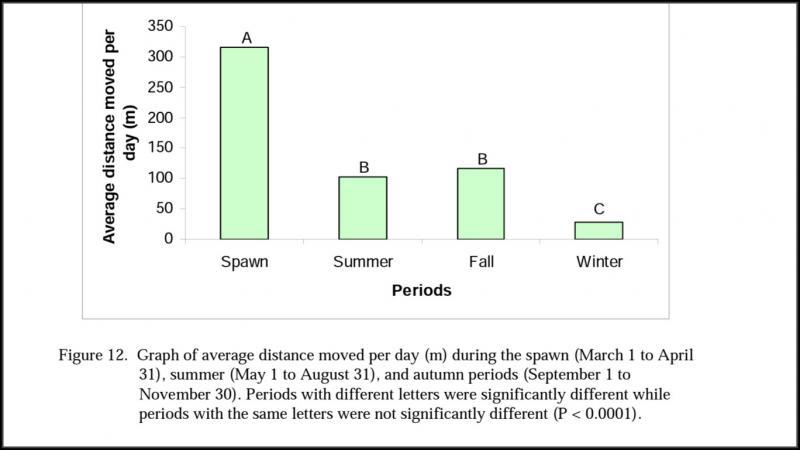
There are quite a few tracking studies available online, Google Scholar Search "walleye movement" will get you several. Here's a summary from an flatland Indiana lake much different from Stockton, but correlates well with results from similar highland reservoirs; Ignoring spawning movements (a whole 'nother story), stability seems to govern movement. As long as temperature, clarity, and prey abundance are stable, the fish seem content to remain in an area till something changes. On the other hand, there are individuals that roam great distances, particularly if the forage is nomadic (like shad).
-
Top 5 Suggestions For Novice Fishermen (To Make Them Good Fishermen)
bfishn replied to *T*'s topic in Table Rock Lake
1. Buy lots of fishing magazines. You never know when you'll need a fire. 2. Seek the wisdom of the biggest braggarts. You can't make that stuff up, right? 3. Carefully record and share all your successful waypoints in the paper and online. The fellows that will be fishing there when you return will gladly show you how to really catch them. 4. Patronize the old farts. Every trip could be their last. 5. Pay money or pay attention. Not many bargains in the expertise aisle. -
+1 (for Android). It's now available for us sadistic users of Windows phones and tablets too; http://apps.microsoft.com/windows/en-us/app/river-flows/d5d8be9a-8e09-45ab-8345-6acd5e18c28e Touch screens and map browsing go together like PB&J. This one's as fast as your fingers.
-
At least he's gittin; some. :-( Some stakes at 1' intervals sure help interpreting critter caliber. Paint inch marks on them if you're so inclined.
-
Ooops.
-
The Bond Of Friendship, And Fishing!
bfishn replied to LittleRedFisherman's topic in General Angling Discussion
Awesome. Fishing buddies all have an expiration date. Use allotment wisely before expiration for best results.. -
If you can count a parasite that just came along for the ride as a catch, you might as well start checking stomach contents too. Probably find several species there that would be mighty hard to catch otherwise. :-)
