hoglaw
-
Posts
1,261 -
Joined
-
Last visited
-
Days Won
3
Content Type
Profiles
Forums
Blogs
Events
Articles
Video Feed
Gallery
Everything posted by hoglaw
-
Question About Rod Tips, Grooves, And Line Choices
hoglaw replied to buffresources's topic in General Angling Discussion
Yep, all those suggestions are accurate. If you're noticing a distinct grove on the tip-top, that's not a good thing. Hopefully your tip-top was glued on and not epoxied on. I've removed a couple that were epoxied onto older rods that I could not get off with indirect lighter heat very easily. I used 80lb braid and tied one end to the tip-top and the other end to a doorknob. Then I put direct flame on the tip-top tube while steadily pulling against the braided line until it popped off. Graphite and direct flame do not get along very well, so be careful using this method. If you take your time and heat that tube evenly, it will eventually pop off with minimal damage to the tip. But try indirect heat first or boiling water (never thought of doing that but it should work like a charm). Don't know if the epoxy bond will break at 220 degrees (or whatever water boils at) but the glue bond will most definitely soften. They make tip-top sizing tools, but in the absence of that you can use calipers to figure out the diameter of your tip, then look it up on the web to find the tube size. Tube sizes come in half increments (millimeters perhaps?). Generally the rod repair kits you buy have poor quality tip tops that are big and heavy. A heavy tip-top will KILL the action of your rod. Go small and light and you'll be alright. -
I've never bait fished for them, but I have a high hook-up rate when fishing a 1/16oz or 1/8 oz olive or brown maribou jig. I've only done it standing in my canoe. If you put it in their field of vision without spooking them, it's game on almost every time. Even cruising fish will go after the jig.
-
Trout: There will be many many folks floating this weekend. I went last weekend (post in thread below) and managed to avoid the crowds. There's an 11 mile float that ends at Maumee I believe that should be a little quieter than most, especially if the water is lower than it was last weekend. I went from Mt. Hersey to Woolum in about six hours, but we were paddling a good deal of that especially through the GIANT pools on that stretch. I liked that float and had never done it before, and it's certainly less crowded than most of the sections. Regardless of where you go, you're going to see traffic. Whether you see ten boats or two hundred is up to you. Find out where the outfitters are putting folks in/taking them out and avoid those areas. Hasty is a major jumping off point on the upper river right now, so I wouldn't float there. If you don't have time for Rush to the White River (you might be close to alone down there this weekend), then look for the longest single stretch you can find as that will keep most day trippers away. Alternatively, put in at 2 or 3 in the afternoon and float half of a more popular stretch and you'll be behind most of the day crowd, and in front of them the next morning. Only problem with this is any other campers will beat you to the good spots, though there are plenty of them. Google "Buffalo River Map" and there's a good river map that shows all the accesses and the distances between them. That will help you pick a float that's hopefully a little too long for most day trippers. The entire river is senic. Don't know what to tell you there. Not far above Woolum we got into some really neat smaller rock formations and cliffs that would have been cool places to camp around. Good luck to you. We caught a lot of fish on DT hula grubs and on topwater frogs.
-
I took my girlfriend to Pinnacle yesterday to walk a few holes. In the process I saw a bluegill spawn in full gear. Looked like moon craters everywhere. It got me to thinking about my favorite lake that has no shortage of monster smallmouth and largemouth, but they can be difficult to catch. Come to find out, I have a hall pass tomorrow night and it's a full moon....interesting. I've never targeted bass during a night bluegill spawn, but I figure tomorrow is as good a time as any to start. The lake is very deep for the most part with hard sloping banks and little to no vegetation in the water, but I know where some bigger flat areas are without as much contour to them so that's probably a good place to start. Any advice for tactics and lures for this kind of night fishing? I planned on slow rolling a big black spinnerbait and slow-waking some magnum sized wake baits. If that doesn't work, I normally wind up worm fishing. But with the bluegill going to beds hard, surely there's a way to just fish that pattern and do well.
-
We floated Mt. Hersey to Woolum. It was a very nice float with few other boats on it. Saw a TON of boats at Hasty. Hope you guys had a good weekend. The fish were very aggressive and we caught a bunch. It was a good trip except for the wind which was pretty stout and seemingly always coming from the wrong direction.
-
muddy, bobber and the others who check this board: I'm going down for my mom's birthday this weekend, and a bunch of us are staying in cabins up by Parthenon. That's WAY up in the upper river, above Jasper. I'd really like to do a fishing float on Saturday, but don't normally fish anywhere above Maumee. I love Maumee to Gilbert, but I'm not sure how far that is from where we are. Any reccommendations based on current water conditions for a stretch to float that won't be overcrowded on Saturday? Maumee? Mt. Hershey?
-
Need A Kayak Reccommendation
hoglaw replied to hoglaw's topic in Tips & Tricks, Boat Help and Product Review
The long and short of this whole deal is I want to fish the NEOKA and NWA Bass Paddlers tournaments. I have wanted to do those mini-boat tournaments for a while, but to really be on par with the rest of the folks I need a de-commissioned ranger and about four trolling motors. Not something I'm willing to do at the moment, but they're fun to look at. I want to do some tournament fishing, but don't have the time or money to jump in with the guys who have ample amounts of both - whether in the real boats or the elctric ones. So, being the model athlete that I am, I really need a boat that will track and move efficiently through the water for longer paddles. I assume Kayaks catch less wind then my canoes or even my john boat or river john. Just seems like such an efficient vehicle if one is truely dedicated to the idea of doing it without a power supply. -
Need A Kayak Reccommendation
hoglaw replied to hoglaw's topic in Tips & Tricks, Boat Help and Product Review
Worm, you're talking exactly what I do. I'm from central AR originally and still make it down quite a bit. My favorite place to fish in the world is the White River Refuge, particularly the oxbows around Maddox Bay. I don't think I'll be lugging this thing down there, over land, and back into the bows much, but what I really want is a lake boat that is servicable on the lower buffalow, crooked, etc. I figure I paddle real deal white water maybe once or twice a year. I think two boats is the right diagnosis. I shouldn't sacrifice my fishing kayak for something I do once or twice a year. Just like the rods I build, I want the very best tool for the job. I can always figure out a way to get it down faster water. The guy at Lewis and Clark said to err more on the river side than the lake side, but I don't think he fishes like I do! So that brings me back to the lake boat realm. I looked at a Jackson Cuda today, which seems to be the big brother of the Coosa. Very stable, very ergonomic, and it has a much more pronounced keel (I think...if I have terminology correct). I will paddle whatever I get before I buy it, no doubt. I like the looks and the setup of that boat, but if I"m going to drop $1200 on a kayak, I want the very best boat for the money. If there's another brand/boat that's a better setup for lakes and (lord willing) salt water some day, then that's the one I want. But dadgum...they had some boats up there by Hobbie that were $1500 plus!!! -
Need A Kayak Reccommendation
hoglaw replied to hoglaw's topic in Tips & Tricks, Boat Help and Product Review
So is that the trade-off? You need a more pronounced keel for lake fishing meaning a more stable boat and straighter tracking, but the more pronounced the keel is the more "draft" and less maneuverable the boat is and therefore less desirable for river fishing? What about a boat that's suitable for the rivers but has a deployable rudder to make up for the lack of a keel? Does that exist? -
I'm sure this topic has been beat to death and I could probably get answers to my questions looking in the previous threads on the subject. Here's what I want. I want a kayak that will spend 65% of its life on ponds and lakes, and 35% of its life on rivers. Most of my river trips these days are overnight trips, and with a girlfriend and shuttling involved, I'm rarely paddling a river solo. So the majority of my river trips will still be out of a canoe. Nevertheless, I'd like a fishing kayak that I could paddle on rivers...and (if possible) paddle it solo in quasi-whitewater conditions, like the Mulberry around 3.5' which is no joke, but certainly not class V water or anything. I'd also like the ability to carry light camping gear for 1 - basically a hammock, tarp, chair, and clothes. More important than whitewater characteristics are fishing characteristics though. As most of its life would be spent on the lake, I want a boat that rides well in the wind. It's an absolute must that I can stand up in it easily and comfortably. Much of the coosa's marketing is directed towards this angle - maximum stability standing up. Some of my lake trips will involve a mile or two of paddling to get to the fishing spot, so efficiency across the water is a big deal too. Seems like a rudder would be a nice accessory to have as well as an easily deployable drag chain for rivers and windy lake days. I know absolutely nothing about kayaks. I've maybe paddled two SOT's in my life, and all I took from those experiences was that the boat was unstable, my butt stayed wet, and I sat very low to the water. Seems like the Coosa resolves these issues, but I'm more interested in performance than marketing and popularity. The Wilderness Systems Commander 120 was reccommended to me as well. I just don't know where to start. Eventually I'm sure I'll run over to garfield and see if I can test-paddle some of these boats to find the one that suits me, but this board being the wealth of knowledge that it is, I thought I'd start here. I don't mind spending $1000 on a boat, but I want it to be the right one.
-
Can Leaders And Micro Guides Co-Exist
hoglaw replied to kirbydog's topic in General Angling Discussion
I'm interested to hear what the result of experimenting with different knots is, so please post it. I build almost exclusively with microguides now, but I don't tie leaders. The stock advice from Tom Kirkman is to always use the smallest guides that will always pass your knots with no problems. It's not like your knot is anywhere near the diameter of the guide, so the fact that it hangs up is interesting to me. I guess I"d also ask why you're using braid at all with heavy cranks and jigs, as it hurts the depth of your cb and floats up causing a loss of sensitivity with the jig? Plus in my mind a heavy cranking rod and a jig rod are opposite ends of the spectrum, but to each his own. Have you tried going to straight floro or are you not wanting to do that for some reason? -
A New Personal Best Largemouth!
hoglaw replied to kevthebassman's topic in General Angling Discussion
very nice fish -
The same thing that stops me from tying up a stringer of donkeys to a tree in a jackpot. Nothing.
-
I second every spot on your list. For better or worse, I'm also a big fan of the original Tony C's on Highway 12. I forget it's out there and will get a craving for their lasagna every now and then.
-
I picked up some of that 8lb CX co-poly to try it out on my shakey head rod. I was fishing flick shake worms with a very light jighead this weekend at greers ferry way back up in newly flooded bushes. It's great stuff! I REALLY like how it glides through micro guides. Setting those up on a spinning rod is a very difficult process. Not so tough on baitcasters, but if you don't get them placed exactly right on a spinning rod, line just doesn't agree with them and you lose some casting distance. That CX casts like a dream and is a smaller diameter than similar test XT. I think I'll be using that on all of my spinning setups now.
-
No one posted a report, so I'll do my best. Southwest corner of lower lake. Lake very high but dropping. My water warmed up fast and by 10 a.m. fish had moved into the newly flooded areas (or at least they started biting there). Lots of trees that are normally dry in at least eight feet of water. Fishing almost exclusively in the newly flooded areas, I had a fun morning withsix or so between two to three pounds and twice as many smaller ones. Was fishing from a friend's pellican/bass-buddy thing and caught all but one fish on a flick shake worm. They liked it.
-
I Shot A Big One (For Fins And Feathers)
hoglaw replied to BilletHead's topic in General Angling Discussion
awesome pictures. I don't care who you are, that's a bad dude. -
I'm headed to Greers this weekend with some of my best friends, none of whom really fish. I won't have access to a bass boat, but will have a party barge while I'm down there. We'll be near Quitman I think...south west part of the lake. Are crappie the deal there right now? I'd really like to do some trolling since I'll only have the barge. Any reccommendations?
-
Do you gus remember Big League Chew?
-
I'm into the Old Crow tonight, so let's ramble. There's zero shame in having nice rods...no need to equivocate Al. Since none of my boats have motors, I have no distinction between big water rods and creek rods. I'm prone to carrying a seven foot broom stick with 20lb floro to fish laydowns and log jams on small creeks, and I'm not the only one. What rods do I use for river smallmouth? The ideal rod for the task at hand. I do my best to keep it to four rods, one of which may or may not be a spinning rod. If I'm floating a stream with good for carp, then I'll carry my carp spinning rod and sometimes another to drag a shakey head or fish a wacky worm. The carp rod is great for those applications too, but if there are big carp to be had, that rod has to stay dedicated and locked and loaded at all times in case I see a good one. Most all of the rods I carry these days I built myself for very specific applications. The exceptions are a loomis GL3 that's a nice general all purpose baitcast rod. Don't recall the model number, but it's ideal for a hula grub or dragging a tube. I was also given an awesome Falcon Cara this winter that's a "jerkbait special," and I like it for jerkbaits, flukes, and cranks if I'm on a tight enough stream that I don't want to take my longer crankbait rods. I think there are two mentalities. Guys like Ron take pride in having a tool they didn't overpay for that gets the job done, and I completely understand that mentality. I happen to take pride in having the absolute best possible rod for a very specific situation. The tradeoff is more money and time on my part for those rods, and less versatility. But I get a tremendous amount of enjoyment from spending my disposable income and time on rods you can't buy in a store, and they are tailor made for a very specific application. If I wasn't into building rods, I doubt I'd spend the money I have spent on off the rack rods. Hard to justify dropping $250+ on a creek rod, much less an arsenal of them. Brand never mattered much to me. I thought it was cool when I got my first G Loomis for sure, but it does it's thing well and other things not so well. I've always felt that you match the rod to the lures you're fishing. On every float trip, I can name (right or wrong) three lures that I think will catch fish, and typically there are three different rods that are ideal for those lures. In general, my rotation would consist of my day's pick from the following: 7'6" spinnig rod with 6lb mono for carp; 6'6" or 7' spinning rod for shakey heads or flick shake worms depending on current; 6' fast tube/hula grub baitcaster; 6'6 or 7' moderate crankbait/swimbait baitcaster; 5'6" pistol grip moderate fast topwater baitcast (doubles as a cypress swamp spinnerbait rod back home); 7' extra fast worm baitcaster; 6' or 6'6" moderate fast jerkbait/fluke/trick worm alternative crankbait baitcaster; 6'6" fast horny toad/buzzbait/spinnerbait rod. Guess I'm somewhat of a gearhead when it comes to rods.
-
Do you have to have a trout stamp in MO to fish any of the trout waters, or just the parks/keeping trout?
-
Not sure what there is to discuss, but this just popped up in my email box. Thought it was pretty cool. March 22, 2012 A service of the Oklahoma Department of Wildlife Conservation Genetic analysis from "Minco mountain lion" confirms ties to South Dakota The Oklahoma Department of Wildlife Conservation recently confirmed origins of the mountain lion struck and killed by a motorist in November 2011 near Minco. According to Erik Bartholomew, furbearer biologist for the Wildlife Department, the 130-lb. male mountain lion that was found dead along HWY 81 north of Minco is closely tied genetically to populations in the Black Hills of South Dakota. DNA analyses performed on tissue collected from the cat also confirm it was a wild mountain lion and not an escaped domestic animal. "The cat's DNA shows a very close genetic relationship to wild populations in South Dakota," Bartholomew said. "We can say with a high level of confidence that this male was born in the Black Hills region. Another clue that this animal was wild is the fact that it had porcupine quills in its stomach. Apparently mountain lions consider them to be good eating, or maybe they are easy to catch, but many times western states report mountain lions with porcupine quills in their front legs and digestive tract." A small tooth from the mountain lion's upper jaw also was sent to a lab for aging. Much like the rings on a tree, the root portion of the tooth has rings that can be used by experts to age the animal. The tooth from the "Minco mountain lion" showed that the animal was at least three years old. "We have no idea of the path he used to get to Oklahoma," Bartholomew said. "However, with him being killed near the South Canadian, he likely was following the river where their primary prey - white-tailed deer - would be in high abundance. Males tend to have very large home ranges at or over 200 square miles. The Black Hills is a small island of habitat, and many times adult males will get in territorial disputes with young males and the loser leaves in search of new territory." This mountain lion represents a unique research opportunity for the Department since the animals are secretive and because biologists have had few other opportunities to study them up close in Oklahoma. Other wild mountain lions documented in Oklahoma also have tested positive for Black Hills origins, such as the female captured in the city limits of Tulsa last year and another believed to have been killed by a train in 2004 near Red Rock. A male mountain lion that was shot in 2010 in the Panhandle by a Department of Agriculture employee while depredating livestock tested positive for genetic ties to populations in eastern Colorado, and another confiscated by the Department's law enforcement division in southeast Oklahoma was genetically tied to populations in the Pine Ridge region of northwest Nebraska. Additionally, several other sightings have been documented, including a young radio-collared male from Colorado that traveled through the Panhandle's Texas County in 2010 and is now living in New Mexico, and trail camera pictures from the fall of 2009 that show mountain lions in Tillman and Atoka counties. Also called "panthers," "cougars" and "pumas," mountain lions are native to Oklahoma and historically would have been found statewide. Bartholomew said it is a common misconception that the Wildlife Department has released mountain lions in Oklahoma. Officials with the Wildlife Department rely on the public to report verifiable sightings, photos and reports of mountain lions to help document the species in Oklahoma. To submit photographs and report sightings of mountain lions in Oklahoma, log on to wildlifedepartment.com and report your sighting online or call Bartholomew at (405) 385-1791. ***Photo*** DNA analysis of the mountain lion that made headlines in November after being struck and killed by a vehicle near Minco has confirmed that the cat was a wild animal with genetic ties to populations in the Black Hills region of South Dakota. In this photo, Erik Bartholomew, furbearer biologist for the Oklahoma Department of Wildlife Conservation, takes the rare opportunity to conduct research on the mountain lion, which was hit on HWY 81 north of Minco.
-
You would not be over limit to continue fishing for and continue catching fish of the same species of which you already have a limit in the cooler. If you have five bass on ice (I assume that's the limit) in a non-tournament setting, you can continue fishing so long as you immediately release all additional fish you catch. You cannot "cull" except in a tournament, but this rule does not mean that you are over limit by catching another fish if you already have a limit so long as that fish is released. "Any fish you catch is included in your daily limit unless you release it unharmed immediately."
-
Well that's a bummer. As it happens, we were planning on taking a co-worker's boat who lives near PC. Unfortunately newborns have very little regard for fishing schedules, and his was up all night with an ear infection, so I don't have a boat or anyone to fish with today. I did manage to pick up a new tackle box from Academy last night. You know how it goes, went in for some pants for softball, left with a $200 tab. Guess I'll get to spend tonight transferring and reorganizing. Not a bad thing.
-
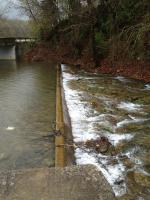
Here's what the spillway at Atalanta looks like today. Definitely a lot of water coming down the creek, but not washing over the low water bridge or anything. Went down to old PC road and the creek is very muddy. Lots of current moving through it, and a definite mudline coming out where it hits the lake. I'm going to give the catfish a shot tomorrow after work I think.