


tjm
-
Posts
4,679 -
Joined
-
Days Won
5
Content Type
Profiles
Forums
Blogs
Events
Articles
Video Feed
Gallery
Everything posted by tjm
-
I've always thought the relation to finding them near trees is that the root mass upheaves the dirt elevating the fungus just enough to make it visible. I've seen pictures of them in pine straw that made them easy to spot too.
-
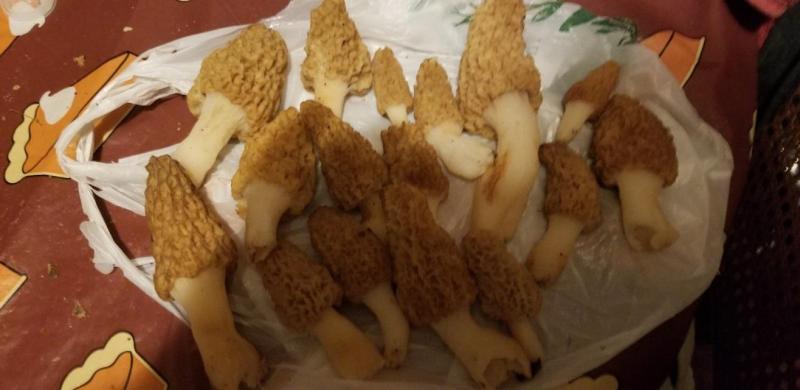
When asked about where they grow, I always say near "squirrel trees". But I have seen a few on the middle of open areas 100 yards from any tree. Then there are the places where they were there one year only and other places where they seem to appear in exactly the same spot year after year. Or the yard in town where they came up for 20-30 years until the owner had the pecan cut down and they never came back. I think that the only thing I know about finding them is that you have get out and look. They will be where you see them. I'm pretty sure that here they must have been up before that last cold snap with the frost, given soil moisture and temperature, but I wasn't feeling like mountain climbing and every one else said they couldn't happen until dogwood bloom. Which is like the tree thing, true enough sometimes but not actually any connection.
-
Oh, but all the experts say that they only grow next to "that kind of" tree. (and the other expert will say no. I only find by That kind of tree.) I went out this evening for 1/2 hour and it looks like I waited too long. But the younguns had walked this area a couple times without finding any
-
Is that the Old Wire Road crossing? (with the MDC parking lot) Shows as "Middle Wire Rd. Access" on this map- There is one crossing that borders the park, I guess could count as "above the park"? or do you mean the "Upper Access" that I have never found?
-
That statement alone should be enough to keep the voters from giving him anything. But I doubt that it will.
-
I haven't followed baseball in decades, but in the years that I did follow it, I always thought baseball on the radio was a lot more exciting than being there and watching it on TV was an excuse for a nap. If they still have good commentators on radio, that would be my recommendation, fish, work or plow while the boys play ball.
-
Should be a law that you have to eat every fish you catch. But then the permit sales would plummet to low numbers and the tournament anglers would be trying for small fish because who can eat 15# of bass? All the money in this $10.6bn recreational fishing business is dependent on C&R. Taxes on other things would have to increase to make up for all the taxes taken in on the estimated "$50bn a year on gear and trips". It doesn't bother me at all to kill fish to eat, but as long as C&R is legal I'll keep turning most of them loose out of laziness. I do expect that one day the animal rights segment will use C&R cruelty to ban recreational fishing, but maybe not for a few more years.
-
Don't you suppose the deck has to be loose so that it can expand and contract with temperature? I used to fish under a bridge that was about 6,130' over all length with 130' or so of clearance, the end of the deck was mounted to a roller on a slab of concrete and I've seen the roller moved several feet from winter to summer.
-
Pilot, not Captain, the Pilot would be a local navigator very familiar the local channels and currents that the ship's Captain would not necessarily know about. Ships over a certain size are required to hire a Pilot to enter most ports. A ship that size doesn't stop very well though and with out the engines wouldn't steer very well, a good reason to have a tugboat in attendance. Apparently the individuals on the bridge were all workers rather than drivers-
-
True, but DNA analysis show some signs that differentiate potential steelhead from potential resident trout within the same population, I don't pretend to know much about all that. The genetic study that started as the DNA research on the Mo. wild trout a few years ago, when completed shows numerous similarities to other groups of trout and many dissimilarities as well, I won't attempt to explain, nor could I, but Crane and Mill creeks have unique (and dissimilar) markers, one of which in the instance of Crane is more similar to the Sacramento River Coastal trout, an "inversion" found in the anadromous members more often than in resident members of that Sacramento group, than other groups of Mo. trout have, including the hatchery trout. I paid more attention to the Crane fish than to the other samples, and, it should be noted that samples taken below the blue ribbon area showed more similarity to hatchery fish, presumably because of stocking in Spring Creek. As I understand it the Mo. fish are not as closely related to the upper McCloud redband as they are to the McCloud coastal trout, but they have been isolated long enough that there has been some genetic drift making them unique to upper Crane, and that there have been some mixing with Mo. hatchery strains (records show some stocking there periodically up until the 1960s). You'd have to examine his charts and graphs to get a real picture of the many similarities and dissimilarities between the several groups of fish compared. Baird Station on the McCloud used numerous strains of trout and mixed them randomly and most of the stocked trout all over the world had origins in the Sacramento/McCloud/Pit Rivers. So, no surprise that our trout have that DNA, nor that it would be mixed rather than pure McCloud redband. Early Mo. stockings would likely have been from Mo. Fish Commision's Brown Spring Hatchery (built 1879, ended 1916) near St. Joseph, from embryos sourced from Baird. The Neosho Federal Hatchery was established in 1888 so after that time fish could have been supplied from there.n (I also remember that in the 1950s (and earlier?) every spring that had a stream of water as big as your hand had people trying to establish commercial "trout farms" and that many of those trout escaped and/or were released over time, I've caught trout in several streams that should not have them) I do hope that the study will be published, I'd like to have time to read and examine his findings and conclusions more closely. I think it merely confirms what I already believed from reading the various records.
-
Spent Friday there and saw no sowbugs at the sowbug. There were dozens of excellent fly tyers, even if the main theme seemed saltwater oriented. The Crane Creek trout are real trout but not defiantly unrelated to steelhead, interesting seminar though.
-
As near as i can recall every single year in the past 70+ has been at once the wettest & driest, as well as the coldest and hottest, I don't think we have had a "normal" weather year in my lifetime. But, doesn't some authority maintain records of past lake levels? accumulated precipitation from past years?
-
I read that trout sink because they have a pressure release valve on the swim bladder that some other fish don't have.
-
@Lvn2Fish I'm curious, would you recommend that equipment for recreational angling or do you regard it as a tool primarily designed for competition angling? would you say it's worth while for meat angler? 5# fish would feed a family better than 1# fish
-
@Maverickpro201 talk to your Dr. not a bunch of fish story tellers; I've heard many stories like oneshot's and I've heard of guys that lived a long time after diagnosis without surgery. At some age it's probable that a man would die of other causes before the slow growth got him. 10 years without surgery or 10 years with surgery? Your Dr. knows a lot more bout your age and other health issues than we do. Apparently oneshot is the only one here that has actually done this. The rest of us would be spectators, or speculators.
-
looks like a lunker compared to the several that I've caught on flies.
-
Do you have a link to a chart or study that starts tracking only after the vaccine was widely available? Didn't deaths taper off before the vaccine was produced?
-
Pretty simple really the birds are protected not by MDC but by a federal law that MDC must comply with, look up the Migratory Bird Treaty Act of 1918. Maybe the USA signed a series of treaties with other countries that spell out how birds are to be treated, then Congress passed a law governing that nationwide. Actually the black vultures are not invasive, they were not introduced; they are simply expanding their natural range as climate change allows then too. Invasive species, those that were introduced, like starlings and English sparrows are not protected. I'm ready to take all raptors off of the protected list, but that requires an Act the US Congress. and probably renegotiating some foreign treaties.
-
They should ask if you are feeding the the things. What are you doing to attract them?
-
My question about vulture problems is why people dump hundreds of fish carcasses on the bank like at the Rt. 10 bridge except to attract them? some one dumped what looked a 30 gal tub full there while I was walking up and back. The fresh pile had the square shape of a cooler so they were hauled there not cleaned there. But even cleaning a few fish or leaving bait containers is an attractant to the vultures. The old cleaning station at RRSP was overrun with them and when that was shut down many trout carcasses were dropped on the bank or in shallow water and the vultures found those. It looks like people want the vultures to come.
-
Do you think fish mate at night or in water deep enough that light doesn't penetrate? are your lures trying to evoke a spawning/mating response? those colors presented at the right time and in the right way might work. Yes, fish "see" colors when the correct wavelength light is present, they have cones in their eyes. That's on the list of things that we know (those things that are not speculation) about how they see. Fish don't see color when those light wavelengths are not available; for that matter neither do we. Go out in the woods on a dark night away from any lights and wait 10-15 minutes for your eyes to adjust until you can see well enough to walk and distinguish different things, you won't see colors as hues. Try the same experiment on a moonlit night in the same place, will you see hues then? We can't see light that isn't there can we? This is not theory or science, it's an observation that everybody has made, whether you believe your eyes or not. Fish can't see what isn't there either. Another way to try color vision might be to grab a dozen similar lures each in a different color and in a closed room with the shades drawn, curtains closed, doors shut turn off the lights and lay those lure out on a table left to right in alphabetical order of the first letter of the color you see in the dark. Still fish feed in the dark.
-
If you spend enough time switching colors the lighting will change angles and the colors visible at depth will change with it, or the wind will change, or a cloud will move in or out, or the moon will be nearer to overhead - you can never be sure what triggered the bite I usually make any changes after the first couple of fish, just to see if the color matters or if it is something else
-
Where is that UV coming from at night? does light from stars penetrate water with the color spectrum?
-
not all, because we do know how light waves are absorbed and when there is no red light the color red will disappear. And we do know that the fish have cones and rods in their eyes and we know how cones work and rods work; so really the only thing we don't know is the fish processes what it sees.


