


bfishn
-
Posts
2,109 -
Joined
-
Last visited
-
Days Won
6
Content Type
Profiles
Forums
Blogs
Events
Articles
Video Feed
Gallery
Everything posted by bfishn
-
5 News just aired the video, stating the bus weighed 35T, but a preliminary inspection today showed no damage to the bridge. Further inspections are expected. No word on the status of the driver...
-
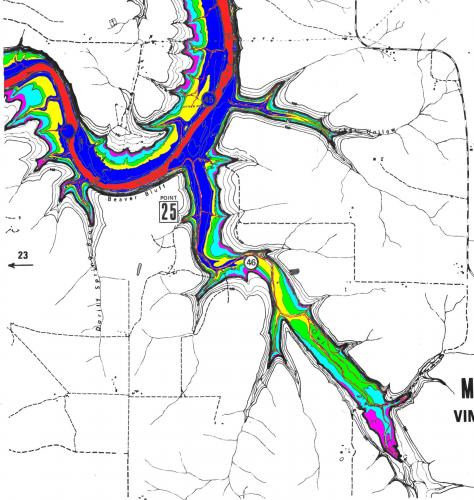
Those pre-lake surveys were the best thing since bread and butter for learning where to look.I spent awhile in some with Photoshop way back when, the result was cool, and I learned a lot doing it.
-
Yeah, cemeteries are mostly "nothing" spots since they often dozed it flat after 'moving' what they could.... open graves & stuff. There are exceptions...
-
That's a pretty good catfish spot after the sun goes down too.
-
Most any given time there are "some". While intentionally catching a striper from TR would probably be more rewarding than finding the needle in a haystack, it might take (a lot) longer...
-
Yeah, the first sixty's a breeze... Happy Birthday Phil! Wish I could come to your party.
-
I've been wondering what Hunter S Thompson would have to say... somebody beat me to it.

-
Or backtroll.
-
Mama missed a golden opportunity to plant a tongue stud...
-
Good grief man, get those poor pollies out of that nastyazz test tank and into a proper puddle. We need all the frogs we can get in the war on carp! Nah, I was fishing the day the teacher talked about tadpoles. You'll have to figure that one out on your own. 🙂
-
You're welcome! Now I have some Qs for you... Would a surface film of boat fuel/exhaust inhibit or prevent the normal exchange of atmospheric oxygen? How long would it persist? Would the effect be more prevalent near a marina given the seemingly unavoidable leakage/spillage?
-
I borrowed the chart below from an aquarium site because it has a Fahrenheit temperature scale. Whoever made it mistakenly labeled the oxygen scale as %, it should be parts per million (ppm). Otherwise accurate. As previously mentioned, DO levels are directly related to water temperature. Saturation is the most DO that water can contain under natural conditions at atmospheric pressure and the indicated temperature. I posted this to illustrate what a narrow range there can be between DO saturation and lethal limits. For instance, at 86 degrees, the maximum DO is ~7.6 ppm, just 3.6 parts per million above lethality for most fish. At 50-59 degrees (common thermocline temps), the spread doubles to ~6-7 ppm. Considering the dynamic, ever-changing nature of DO, it’s pretty amazing that we have as few DO-related fish kills as we do. Surface aeration replenishes DO, Biological Oxygen Demand depletes it. Then you have the daily phytoplankton cycle that replenishes DO in the day and depletes it at night. Inflows can be beneficial or detrimental simply depending on the specific conditions at that particular time and place. I’ll make no claims as to what I think a fish knows or thinks, or whether it’s smart enough to sense potentially lethal conditions and relocate accordingly. In the case of walleye that are conditioned to summer thermocline temperatures, I know it wouldn’t do them much good to leave that zone because DO was dropping and move the mere ~30’ to the surface where it’s better, because the sudden change from ~55 degrees to ~85 would croak them in a fairly short time. Maybe that’s what happened.

-
I can dig it up at home, but a basic ROT is 6 ppm for trout and 4 ppm for most other gamefish, but there is really more to it than DO alone. I'll dig up some data for you tonight.
-
That's a pretty good buy. I gave a little more than that for a used YSI analog model back in the early '90s. My primary use was at my trout farm and for live hauls, but I've used it plenty for fishing purposes too. Haven't used it since the AG&FC started posting temp/DO profiles online for the WR chain.
-
Nothing wrong with that, but they're far from new to fisheries folks. Here's a study on it from the early '60s on Lake Erie. I'm sure you could go back farther, I only spent about 30 seconds looking. https://kb.osu.edu/bitstream/handle/1811/5114/1/V65N06_319.pdf
-
Anywhere near a bank or a law office...
-
Carp phobia.
-
-
While it's illegal to shoot down or jam a drone, I think a prosecutor would have to get pretty creative to charge anybody for putting on an otherwise-legal aerial fireworks display...
-

Your screen name is what? And what about that avatar??
bfishn replied to ness's topic in General Angling Discussion
I guess it's a good thing he doesn't have ultra-curly hair given the story he told, otherwise we might be calling him Knappyhead... 🙂 -
Your screen name is what? And what about that avatar??
bfishn replied to ness's topic in General Angling Discussion
All I got was, "The billet head is a decorative piece of woodwork that adorns the bow of a ship". That left me even more confused... Good idea for a thread Ness. -
Your screen name is what? And what about that avatar??
bfishn replied to ness's topic in General Angling Discussion
Be fishin'. As in "I be fishing", "We be fishing", or the existential "BE Fishing". Might as well explain avatars too. Mine's a spring peeper, which I listen for on the first few warm Feb-March evenings to know when to gather some creek minners for an offering to Walter. -
Fishing Spot in Kingston
bfishn replied to Eric01's topic in Canada, South & Cental America, Europe, Asia and the Down Under
You don't have to click it to see where it goes... Turns out to be a legitimate link to a resort in Ontario. Sure smelled like spam though. -
Heck, you could anchor one on a channel break and create enough shade to attract some fish... the inverse of sitting with a light at night. 🙂


