


mojorig
-
Posts
434 -
Joined
-
Last visited
-
Days Won
1
Content Type
Profiles
Forums
Blogs
Events
Articles
Video Feed
Gallery
Everything posted by mojorig
-
I realize this is a James River Arm discussion but here is what we are seeing on Lake Norfork Dam with regards to DO. The Aug 11th readings were taken by the USACE, the Aug 17th readings were collected by a local walleye club, and the other two readings were taken by us. We will be taking daily readings for the next few weeks. Also, I have attached a link to a video showing DO over time for Table Rock. I realize the video is old but it visualize DO changes over time. https://drive.google.com/file/d/0B7yZGlFlMjD-Qkk4ZE93WjYxMUE/view?usp=sharing. I hope this helps with the conversation.
-
Last time I talked with the Winter Bassothon guys, they were wanting to get the schedule out pretty soon.
-
The USACE is predicting that Bull Shoals Lake should be down to normal by first of November. I agree that high water events make it difficult to access the lake and also can make the fishing difficult. The high water events are very important to most of the sport and forage fish populations in the lake. Overtime, catching (not fishing) would be very difficult if we didn't have these events. Please don't get me wrong, I don't think we need high water events every year. Every 3 to 5 years would be excellent.
-
I would fish around the 20 to 25 foot range. Dissolved oxygen drops off around 30 feet and increases at 40 feet.
-
Blue Catfish and Drum will feed on zebra mussels. Redear Sunfish will feed on them but that isn't their preferred food choice. There has always been some redear in Bull Shoals Lake. We did put some in the Bull Shoals Lake Nursery pond as a second crop in the pond. However, we don't believe they had time to have a successful spawn before the pond was flooded. We will continue to try to get some more redear in the lake. They will not eliminate or even control the zebra mussels. However, there is that potential for another fishery in the lake.
-
November 1 is the new prediction. That prediction will likely be tweaked as the water recedes.
-
We have been getting some reports from some of the marinas saying they are seeing lots of dead zebra mussels. The die-offs would be temperature related. Those that are deep enough to avoid the hot water, unfortunately have lots of nutrients to filter this year. The only good thing is many will die when the water recedes.
-
They must keep a specific water level at the Newport and Georgetown gauges down stream on the White River as described in this water management plan (http://www.swl-wc.usace.army.mil/pages/docs/White_River_Master_Manual.pdf). I would image there would be legal ramifications if they didn't follow this plan as well if they let the water get above the flood pool in each lake.
-
Little more info about one of the facts influencing the high water low DO kills occurring on TR right now. This is from pages 2-3 of "Hypolimnetic Dissolved-Oxygen Dynamics within Selected White River Reservoirs, Northern Arkansas–Southern Missouri, 1974–2008" by Jeanne L. De Lanois and W. Reed Green link: http://pubs.usgs.gov/sir/2011/5090/pdf/sir2011-5090.pdf). I hope this helps the conversation. Fish kills of the nature have occurred in Lake Norfork in 2002, 2004, and 2011. It occurred in Bull Shoals Lake in 2004 and 2011. In general, hypolimnetic temperature and DO concentrations vary from summer to summer in reservoirs, more so than in natural lakes, largely in response to the magnitude of flow into and release out of the water body. In a bottom-release reservoir, during periods of high outflow, the coldest hypolimnetic waters are often released, and replaced by the warmer waters from above (Cole and Hannan, 1990). Typically, the temperature of hypolimnetic waters during years of high inflow/outflow is greater than during years of low inflow/outflow. These differences in water temperature affect the amount of DO in the hypolimnion because warmer water contains less DO than cooler water and yet causes greater DO consumption because of increased metabolic rates. The general pattern in hypolimnetic DO dynamics following the onset of thermal stratification has been described in deep-storage reservoirs (Cole and Hannan, 1990) (fig. 1). In general, the hypolimnetic anoxic zone initially develops in the thalweg (deepest areas of the lake) in the upper end of the reservoir following the setup of thermal stratification. The zone of hypolimnetic anoxia then extends upstream and downstream as the summer stratification season proceeds. At the same time, the anoxic zone originally develops in the deepest areas of the lake but then extends vertically upward and laterally out of the thalweg. In many cases, the hypolimnetic anoxic zone extends into the metalimnion (the stratum between the epilimnion and hypolimnion exhibiting marked thermal discontinuity). The pattern in hypolimnetic DO depletion results from an interaction of flow and morphology, which in turn affects sedimentation, primary production, and the hypolimnetic temperature regime.
-

Lake Biologist is Aware of the Dead Gizzard Shad
mojorig replied to Bill Babler's topic in Table Rock Lake
We currently don't believe there will be a fish kill on Bull Shoals Lake, this year, based off the DO readings for July. We should have a better idea once we receive the new readings for this month. -
Lake Biologist is Aware of the Dead Gizzard Shad
mojorig replied to Bill Babler's topic in Table Rock Lake
Quillback is correct about minimum flow. As of 2014, the new conservation pool level for Bull Shoals Lake is 659. The pool was raised because most if not all the acre-feet of water in the lake has been allocated for some purpose. Thus 5 foot was taken from the flood pool to allocate for minimum flow. I am guessing this was done so no water would be removed from already allocated acre-feet of water (see picture below based off this super long document http://www.swl.usace.army.mil/Portals/50/docs/planningandenvironmental/Final%20-%20Bull%20Shoals%20Reallocation%20Report.pdf). Fishing Hodges, Yes, politics does have a part in water level control on USACE waterbodies. Congress actually had to approve minimum flow for Bull Shoals Lake and Lake Norfork. I will say high water events are a double edge sword. High water events like this year are very difficult on anglers and marina owners. However, high water benefits the sport fish thus benefiting anglers in the long run. Bull Shoals Lake sport fisheries benefit greatly from the high water. Past data has show that high water years (years where high water stay through the summer like 73,78,79,85,90,02,08,11) there is increase in LMB production and forage fish production. Previous studies have shown 520 times as many LMB in a high water event compared to a low water event. Sorry all for deviating from the original topic of this post!!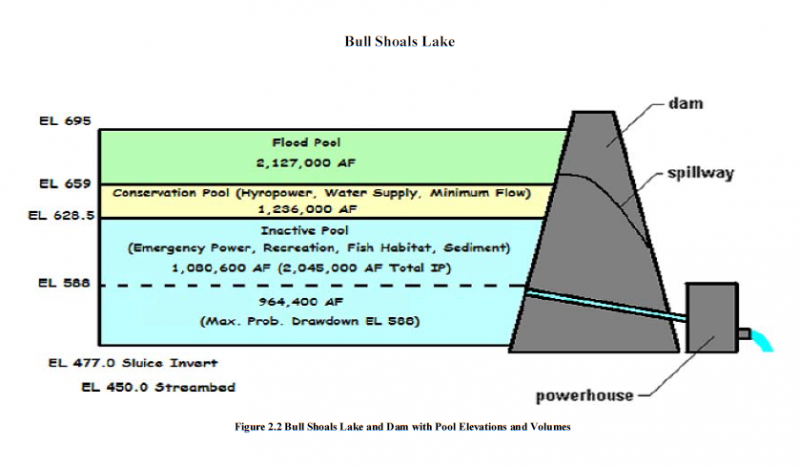
-
Lake Biologist is Aware of the Dead Gizzard Shad
mojorig replied to Bill Babler's topic in Table Rock Lake
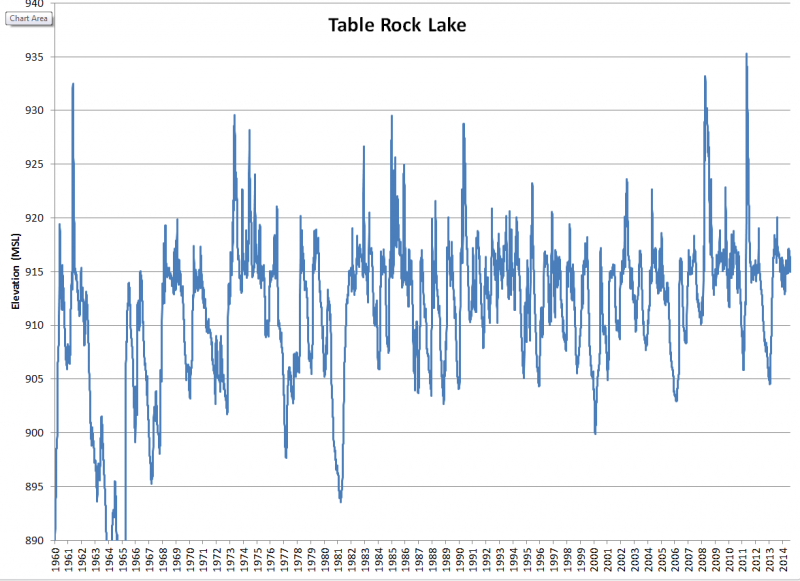
I realize this is the Table Rock board but here are the daily water level readings for Table Rock and Bull Shoals Lake from impoundment to Dec 2014. I hope this helps to give an idea of the yearly pool level over time especially during the winter. Also, I attached this link (http://www.swl-wc.usace.army.mil/pages/docs/White_River_Master_Manual.pdf) from the USCOE website. It discusses the water control plan for the white river reservoirs. We just discovered this document no long ago and found it useful when trying to understand why the USCOE holds or releases water. Again, I hope this helps the discussion.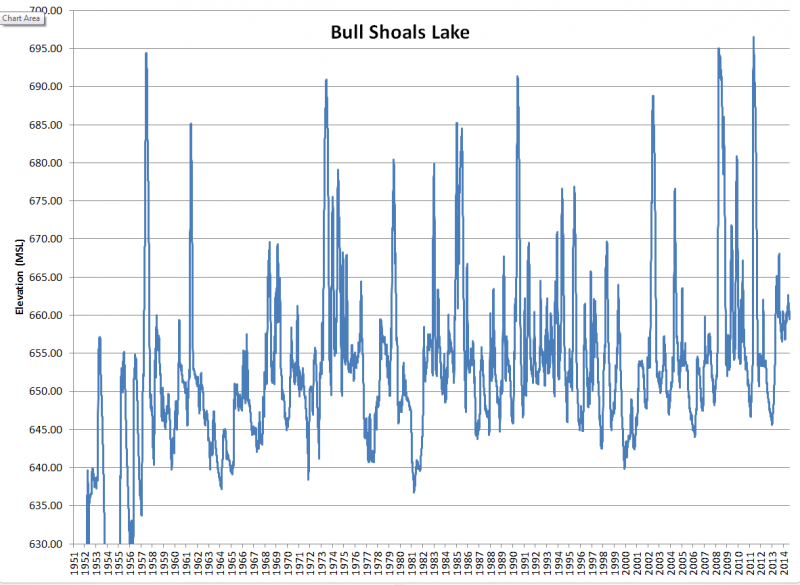
-
They are predicting TR to be normal by August 30th. http://www.swl-wc.usace.army.mil/pages/reports/remote/lakfcst.htm
-
Here is what is listed on the USACE Table Rock Page: http://www.swl-wc.usace.army.mil/pages/data/tabular/htm/tabrock.htm Top Flood Pool: 931.0 Current Power Pool: 917.0 Top Power Pool: Jan 01 to Apr 30 915 Apr 30 to May 01 915 to 916 May 01 to Jun 01 916 to 917 Jun 01 to Nov 30 917 Nov 30 to Dec 01 917 to 915 Dec 01 to Dec 31 915
-
AGFC District 2 Fisheries 2015 Second Quarter Newsletter
mojorig replied to mojorig's topic in Lower Bull Shoals
We are not aware of them eating zebra mussels. However, they are animals so they can do strange things at time, lol!! -
We are having an onsite meeting about the access on Thursday. I will update everyone after that meeting.
-
All, I have attached the AGFC D-2 Fisheries 2015 second quarter newsletter. If you would like to be added to the newsletter email list, feel free to email me at Jeremy.Risley@agfc.ar.gov Thank you for taking the time to read our newsletter. Feel free to contact us with an questions. Thank you for fishing Lake Norfork!!! Thanks, Jeremy D-2 - 2015 Second Quarter Newsletter.pdf
-
AGFC District 2 Fisheries 2015 Second Quarter Newsletter
mojorig posted a topic in Lower Bull Shoals
All, I have attached the AGFC D-2 Fisheries 2015 second quarter newsletter. If you would like to be added to the newsletter email list, feel free to email me at Jeremy.Risley@agfc.ar.gov Thank you for taking the time to read our newsletter. Feel free to contact us with an questions. Thank you for fishing Bull Shoals Lake!!! Thanks, Jeremy D-2 - 2015 Second Quarter Newsletter.pdf -
http://www.swl-wc.usace.army.mil/pages/reports/remote/lakfcst.htm
-
T, the striped bass fishing has been great, so far, this year. There are plenty of fish in the lake. They are starting to rebound after the fish kill of 2011.
-
Looks like the new crest will be somewhere in the 688 ft-msl range.
-
Quick Update: Yesterday (6/18), the AGFC Commissioners approved the AGFC to enter into a land purchase agreement to purchase 10 acres at George's Creek to construct an access. The land acquisition and some of the access construction will occur in FY 15-16 (July 20115 - June 2016). The access will be completed in FY 16-17. Basically, the access should be totally complete by late summer/early fall 2016.
-
Looks like they have updated the Bull Shoals Lake level forecast again. They are forecasting Bull to reach 670 by May 31st. http://www.swl-wc.usace.army.mil/pages/reports/remote/lakfcst.htm
-
The crappie anglers that we have been in contact with haven't be doing any good since the water start rising this spring. The same thing occurred on Lake Norfork too. We saw a few crappie while conducting our spring bass samples on Bull Shoals near the end of April. Most of them were really dark suggesting they were about to start spawning.


