


tjm
-
Posts
4,676 -
Joined
-
Days Won
5
Content Type
Profiles
Forums
Blogs
Events
Articles
Video Feed
Gallery
Everything posted by tjm
-
The water quality issues belong to a different branch of the government, Department of Energy and Environment, DEQ. Asking AGFC to fix the water problem is like asking your dentist to overhaul your car engine or asking the mechanic to remove you appendix. I'm sure AGFC is just as frustrated as you are with the situation, but even knowing exactly what went wrong and why, there is nothing AGFC can do about it. In general the low DO2 in reservoirs type situation comes from rain and generation. Rain effectively reduces the oxygen levels in lakes through a few actions, and generation sucks the cool water oxygenated out of the reservoirs and when combined the result is low dissolved oxygen in the remaining lake water. Happens to some extent every year in every reservoir as far as I can find out. Did that area get more than usual early summer rain over a longer than normal time period?
-
The park shouldn't have any biologists. Should be mostly admin and maintenance with a ranger thrown in. They shouldn't have anything to do with the hatchery management. The hatchery is MDC's and can be thought of as an inholding of the park, kinda like BillBob's house in the middle of national forest. Any improvements that BillBob makes to his house or land or his access easement have nothing to do with the Forest Service other than cooperation as neighbors. I guess that I see that distinction as important because MDC belongs to the people and DNR belongs to the Governor and the politicians. And in many other states the politically controlled DNRs are the overseers of fish and game; where all hunting, fishing and trapping regulations depend of the day's flavor of politics and may change with each election, but are often enough controlled by antis. Mo.'s MDC is almost unique in it's (somewhat) political independence and it's source of fiance not being through the politicians. From my view the Parks suck, and that is because they are apparently run by PETA types that would prefer no fishing there; just as they have no hunting or trapping on any DNR owned lands. Their biggest interest in the parks seems to be in monetizing them. The fact that the hatcheries still exist within the parks is a marvel to me. But perhaps my view of DNR is biased by the employees that I have talked to.
-
If you did well, why do you think there is a problem? When I was there last spring, the work on the hatchery didn't seem to be having much effect on anything else. Of course at that time it didn't seem that much work was being done either. Scuds make trout meat turn pink/red/orange, but hatcheries and farms usually feed synthetic carotenoids, often canthaxanthin or astaxanthin. I'm not sure that such color would significantly change the taste of the fish. It certainly makes the meat more attractive and possibly has some health benefit for humans if they eat enough trout. So, this prompts a question, what is in the spring run that trout eat after stocking? Is it an insect factory? loads of scuds ? do they continue to feed them pellets?
-
That would be a great improvement over the paved parking lot look that it has in my memory.
-
Just north of the Walmart on US71, not too far from Bella Vista they used to cross 71 by the dozens/hundreds going up the hill to the former glades in fall and down to the creek in the spring. Fall movement was more obvious and lasted for a couple weeks each year. Then 10-15 years ago the government put that concrete barrier down the center of the highway and I haven't seen them since. My assumption is that they couldn't pass the solid barrier and died out. I bet most people didn't even realize what they were seeing. Curiously the tarantulas that used to live in my "yard" seem to have disappeared in recent years as well, probably been 5-6 years since the last time that I saw one. For over 70 years they just been "tarantulas" or "Ozark Tarantulas" to me, with no reference to color. Your comment caused me to look it up and the interweb says the common name depends on what state they are found in. So I guess we should have been calling them "Missouri Brown Tarantulas" all these years. I took a few to school as "Show and tell" pets back in the '50s. At that time they were common enough here that a kid could likely find one on any summer day. Oklahoma Department of Wildlife Conservation calls them "Oklahoma brown tarantulas".
-
emergency trout regulations on the white/norfork rivers!
tjm replied to gotmuddy's topic in Conservation Issues
Exactly and if you fish, then don't claim to be superior to any other angler in regards to fish welfare. -
emergency trout regulations on the white/norfork rivers!
tjm replied to gotmuddy's topic in Conservation Issues
Studies don't show that. But ultimately it is up to the individual doing the release, I've watched as C&R fly anglers attempted to kill trout at RRSP numerous times. Mishandling is a trend. Three minute photo shoots don't help a fish recover nor does dropping on the dirt a couple times trying to handle net, rod, fish and camera. I've also watched as anglers cut the line as close to the mouth as possible, leaving the fish to choke later just to save a foot of cheap tippet, when leaving the line dangle might allow passing of the hook. The more I saw C&R practiced in the park the more I became convinced that every angler should be required to eat every fish they catch. -
emergency trout regulations on the white/norfork rivers!
tjm replied to gotmuddy's topic in Conservation Issues
Trout were introduced long before tourism became an industry. And if you class them as an invasive species you'd want to eliminate all restrictions and encourage wanton waste of them. But if managing trout strictly for tourism, you'd want to make them more available by having less restrictions not more. Guides using live bait can reach more tourists than guides using only barbless circle hooks on flies. Killing of the trout should be of no concern and there should be no attempt to legitimize the exploitation of the trout by saying that one method benefits the fish more than another method. Make the Feds supply their contracted number of fish even if they have to buy them from some fish farm. Aren't the tailwater trout mitigation for loss of native fish? -
emergency trout regulations on the white/norfork rivers!
tjm replied to gotmuddy's topic in Conservation Issues
I would say that not ;leaving the line dangling from a deep hooked fish should be criminal. I'm not going to look them up for you but over the past 30-50 years at least three studies have shown that fish have better chance of survival when the line is cut a foot from the mouth and allowed to drag. All the studies that I read said that when the line is cut close the hooks tend to turn crosswise to the gullet and prevent swallowing of food resulting in starvation, the hanging line keeps the hook aligned with the throat and allows food to pass. Here is a cut from a North American Journal of Fisheries Management article that has some numbers indicating bait may not be all that evil. Granted it may not be fully applicable to tailwaters where trout do much better than in the wild, where natural mortality can run 50-70% in some years. Now I am a fly rod only fisherman and have been for most of the past 40-50 years and if there were any science to support fly only as better for the fish I'd be yelling for such regulations on all waters.But there doesn't seem to be any. Never mind that no one anywhere can define what constitutes "Fly Fishing". Or even what is or isn't a fly. And the science supporting C&R is kinda thin and tends to gloss over the fatalities from C&R as being within the range of natural mortality, skipping the part about it might be in addition to. As to the barbless hook argument, several studies in several places also show that barbed hooks result in exactly the same mortality that barbless hooks do, so we can say that barbless are no worse than barbed for C&R. Barbless have one great advantage over barbed and that is when the angler hooks himself, it is much easier to turn him loose. I decided years ago that AGFC regulations don't even look to science, but are strictly political and based around generating money. Fish welfare and welfare of the fisheries always take back seat to the tourist dollar. -
I would not necessarily restrict the areas, but if I had my way all boats would be restricted to 15mph, or no wake speed whichever is less. That might keep the bass from being hauled 50 miles before "immediate release" and it'd make it safer to wade or swim or use paddle craft. Save the speed for the highways. I like seeing boats doing 80mph on the interstates, not so much when they create a wave. But if any restriction is placed on one type boat the same should apply to all boat types, be it power, speed, size or areas of use. I' could get behind restricted power/speed within 300 yards of shore, for all boats.
-
L.Sugar is now down to 1560 CFS after peaking ~3550 and the low water bridge will reappear at ~500. We might need rain again in 3-4 weeks.
-
Put a mink in the boat it will kill and eat the muskrats.
-
Yeah we had plenty of rain by a day or two ago, all that has fallen in the past 48 hours is wasted runoff. That creek is up to 2,580 CFS from 48 CFS
-
In my mind all modern trout are artificial. In the few places where indigenous trout remain, I think most species have been contaminated by stocking of other species or subspecies. Hard to justify protecting a fish that exists only to be stocked for recreational use. If my memory serves, there were no native trout east of the Mississippi, only the two chars; brook trout and lake trout. Rainbow Trout and the char Dolly Varden were native only to the streams draining directly into the Pacific. The Great Basin and the Rockies had only Cutthroat trout and and the char Bull Trout. Browns were strictly European. As were the common carp that were imported at the same time. I was going to refresh my memory but apparently the USGS no longer has a website.
-
If the Federal stocking is in mitigation of the lost native fisheries, as I think it is, the Feds would be legally obligated to furnish trout from some other source. A certain number of trout annually is typically a part of the negotiations when the Army wants to build a dam that has out flow cold enough to kill the native fishery. I'm not sure that is true on the White and the Northfork, but presume that it is.
-
From here in the rocking chair, it sounds like time to install a cooling unit and an air compressor. Might cost a bit but if this is an ongoing condition of the lake, then the alternative would be to convert the hatchery to producing crappie. It does sound like the tailwater itself is marginal for trout survival though if it is getting water at the same depth and conditions.
-
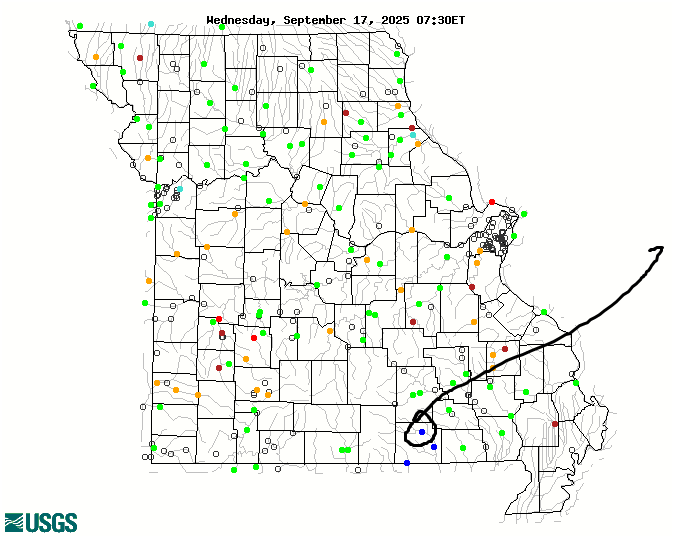
Greer https://waterwatch.usgs.gov/?m=real&r=mo
-
Some people would say oh no, no, wild trout are different; or oh no this river is special because it's a "spring creek" and you have to use 18' leaders with triple aerial mends. But I'll bet you are right trout are pretty much fish brained and try tasting everything to see if it is food. I guess I didn't find those short stretches.
-
Enforcement costs money and is pretty scarce everywhere, I can't recall the last time I saw an Agent in the park at RR and although I saw agents on streams three times last year (the first in several years) none of them asked me for a license. I did notice that they were in pairs which didn't used to be the case.
-
Nope, just telling it like I saw it. People lined up wading into the stream and following each other down river a step at a time to get out and repeat. Other people "Fly fishing" with spinning rods. The prettiest part of the park stream was the bait area as best I recall. I think we stayed there in passing three times in the mid/late '80s and I never went back until year before last and again last spring. From my perspective it's just as bad now as it was then. The pool was DNR and had zilch to do with fishing and dredging and chairs take away from fishing. That's one of the things MDC did to down grade RRSP is extensive dredging and stream modification in the lower section of the Park. But I was probably spoiled at that time having been fishing in the North East for 9-10 years, where it was rare to see two other anglers on any given piece of water other than the Bay. And none of the streams had been "improved" or "maintained" since the mills stopped using water power.
-
Doesn't that park have a stream nearby that is more or less wild and natural where a person could actually fly fish? I've always considered the parks as "almost fly fishing", because there are always other people in the way. 3/4s of which will walk right into a fly line. Or cast a spinner across your line. Some day I will learn to dangle a fly under a bobber, but so far it hasn't worked for me. I try that method once or twice a year whenever I find a nice bobber by the creek. The same with those balls, I've been picking them at RRSP up in mint condition for 40 years and try all of the ones I find, but have yet to catch a single fish with one. It's crazy, because I've seen hundreds of trout caught by both those methods. I've even asked others exactly how to set up a bobber rig. I think the first time that I fished BSSP was in the mid '80s and it did not have any "real fly fishing" even then. It's why I've been back there so infrequently since. I did kill some good sized trout, but it was not "fun". Montauk was nicer than BSSP back then with some green stuff and bushes by the stream, but the fish were smaller on the days I was there. Truth is you can't have thousands of people walking back and forth without destroying the vegetation and eventually the banks. And I appreciate the Parks most for the fact that they keep all those people in one place, leaving the White Ribbon areas and "warm" streams for antisocials like myself. We need to plant more stinging nettle.
-
Well, yes the limit is now 4. But the fish are not the Park when it comes to talking about upkeep or improvement, the number of vehicles and the number of people dumping trash or using the toilets etc. would affect Park maintenance expense and need for personnel, but those would be on the DNR. Some days at RRSP the dog walkers and hikers have outnumbered the anglers and they have no qualms about dragging their dogs and leashes through the fishing areas. None of those users buy tags but they all cause park wear and tear. Hatchery maintenance, improvement and fish quality, on the other hand are MDC's responsibility and expense. I'm confused about what your complaints target, are you disappointed in the fish or in the park management? I'm quite curious how the daily tag money is divided up, part to the concessionaire, part to DNR, part to MDC, or does the concessionaire keep it all? and how big are the parts? Why do we have the same guy as concessionaire at multiple parks and why doesn't that change every year with a bid process?
-
Well that's too bad, RRSP tore out all the tent sites and converted them to concrete parking for those things. Pulled out all the trees that they had planted 30 years ago too, digging electric and water lines. I haven't been over there for months but I suppose the whole place is now as interesting as a Walmart Parking lot. One of the things that I hate about BSSP is having to see the massive parking lot near the stream. They need to tear the bridges out not improve them. Wrench's comment had me thinking about how pleasantly run RRSP was in the 80s-00s and how shabby it seems now, rather like wench's view of BSSP. and wondering if it was DNR spoiling the place or just We The People trashing it.
-
Would you say that those years of the 70-90s had more users than today?
-
Maintaining the park falls on DNR, MDC just deals with the fish and the hatchery. Perhaps some stream work that would affect the fish. Any decision about maintaining the park would be one of to do or not to do by DNR which is politically dependent so on the Politicians.


