


Al Agnew
-
Posts
7,085 -
Joined
-
Last visited
-
Days Won
27
Content Type
Profiles
Forums
Blogs
Events
Articles
Video Feed
Gallery
Everything posted by Al Agnew
-
I'm a lot closer to the way you do it if I'm floating an unfamiliar stream. Then it's as much about exploring and soaking in the scenery as it is fishing--sometimes even more so. But I've floated every inch of Big River dozens to hundreds of times. On it I only notice the other stuff in passing. Everybody fishes their own way, or should; I'm certainly not saying my own way it the only right one. And it's not a competition for me, nor do I set goals. It's just the way I like to fish. Canoe control, accurate casting to tight targets, figuring out the optimal casts as I'm drifting down a bank, and just pure efficiency, are all things I truly enjoy doing.
-
By the way, I started counting fish like this back when I was collecting scale samples and counting fish for MDC. Then I was writing it all down, but if I went to a different river where they didn't need the data, I just started keeping a running count in my head. There's a method to my madness...I just keep the numbers in my head--smallmouth, largemouth, spotted in that order. So my count at any given time might be something like "14/5/16". I can just keep the tally like that in my head as I'm fishing. But I do love fishing in places where you only catch smallmouth with an occasional largemouth; keeping the numbers is easier. Fishing Big River, you gotta keep all three, and often a fourth category--spot/smallmouth hybrids! Also, I found while keeping the records for MDC that on average, about half the fish I catch will be under 12 inches, and then the numbers go something like halving it for each inch or two. So if I catch 80 fish, somewhere around 40 will be over 12 inches, of those around 20 will be 13-14 inches, around 10 will be 14-15 inches, around 5 will be 15-16 inches, leaving 5 or so over 16 inches. This isn't always true, of course, but it kinda shows you an average of what size structure you should catch from a decent Ozark stream. Today, as near as I can remember I caught 6 smallmouth and a largemouth over 16 inches out of 58 fish, so it was a better than average day for bigger fish.
-
Your math is probably right, but what you have to realize is that a lot of times I get into a nice stretch of bank and I'm catching a fish every other cast. I fish fast moving baits almost exclusively, so a cast only takes about 10 seconds to fish back to the canoe. If I hook a smallish fish, under 12 inches (which I count if it's a bass), it only takes a few seconds to get it to the canoe, and 10-20 seconds to release it. So often I'm catching a couple fish per minute for a few minute stretch. I will also admit that if I get the fish to the boat and lift it out of the water and it shakes off before I touch it, I still count it if it's a small one. The bigger ones I have to hold to count. I find that most people really underestimate the number of fish they catch on a good day. I've had a lot of guys in the canoe with me when we are catching fish, and I keep a running count in my head and keep them apprised of how many we've caught. But in the past I've kept a silent count, and asked them at the end of the trip how many they thought we caught. They invariably underestimate by 25% or more. Why? Because the little ones don't stick in their mind. It's not that I'm proud of catching 40 dinks, it's simply that I want a yardstick for how good a numbers day it was. Today I did 12 mile float, from 7 AM to 5:30 PM. It was a typical fishing day for me in warm weather; I only got out of the canoe three times, twice to stretch my legs and pee, and a 15 minute lunch break. I caught a big one early and had a couple more strikes from big fish in the first couple hours, which always makes me fish even harder, but this is a very familiar stretch of river and much of it not all that scenic, so I didn't spend a lot of time gawking at the scenery or leisurely paddling, I fished hard and hit every spot I possibly could. And it's great habitat, without much "wasted water" to paddle through and the riffles are short. So I would estimate I was actively fishing for probably 9.5 hours of the 10.5 hours on the water. Let me tell you how the day went: 7-8 AM--caught a 12 inch largemouth before I got in the canoe, while tying on lures and casting them to make sure they were working right. A dink spotted bass in the riffle right below the put-in. Then I fished a pool nearly a mile long, with only 2 more dink spotted bass throughout it. At the tail end of the pool, I hooked a really good fish and lost it, caught another small spot, and then caught a 19 inch smallmouth. First hour, five fish. 8-10 AM--the big one made me start fishing hard, and it hit topwater, so I was fishing walking baits a lot, but I was also using my homemade crankbait. I didn't hook any more big fish, but caught a couple nice smallmouth in the 15 inch range, and a bunch of spotted bass. I believe that by 10 AM I'd caught 4 smallmouth, 2 largemouth, and 11 spotted bass total, so second two hours, 12 fish. 10-11 AM--Mary called me around 11, and asked me how many fish I'd caught so far. I remember telling her that I was up to 24 fish, so I must have caught 7 in that hour. One of them was an 18 inch smallmouth, which I caught on my homemade twin spin, which made me start fishing it a lot. It's probably the fastest lure I fish because I reel it so that it bulges the surface. If I'm fishing that lure I make a LOT of casts! 11 AM-1 PM--I stopped for lunch about 1 PM, and called Mary again. This time I told her I was up to 31 fish, so 7 fish in those two hours. 1-3 PM--the fishing seemed to slow considerably during this time, with long stretches of no fish or maybe one dink spotted bass, but I hit a couple stretches of good fishing. At about 3 PM I passed one of the major landmarks on this float, and had three miles to go. I remember at that point I was up to 24 spotted bass, 9 smallmouth, and 7 largemouth. So I caught 10 fish in that 2 hour period. 3-4 PM--I had stopped using the twin spin and was trying other stuff, and not catching much. I think I only caught 6 fish in that hour, but one of them was right around the end of the hour, and was my second 19 inch smallmouth--as soon as I'd picked up the twin spin rod again! I also hooked and lost two more big ones on topwater. 4-5 PM--then things really got slow. I only caught two dink spotted bass in this hour. I was up to 48 fish total. 5-5:30 PM--the big reason I can be so precise on these times is that I was supposed to be at the take-out at 5:30 to meet my shuttle person, so I was timing the float more than I usually do. In that last half hour the big fish turned on. I hooked and lost another big one on top, then caught my best of the day, a 19.5 inch smallmouth, and had strikes from two more big ones. So obviously I was fishing really hard that last half hour. I only had a half-mile to go, and in that half hour and half mile I caught 10 fish to bring the final tally up to 58. Now...double those numbers for a day of more than 100 fish. Believe me, it isn't that hard to do if the fish are cooperating and you're counting every bass you catch, no matter how small. I've had a few days in the past where I seldom made more than a half dozen casts without catching a fish. Heck, my buddies and I all kept count one day on the John Day River in Oregon, when you literally could have caught a smallmouth on every cast the little ones were so thick; the only reason we didn't is because we were trying a lot of big lures to try to find the bigger fish. We all caught between 140 and 250 fish apiece. Cory Cottrell and I kept count on the trip up north this year, and caught 140 our best day between the two of us, and the great majority were over 15 inches. We were fishing mainly spinnerbaits and buzzbaits in murky water where most of our casts were very short, and we burned them back to the boat if the fish didn't hit in the first 3 feet off the bank.
-
Brown trout are gorgeous fish! My favorite of the trout, other than native cutthroat in their native streams.
-
When I was a kid and the original Rapala was still a "new" lure, I caught a pile of smallmouth, including my first 20 incher, on a 2 3/4th inch long Rapala. I did NOT fish it as a crankbait, I fished it as a surface lure, just twitching it quickly but gently enough that it stayed on the surface. After fishing it through the assumed strike zone, I burned it back in. Sometimes a bass would zip out after it when I was cranking it back in and slam it. But I found out as time went along that other lures were simply better. I haven't used any shallow diving minnow lures for probably 40 years. I'm sure they still catch fish, but I'm very happy with the lures I DO use. That section of Big River was one of the original three special management areas. I caught one of my two biggest, by weight, smallmouth on it, which was also the longest smallmouth I've ever caught (22.5 inches) long before the spotted bass invaded and it became a special management area. It has never been a great stretch for numbers of fish, but used to produce big ones with some regularity until the spotted bass resulted in a decline of probably 70% in the smallmouth population (which also means a decline of something like 70% in the numbers of BIG smallmouth). On a different stretch of Big River last week, I caught 80 bass, including 6 between 17 and 18 inches. Had I been floating the stretch you floated, my numbers would have been less than half that under the same conditions, I suspect.
-
But...but...but...MDC denies there are mountain lions in MO! I see this on social media constantly, along with "they stocked (bears, rattlesnakes, wolves, mountain lions, bobcats)". I still patiently explain that MDC said there were no mountain lions in the state because there was no REAL evidence. Your grandpappy's stories of seeing them on the back 40 don't count as evidence, because MDC had no way of knowing the reliability of ordinary people as being able to identify mountain lions. If there were as many of them as there are people saying they see them all the time, we'd be overrun with the critters. Once that evidence showed up (dead bodies, good tracks, game cam photos, etc.) MDC reported it. And there is still no evidence of a breeding population, but I suspect it's only a matter of time before that evidence shows up as well. One big blurb on social media reported this and said, "be careful out there". Yeah, right, mountain lions are going to be stalking hikers and floaters in MO any day now. Living part of the year in great mountain lion country in Montana, I have exactly zero worries of mountain lions, or wolves, or black bears. Grizzlies are another story...I'm paranoid about grizzlies...because a person gets chewed up by a grizzly about every year in Montana.
-
That same week that I floated in the trout section in May and found water temps as high as the lower 70s, I also floated the upper North Fork and had the best day of smallmouth fishing I'd ever had on the river. So no, I don't think the smallmouth in the UPPER river were much affected.
-
I don't know why I can't get this comment to not be in bold type, so I'll just keep typing... The reason you didn't catch many smallmouth is because that section is simply too cold for a good smallmouth population. There aren't many bass in the North Fork between where the big springs come in and Dawt Mill, though they get more common the closer you get to Dawt. The upper river has a good population of smallmouth. The flood of 2017 did great damage to the trout population in two ways. One, it wiped out a lot of the aquatic insect life. Two, and in my opinion far more important, it scoured most of the trees out of the banks along the river, exposing it to the sun a lot more than it had been. The river is warmer now in the summer because of that exposure. I floated the entire trout section in 2018, in MAY, and measured water temps in the lower half of the trout section at 71-72 degrees. I think it's simply too warm now for the trout to thrive except in the first few miles below the springs. There was a big controversy among trout anglers about the removal of the mill dam at Dawt. They knew it would allow the stripers to move farther up into the trout water. It did. And there is no doubt that the stripers are doing a number on the already suffering trout population. In a way it's funny...one introduced species being decimated by another introduced species.
-
I never used Hot N Tots, but there are several lures in that photo that bring back memories. The Hellbenders and Bombers, especially. When I was a kid bass fishing with my dad on Wappapello Lake nearly every Sunday, Bombers and Hellbenders were our favorite lures for crankbaiting the stump fields on the lake. Although I don't see our go-to colors represented in the photo. With Hellbenders, we used the shad colored one in the largest size other than the Magnum Hellbender. In Bombers, we used the Christmas Tree color, which was white with green back and lots of silver flecks, in the 400 and 500 series sizes. I do see a coachdog Hellbender, which for some reason was Mom's favorite color. Some of the other lures were ones we tried during those times and decided that they just weren't good enough. The three bigger ones in the boxes are Bomber Company Water Dogs, and they should have been as good as the Hellbenders, but they just didn't catch fish for us. I also see an Arbogast Mudbug, which was far inferior to the similar shaped Bomber. And almost hidden among them is a South Bend Midge-oreno, which is the lure that I learned to add a skirt to the belly hook to make it one of the best river smallmouth lures ever conceived.
-
A guy on one of the fishing groups I frequent on Facebook put up a post in which he said he got immediately into tournaments when he first started bass fishing, and now he is at a point where he wants to just fish for fun, with no pressure to catch a limit of fish or big fish to win, but he can't turn off his wanting to fish as hard as possible. It got me thinking... When I was a kid, from about the time I was 7 or 8 years old, I was fishing every Sunday with my dad on Wappapello Lake. That was back in the early 1960s, and you could have counted on the fingers of your hands the number of really serious bass fishermen on the lake back then. Dad was one of them, and I wanted to be like Dad, so I tried to be one of them, too. And it was all run and gun, power fishing back then. Topwater lures like the Devil's Horse and a Lucky 13 with a prop on the back in the spring and fall, deep diving crankbaits in the summer, hitting the stump fields. That was even before many spinnerbaits had appeared; if there had been spinnerbaits like we have now back then, I'm sure we would have fished them. I quickly learned to use a baitcast outfit, after starting out with a Zebco spincast rig, because that's the way power fishing like we did was done. No spinning reels. No light line; we used 20 pound test Trilene. We made thousands of casts each day, and man, did we catch fish! When I first started fishing the local river, at about age 10 or 12, I was given my first spinning reel, a Mitchell. But the fishing remained the same. Make a lot of casts with lures like Rapalas (this was not long after the original Rapala swimming minnow first came out). Cover a lot of water and just cast to everything. I never got out of that mindset. I still far prefer fishing with fast moving lures. Unless it's cold weather or I get desperate to catch a fish, I never use slow moving stuff on the bottom. I guess as an angler I have Attention Deficit Disorder. I want to keep moving and keep casting. It's how I like to fish. And if it doesn't always work, so be it; I'm not going to change. Oh, I carry a rod with something I can fish slowly and on the bottom, rigged just in case I see a situation where it might work. I see people ask all the time what you use to catch river smallmouth. Seems like 90% of the answers are stuff like tubes and jigs and Nerd Rigs. At least 90% soft plastics fished slowly and deep. That's almost an alien concept to me. I fish fast, and high in the water column. Here lately I've had four rods rigged with a walk the dog topwater, the plopper lure I fell in love with, a shallow running crankbait, and a spinnerbait. And even on my one "slow" fishing rod, I've been using a swimbait. Monday, I floated a stretch of river that doesn't see much use because of inconvenient accesses. Covered about 10 miles in 10 hours. Between when I started at 8 AM and noon, I caught 40 bass, mostly on spinnerbaits. Only one was a good one, about 18 inches. I considered it a slow morning. But in the afternoon the fishing got a lot better, and between noon and 6 PM when I reached the take-out, I put another 70 or so bass in the canoe, including 8 that were all around 17 inches, a lot on the spinnerbait but the later it got the more they hit topwater. It was a great day, fishing exactly how I wanted to fish. Then today, Mary and I floated another stretch of river. This one sees a lot more pressure, and the fishing was tougher. I just kept fishing what I like to fish, even though I suspect I could have done better if I'd slowed down and fished the optimal spots carefully with the bottom stuff, especially because it was such a bright sunshiny day. I probably only caught about 20, none over 16 inches and most under 12 inches, in 6 hours. But I was fishing the way I want to fish. So getting back to the tournament guy...I still fish HARD when I'm on the water. I cannot turn that off any more than he could. But I'm fortunate in that it's the way I WANT to fish. Catching the most fish possible or the biggest fish I can is just not that important to me; if the stars align as they did Monday and I catch over 100, fishing like a danged fool, I love it. If they don't align and I have a day like today, so what, I'm still fishing the way I want to, enjoying the casting, the working of the topwater lure, seeing the fish hit, hoping for a big blow-up or the bulge on the surface as a big one takes a shallow running crankbait. People who know I fly fish out in Montana all the time often can't figure out why I don't do more fly fishing in MO. Well, it's because I love fishing with light baitcasting tackle just as much as I like fly fishing; in fact, probably more than I like fly fishing. I get my fly fishing for trout fix in Montana, in Missouri I get my baitcasting for river bass fix. I'm fishing the way I want; heck, I'd rather fish with streamers than anything else for trout, even dry flies. I've been known to fish streamers when the trout were rising and my buddies were catching them on dries. I might not catch as many as they do, but I just love stripping streamers, and hoping for that big meat eater.
-
Must have just been a good day for river fishing. A buddy and I floated a 5 mile stretch of a local river this morning, and caught about 40 bass in less than five hours, including a half dozen smallmouth between 17 and 19 inches.
-
Hmm...about that half man, half bear, half pig...apparently somebody didn't study fractions!
-
Professional fishing only for the tough!
Al Agnew replied to pjlures's topic in General Angling Discussion
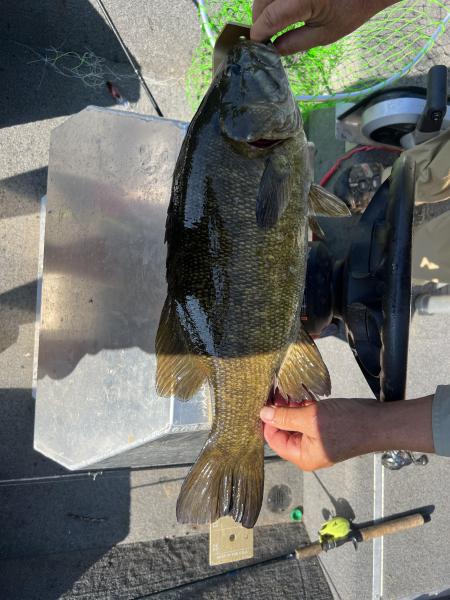
Only of the biggest one…21 inches and probably 6 pounds or better.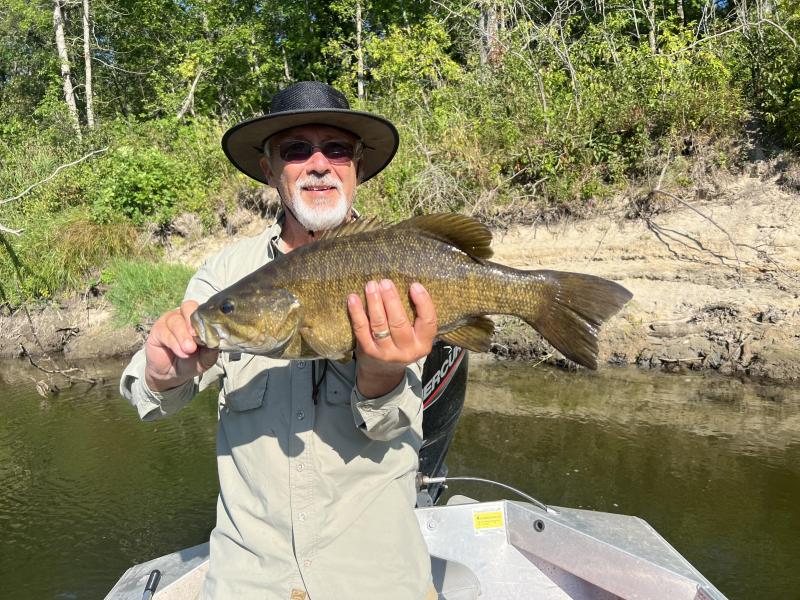
-
Professional fishing only for the tough!
Al Agnew replied to pjlures's topic in General Angling Discussion
I used to fish a three day tournament, small, not professional, friendly, but money on the line, every year. It was three days of fishing as hard as I ever fish. And I never won it. Only once finished in the top three, fishing with my dad. Both of us were decent reservoir anglers back then, and we weren't fishing against pros, just guys that were a little better than we were. So I know just a tiny bit of what big time tournament fishing entails. I also just got back from four days of HARD fishing on a river somewhere in the North Country. Not quite tournament angling...get up at daylight, drive 40 minutes from the motel to the boat ramp, fish about 10 hours, on the trolling motor the whole time, power fishing with spinnerbaits and buzzbaits and topwaters, catching 60 to well over a hundred smallmouth in places where you had to really wrestle them out of heavy wood cover. Big fish, like half of them over 17 inches. That has to be as hard as most tournament anglers' days, and I'm 71 years old today. But of course, I don't do it for a living. I didn't HAVE to catch those smallies to cash a check, nor fish that hard. And I won't fish that hard for that many days in a row the rest of the year. But maybe it was a pretty good representation of what one tournament is like as far as traveling, staying in motels, eating restaurant food just before the restaurant closes, trying to get a good night's sleep, keeping your gear in order (for one thing, I went through more than a dozen spinnerbaits, either losing them to fish in heavy cover or the fish tearing them up, and had to change out blades and skirts on the ones I had left to get something that worked best), and then fishing all day and keeping your focus. Are they athletes? Nah, not really. Do they work hard? Yup, but not as hard as some working folks. But consider this...a lot of people who work for a living work very hard, taking a toll on their bodies...but it's a physical job where they do just a few things. They don't also have to continually figure things out, they don't have to keep a laser sharp focus on what they are doing, they aren't under pressure to succeed in beating most of their competitors, they don't have to also be a "people person" who presents themselves well to the public. And then you have the workers who DO have to really be sharp mentally, beat out competitors to succeed, and present themselves well to the public...but they tend to not work hard physically. Professional bass fishing is something that combines both, and that's a relative rarity. -
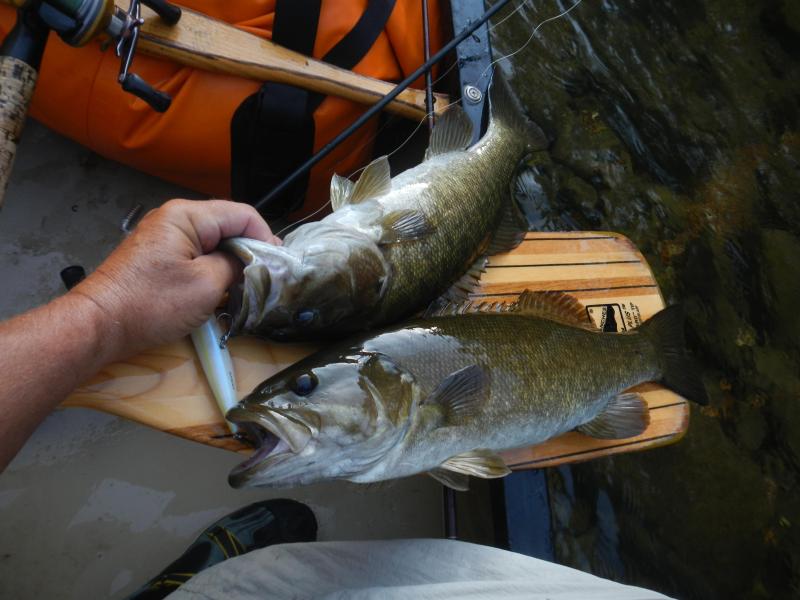
My best double of many over the years...the larger one was a bit over 18 inches.
-
Got back to MO over the weekend, and had my annual three day solo float planned for this week. I kept looking at the long range forecast, and seeing little to no chance of rain during the week, so I figured it would be great weather--I hate doing overnight floats if there's a chance of thunderstorms. But...I didn't really pay attention to the forecast temperatures. Stepping off the plane in St. Louis, I was hit by a wave of humidity that was worse than a sauna. So I paid a bit more attention to the forecast, and saw the temps in the 90s and 100s and the humidity. Well, maybe...I've fished all my life in hot weather, and it never much bothered me, but I think I'm getting more sensitive to it as I age and as I spend more time in the negligible humidity of Montana. And Mary, who doesn't do heat well, is always worried about me when I'm gone overnight in such heat. I needed to do some stuff around the house yesterday, so I got up at 6:30 and walked outside, again being hit with the wave of humidity, temperatures already in the 80s. I thought that it wouldn't be comfortable sleeping on a gravel bar in this kind of weather, and was coming to grips with the fact that I wasn't going to do my solo float this week. This morning I worked a bit more in the yard, then decided, heck with it, I was going to do some exploring and checking out some spots to wade and fish; surely it wouldn't be too uncomfortable if I was standing in the water, would it? Having made the move to our place on the Meramec, I was a good distance from all the wading creeks I had usually fished, so I needed to find some new spots. I loaded a cooler of drinks, some topwater lures, and my creek fishing cast rod, and headed for the first creek I wanted to check out. The first bridge I stopped at was fairly far down on the creek, looked slow and a little murky. First cast at the low water bridge I got a strike from a nice green fish, either a largemouth or spotted bass. Missed it. I waded up the creek about a quarter mile, caught a couple little largemouth and a couple small spotted bass. Never got wet up to my shorts legs. It was hot. As far as I could see, slow, shallow water. Decided to check it out farther upstream. I stopped at another bridge, with a lane leading off the highway down to the creek. Looked it over...not much water flowing, a little clearer, could be fishy...but still wide open to the sun. I wasn't too impressed, decided to check out a couple other spots a little farther upstream. Neither looked all that great, mainly because there was really no good place to park at the low water bridges. So I gave up on that creek and headed for the far upper reaches of the Bourbeuse. I had checked out several road crossings on the Bourbeuse a few years ago when researching for the book I was writing on the Meramec river system. The book has never gotten quite finished, and I didn't know if those accesses were still viable. The first one I stopped at was good looking, except that even as high up on the Bourbeuse as it was, the water was very murky. There was a big, deep-looking pool above the bridge, and what looked like short pools and big water willow beds everywhere downstream. I started wading downstream, fishing that same topwater. In the first pool, I got a strike from a really good fish, had it on for a bit, and lost before seeing it well enough to tell what it was. Next cast I caught a small largemouth. Next pool, I caught four straight smallmouth from the same 10 foot section of bank. Third pool was too shallow. Fourth pool, three more smallmouth. None were over 14 inches, but plenty of fun. Long section of shallow water. Very tough wading on chunk rock. Finally reached another decent looking pool, caught one small smallmouth at the head of it, nothing through the rest of it. I suddenly realized that I was REALLY hot. I'd been wading up to my waist in places, but the water was warm, had to be in the 80s. The sun was beating down. The humidity was stifling. I was beginning to worry that I might be getting a little bit of heat exhaustion. I stripped off and got into the water, submerging head and all, lolled around for a bit. I felt a lot better, but the thought of wading farther and then having to trudge back up to the truck just didn't sound appealing. So I headed back. Got to the truck, dug a cold beverage out of the cooler, and started the drive back to the house. Took a nap when I got home. Dang, I must be getting old!
-
I was wading in waist deep water along an undercut bank when a beaver shot out from under the bank and by me, glancing off my leg. Scared the bejeebers out of me!
-
I knew the biologist in charge of otter reintroduction, too. He told me after they began to be a problem not only what Mitch said about farm ponds, but also about the habitat, especially wintering habitat, in smaller streams. Many smaller streams do not have the large, deep, cover-filled pools they once had. When fish are squeezed into smaller areas, especially in the winter, it makes things easier for otters. He also said that ALL the studies and the literature on otter reproduction turned out to be wrong when it came to Missouri, probably because of farm ponds and habitat deterioration. He said the otters were reproducing NINE TIMES faster than the literature said they should be. But, when you think about it, with the lack of otters, a first class predator of fish, perhaps populations of game fish in smaller streams were "unnaturally" heavy. This is the same thing I think about when you're talking about the undeniable decline in turkey populations from the 1980s and 1990s. When turkeys were reintroduced into Missouri, the found a huge unexploited habitat niche, and predators that didn't know how to exploit the turkeys. So they exploded in population. The turkey population at its height was probably way larger than a natural turkey population. Then the predators caught up, and the turkey population dropped. It's the same with game fish in small streams...without the otters preying upon them, their populations may have been unnaturally high. Once the otters showed up and found a smorgasbord of fish and no natural predators, they went the same way, exploding to unnatural levels, and dropping the fish populations in small streams to a point where in many cases they were almost wiped out. Eventually, theoretically, it should all work out; the otter population and fish population stabilizes, probably at a level that we human anglers won't like because there aren't as many fish as there used to be. However, we humans need to be part of the population control mechanism for otters, since they still don't have any natural predators except for the handful of mountain lions that may or may not be roaming the woods. With some human population controls the otters and fish might stabilize at levels happier for us anglers.
-
The guy that was MDC's "otter ambassador", back when MDC was just considering reintroducing otters, traveled around the state with several "tame" otters giving programs. The otters, of course, were the stars of the show. I knew him well, and talked to him about the otters. I may have mentioned how cool animals they were and they seemed very friendly and acclimated to humans. He just shook his head, and rolled up his sleeves. His forearms were a mass of scars. He said he really didn't enjoy handling the otters, because they could be "real s.o.b.'s", docile one moment and vicious the next.
-
Stirring the pot but there is much truth to this.
Al Agnew replied to BilletHead's topic in General Angling Discussion
Nobody ever touted walleye or crappie as hard fighters for their size. Indeed, most people pursue them because they are great to eat, and once you find them, easy to catch in most places where they are found. Brook trout aren't the best fighters, either, compared to some of the other "real" trout (brookies are char, not trout). They are pursued mostly because they are trout but kinda easy, and in the east, because they are the only native trout and live in some wonderful streams. There is no doubt that bass are not quite as great fighters as mythology says they are. Comparing species at their best--in moving water that is optimum temperature for their metabolism, and wild fish, rainbow trout are faster and jump higher, brown trout are just as strong and often jump just as well, catfish are stronger, and a whole bunch of saltwater fish would pull a smallmouth inside out if they were hooked together. But the beauty of bass is that they do a little of everything; they pull hard, they go for cover, they jump, and it takes them a while to give up. This combination of fighting abilities, and their aggressiveness and the myriad of ways you can fish for them...heck, even the fact that they are easier to handle once you get them to hand than most other fish, makes them almost the perfect game fish. -
Wyoming/Montana Fly Fishing Info
Al Agnew replied to Bill Babler's topic in General Angling Discussion
I know plenty about streams in the area of SW Montana where we live half the year. I know a lot less about Wyoming streams. If it's anywhere from the Missouri River south and in between the Bighorn and the Big Hole, I can help. The choices are endless, from tiny mountain streams full of native cutthroat that are so small and so brushy that you never actually make a fly cast, to big, brawling rivers like the Yellowstone (which still have places to wade but are mostly fished from boats). A few pieces of general advice... Don't fall in love with idea of a road trip fishing rivers all over Wyoming and Montana. This is BIG country, and there is often a LOT of space in between rivers. You end up doing more driving than fishing. Pick a region where there are several rivers and all their tributaries all within a couple hours' drive. For instance, in my area, within two hours or so I can fish 50 miles or more of the Stillwater, 40 miles of the Boulder and the West Boulder, a hundred miles or more of the Yellowstone, 75 miles of the Gallatin, 50 miles of the Madison, and goodness knows how many miles of smaller tributaries. And there is a LOT of variety in all those waters, it ain't like cookie cutter streams. There is far more variety in Western streams than there is in Ozark trout streams. So pick a base to stay and branch out from that base to whatever rivers or creeks that most interest you that you can easily drive to without wasting half the day. Guides are essential for fishing the big rivers from boats. They are far from essential if you're wanting to fish smaller streams by wading. Personally I'd advise doing at least a little of both, and hiring a guide for a river trip. You should learn a lot about things like the spots trout hang out in from the guide, and how to fish those spots, if nothing else. There are plenty of good fly shops, but don't get too hung up on "local" and "hot" patterns. I use pretty much exactly the same stuff in Montana that I do in Missouri...basic nymphs, dries, and streamers. For instance, my Montana nymph box has a whole bunch of Hare's Ears, Prince, Pheasant Tails, Copper Johns, scud patterns, San Juan Worms, Pat's Rubber Legs, and some soft hackles. Any other nymphs found in my box were bought on a whim and are unlikely to ever get wet. Yes, it will be hopper season when you're out here. Don't fall in love with hopper patterns, though. Try them, but what we are finding in recent years is that the fish in the more heavily pressured rivers are so conditioned to avoid hopper patterns that they've almost stopped eating the real grasshoppers. I discovered last year that all the foam hoppers that look so realistic that the fly shops sell by the truckloads weren't working at all, and I went old school and fished a Joe's Hopper and actually caught some nice fish on it. First good hopper fish I'd caught in a couple years. Let me know if you decide to fish in my area. I'm not saying it's the best region; it certainly gets a ton of fishing pressure and the fishing can be tough. But it's a beautiful area. -
Actually the population of whitefish in the Yellowstone is down considerably. Apparently the record flood last year did a number on them. I floated today by myself in my Water Master raft. Had to cut the float short because I lost one of my swim fins. But I caught 14 trout and not a single whitefish, and I don't think that's ever happened before.
-
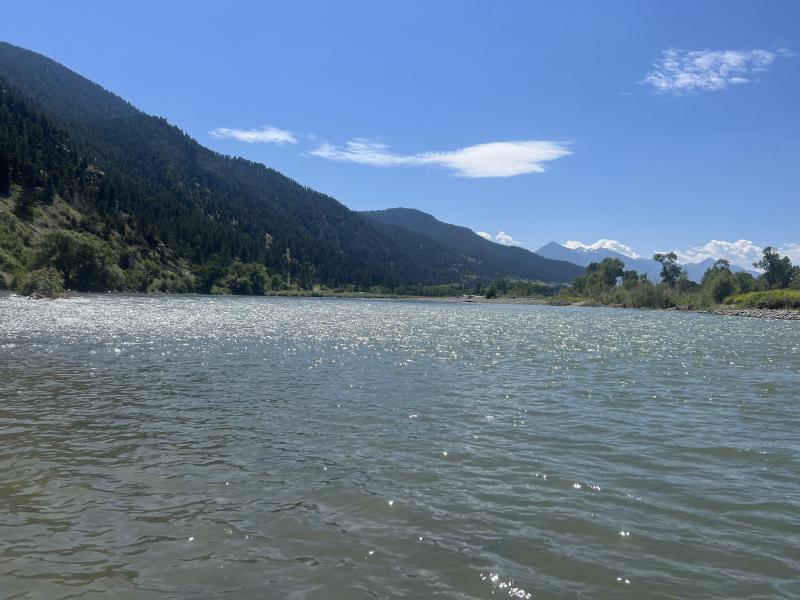
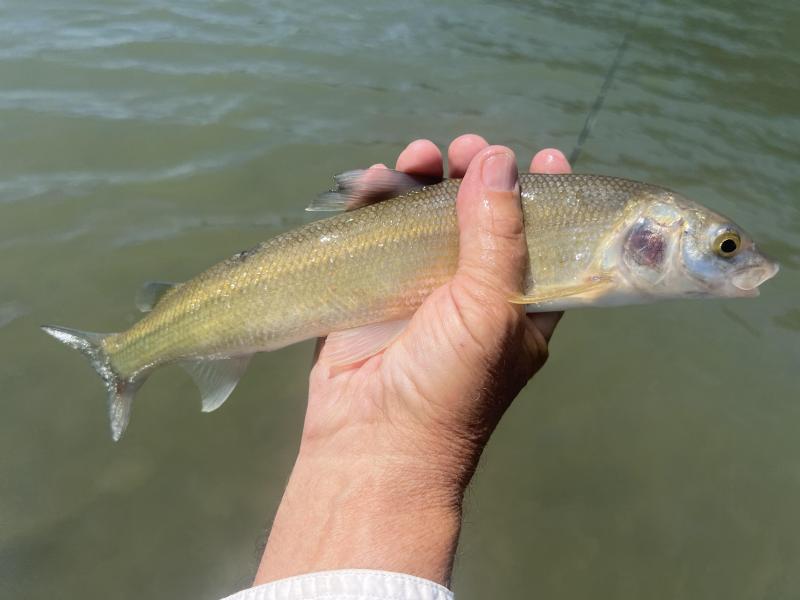
For Ham…first time on the Yellowstone this year. Mary and I were just floating, planning to stop here and there to fish good looking riffles. This is the first riffle we stopped: Fourth cast: River is still high, not many places to wade and fish yet. Caught a bigger whitefish at the first spot and a half dozen at one more spot. Caught one rainbow.
-
Yup, and lake whitefish are pretty good. Totally different species.
-
Nah, drum are far superior to whitefish. Drum are pretty decent. They are in the same family as saltwater redfish (the only freshwater member of the family). If you like blackened redfish you'd like blackened drum.


